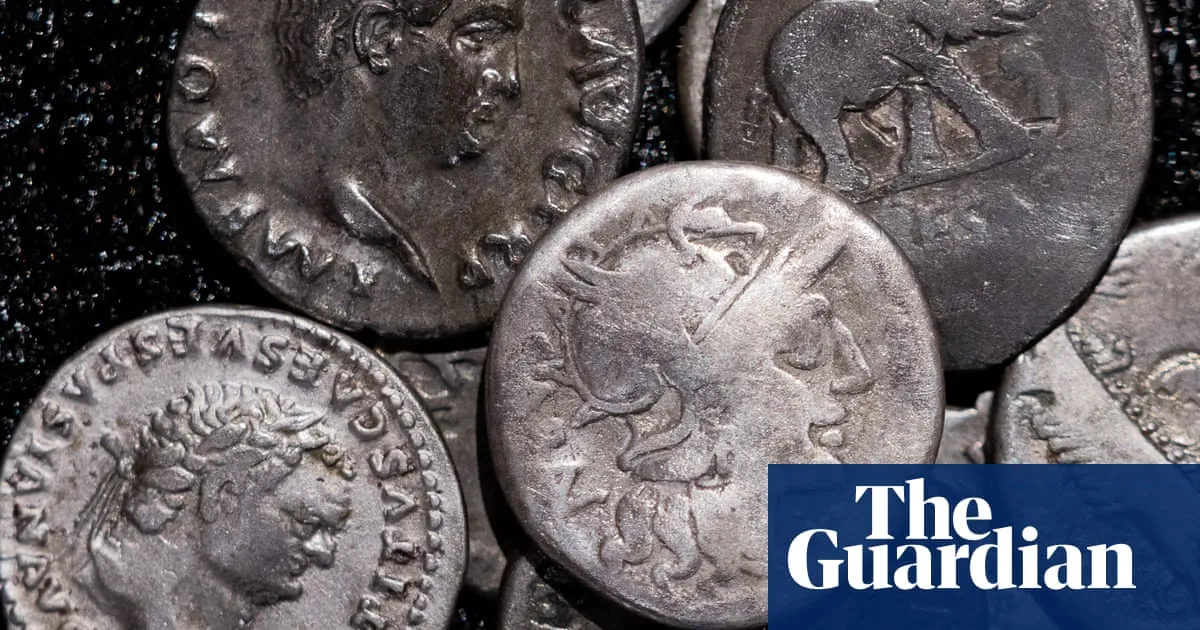
An amateur archaeologist who discovered several Roman silver coins in a field in western Germany realised he had stumbled upon something much bigger when his metal detector kept beeping.Oliver Riedl called the authorities for help and a group of experts who began digging immediately discovered a total of 934 Roman silver denarii. It is the biggest coin treasure ever found in Germany from the time of the Roman emperor Hadrian, the local office in charge of archaeological monuments said on Tuesday.“It was clear to me that there was something bigger buried here,” Riedl said, describing how his metal detector continued signalling even after he had found several coins near Wesseling, south of Cologne, a year ago.The hoard of coins, which weighs 3.1kg (6.8lb), went on display at the LVR-LandesMuseum Bonn on Tuesday.The collection was probably buried deliberately in the second quarter of the second century AD, according to the LVR Office for the Preservation of Archaeological Monuments in the Rhineland.“Of course, we can only speculate about the motives, but it’s very likely that someone wanted to keep this money safe. After all, banks didn’t exist back then,” said Erich Classen, a state archaeologist and the director of the office.Roman coins on display at the LVR State Museum in Bonn, Germany. Photograph: Rolf Vennenbernd/DPA/APClassen said it was not clear why the treasure had not been recovered, adding that “perhaps the owner died before that could happen, without being able to pass on the knowledge about the coins”.Treasure troves from ancient Roman times or other distant eras are not uncommon. However, few from the second century are as extensive as the one found in Wesseling, the archaeological office said.It said it was difficult to estimate the coins’ value at the time of their burial, but the pay of Roman legionaries, which is well documented in written sources, provides a point of reference.“At that time, an ordinary soldier in the legion earned 300 denarii a year,” said Rahel Otte, a research associate at the archaeological office. “However, about half of that was withheld for food and equipment.“A legionary would therefore have had to save all of his disposable income for about six years to amass the Wesseling hoard,” Otte said. She added that it remained unclear exactly who ultimately amassed this considerable fortune.The Cologne area was under Roman control roughly from 39BC to AD459. The Romans established a presence in the region under General Marcus Vipsanius Agrippa to secure their empire’s border along the Rhine River, setting up a military outpost which later became Colonia Agrippina – today’s Cologne.
SRCThe Guardian - World News
LANGEN
LEANCenter-Left
WORDS426
ENT11
TUE · 2026-09-22 · 14:54 GMTBRIEF NSR-2026-0922-113232
NSR-2026-0922-113232News Report·EN·Human Interest
Amateur archaeologist finds 934 Roman silver denarii in German field
An amateur archaeologist, Oliver Riedl, discovered 934 Roman silver denarii in a field south of Cologne, Germany. The hoard, weighing 3.1kg, was buried in the second quarter of the second century AD, during the reign of Emperor Hadrian.
Associated Press in BerlinThe Guardian - World NewsFiled 2026-09-22 · 14:54 GMTLean · Center-LeftRead · 2 min
The Guardian - World NewsFIG 01
Reading time
2min
Word count
426words
Sources cited
3cited
Entities identified
11entities
Quality score
100%
§ 01
Briefing Summary
AI-generatedNEWSAR · AI
An amateur archaeologist, Oliver Riedl, discovered 934 Roman silver denarii in a field south of Cologne, Germany. The hoard, weighing 3.1kg, was buried in the second quarter of the second century AD, during the reign of Emperor Hadrian. This discovery marks the largest coin treasure from Hadrian's era ever found in Germany. Experts believe the coins were deliberately buried, likely for safekeeping, and the owner may have died before recovering them. The value of the hoard is significant, with a Roman legionary earning approximately 300 denarii annually, meaning it would have taken about six years of disposable income for a soldier to amass such a sum. The coins are now on display at the LVR-LandesMuseum Bonn.
Confidence 0.90Sources 3Claims 5Entities 11
§ 02
Article analysis
Model · rule-basedFraming
Human Interest
Tone
Measured
AI-assessed
CalmNeutralAlarmist
Factuality
0.80 / 1.00
Factual
LowHigh
Sources cited
3
Well sourced
FewMany
§ 03
Key claims
5 extracted01
The hoard of coins weighs 3.1kg (6.8lb).
statisticnull
Confidence
1.00
02
An amateur archaeologist discovered 934 Roman silver denarii in a German field.
factualOliver Riedl
Confidence
1.00
03
An ordinary Roman legionary earned 300 denarii a year, with half withheld for expenses.
statisticRahel Otte
Confidence
0.90
04
The collection was likely buried deliberately in the second quarter of the second century AD.
factualLVR Office for the Preservation of Archaeological Monuments in the Rhineland
Confidence
0.90
05
This is the biggest coin treasure found in Germany from the time of Emperor Hadrian.
factuallocal office in charge of archaeological monuments
Confidence
0.90
§ 04
Full report
2 min read · 426 words§ 05
Entities
11 identifiedKey playerOppositionContextPositiveNeutralNegative
People5
Organizations2
§ 06
Keywords & salience
8 termsroman silver denarii
1.00
coin treasure
0.90
amateur archaeologist
0.80
roman emperor hadrian
0.70
archaeological monuments
0.60
roman legionaries
0.50
metal detector
0.50
ancient roman times
0.40
§ 07
Topic connections
Interactive graph No topic relationship data available yet. This graph will appear once topic relationships have been computed.