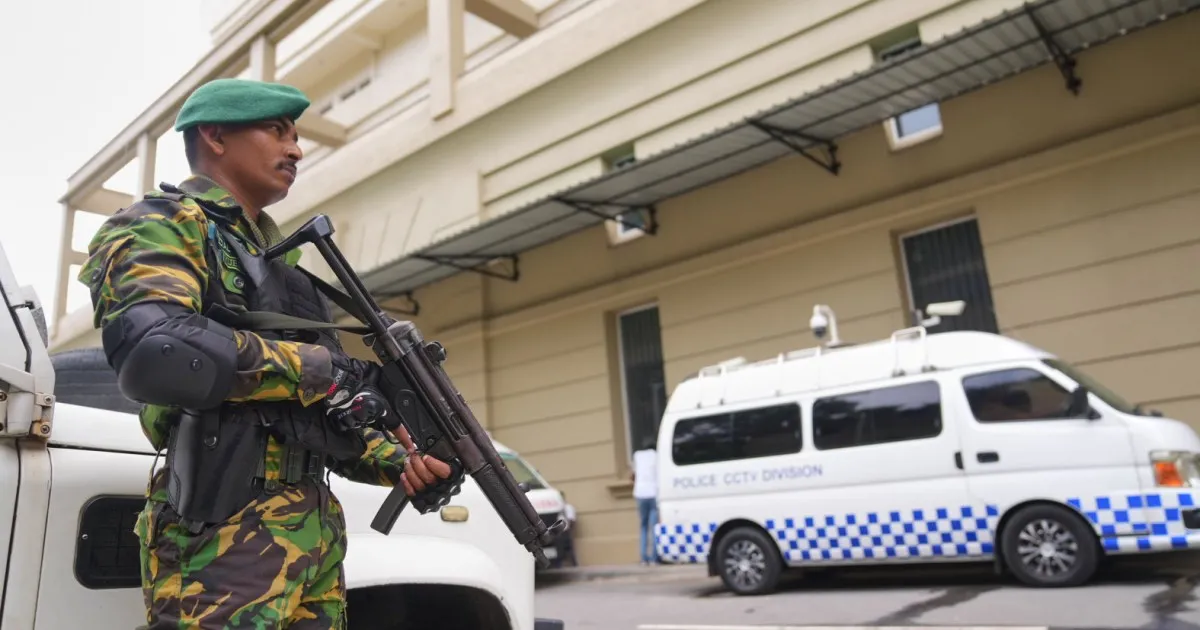
EXPLAINERThe suicide bombings were the deadliest attacks in the country since the end of its civil war in 2009.A police commando stands guard at the High Court complex before a verdict related to the 2019 Easter bombings in Colombo, Sri Lanka on September 22, 2026 [Eranga Jayawardane/AP]Published On 22 Sep 2026Fifteen of the 24 people accused of being directly involved in the 2019 Easter Sunday bombings in Sri Lanka have been found guilty of charges including murder and conspiracy to commit terrorism.Here’s what the verdict says, how the legal case unfolded and what we know about whether the government failed to act on intelligence prior to the bombings taking place.Recommended Stories list of 3 itemslist 1 of 3Sri Lanka shuts schools as floods and mudslides kill 7list 2 of 3Two ex-Sri Lanka officials sentenced to death over 2019 Easter bombingslist 3 of 3At least 26 people killed in Sri Lanka prison clashesend of listWhat does the verdict say?The three-judge bench in Sri Lanka’s High Court has found that 14 of the accused were guilty on all charges, which included murder, conspiracy to commit terrorism and possessing firearms and explosives under the Prevention of Terrorism Act.A 15th defendant was found guilty of only some of the charges, while nine others were acquitted of any charges related to aiding and abetting the suicide bombers.Twenty-five men were originally charged, but one defendant died in custody.Police had filed more than 23,000 charges against the suspects, all of whom denied involvement.The presiding judge told the court that sentencing would be delivered later on Tuesday.What happened in the bombings?Six almost simultaneous bombings struck churches and hotels on Easter Sunday in 2019, killing 279 people and marking the deadliest attacks in Sri Lanka since the end of its civil war in 2009.At least 450 people were injured, with officials in the aftermath blaming a local armed group for the suicide bombings.Most of those killed were Sri Lankan and died in three churches where worshippers were attending Easter Sunday services. Three other bombings struck luxury hotels – the Cinnamon Grand, the Kingsbury and the Shangri-La – located in the heart of the capital, Colombo, killing at least 45, including foreign nationals.Among the dead were Japanese, Dutch, Chinese, British, US and Portuguese tourists.All of the accused are from Sri Lanka’s minority Muslim community.How did the legal case unfold?The prosecution in the case, which opened in November 2021, named Naufer Moulavi as the main architect of the attacks.Moulavi had submitted what they said was a voluntary confession to the court in which he had admitted his role.While the court accepted the confession, Moulavi later told the court that he had not been shown what he was signing, leading him to retract his statement and reject the allegations against him.Moulavi was ultimately one of the 14 found guilty of all charges by the court on Tuesday.During the trial, more than 2,300 people gave evidence for the prosecution.There were also 2,076 pieces of evidence, including explosives, swords and firearms.Last month, Former Police Chief Pujith Jayasundara and former Defence Ministry Secretary Hemasiri Fernando were sentenced to death by the country’s High Court, which found them guilty of criminal negligence. Chaminda Athukorale, lawyer for the two men, said they would appeal the ruling.What did the Supreme Court rule in 2023 about the government’s role in the bombings?Sri Lanka’s Supreme Court ruled that former President Maithripala Sirisena and four other top officials failed to prevent the bombings despite having prior intelligence about them, and ordered them to pay compensation to the victims.The court ordered Sirisena to pay 100 million rupees ($273,300) from his personal funds to family members of victims who brought the civil case before the court.Former Police Chief Jayasundara, two top intelligence officials and former Defence Ministry Secretary Fernando were ordered to pay a total of 210 million rupees ($574,000).The seven-judge bench ruled that Sirisena had failed to take adequate measures to prevent the attacks, despite receiving solid intelligence warnings that they were being planned two weeks earlier.In addition, the court ruled that Sirisena, who also served as defence minister and commander in chief of the armed forces, had failed to hold regular meetings of the national security council and had omitted key personnel from meetings he did hold.What else has been discovered about these bombings?In February this year, Retired Major-General Suresh Sallay, the country’s former intelligence chief, was arrested for his connection to the bombings.Sallay, who was promoted to State Intelligence Service (SIS) chief in 2019 after Gotabaya Rajapaksa became president, has been accused of involvement in the coordinated suicide bombings – a charge he has denied.“He was arrested for conspiracy and aiding and abetting the Easter Sunday attacks,” an investigating officer told the AFP news agency at the time of his arrest. The investigation into his role in the attack is ongoing.A 2023 investigation by the British broadcaster, Channel 4, found that Sallay was linked to the bombers and had met them before the attack.A whistleblower told the network that he had permitted the attack to proceed with the intention of influencing that year’s presidential election in favour of Rajapaksa.Two days after the bombings, Rajapaksa declared his candidacy and went on to win the November vote in a landslide after promising to stamp out violence.Rajapaksa’s government was rocked three years after the bombings by mass demonstrations about the economy in Sri Lanka.In a 2022 address to the UN Human Rights Council in Geneva, Cardinal Malcolm Ranjith demanded a mechanism to probe the attacks, which had been blamed on local Muslim groups.“The first impression of this massacre was that it was purely the work of a few Islamic extremists,” Ranjith said at the time. “However, subsequent investigations indicate that this massacre was part of a grand political plot.”Other investigations also faulted the authorities for failing to act on warnings from an Indian intelligence agency that an attack was imminent.
SRCAl Jazeera
LANGEN
LEANCenter
WORDS977
ENT10
TUE · 2026-09-22 · 16:31 GMTBRIEF NSR-2026-0922-113252
NSR-2026-0922-113252News Report·EN·Legal & Judicial
Fifteen guilty in 2019 Sri Lanka Easter bombings: What the verdict says
Fifteen individuals have been found guilty of charges including murder and conspiracy to commit terrorism in relation to the 2019 Easter Sunday bombings in Sri Lanka. These attacks, which killed 279 people and injured hundreds more, targeted churches and hotels.
Al Jazeera StaffAl JazeeraFiled 2026-09-22 · 16:31 GMTLean · CenterRead · 4 min
Al JazeeraFIG 01
Reading time
4min
Word count
977words
Sources cited
1cited
Entities identified
10entities
Quality score
100%
§ 01
Briefing Summary
AI-generatedNEWSAR · AI
Fifteen individuals have been found guilty of charges including murder and conspiracy to commit terrorism in relation to the 2019 Easter Sunday bombings in Sri Lanka. These attacks, which killed 279 people and injured hundreds more, targeted churches and hotels. The verdict follows a legal case that opened in November 2021, with the prosecution identifying Naufer Moulavi as the main architect. Separately, two former Sri Lankan officials were sentenced to death for criminal negligence related to the bombings. Sri Lanka's Supreme Court previously ruled that former President Maithripala Sirisena and other officials failed to prevent the attacks despite receiving intelligence warnings.
Confidence 0.90Sources 1Claims 5Entities 10
§ 02
Article analysis
Model · rule-basedFraming
Legal & Judicial
National Security
Tone
Measured
AI-assessed
CalmNeutralAlarmist
Factuality
0.90 / 1.00
Factual
LowHigh
Sources cited
1
Limited
FewMany
§ 03
Key claims
5 extracted01
The legal case against the suspects opened in November 2021.
factual
Confidence
1.00
02
All of the accused are from Sri Lanka's minority Muslim community.
factual
Confidence
1.00
03
Naufer Moulavi was named by the prosecution as the main architect of the attacks and was found guilty of all charges.
factual
Confidence
1.00
04
Six simultaneous bombings struck churches and hotels on Easter Sunday in 2019, killing 279 people and injuring at least 450.
factual
Confidence
1.00
05
Fifteen of the 24 people accused of direct involvement in the 2019 Easter bombings in Sri Lanka have been found guilty of charges including murder and conspiracy to commit terrorism.
factual
Confidence
1.00
§ 04
Full report
4 min read · 977 words§ 05
Entities
10 identifiedKey playerOppositionContextPositiveNeutralNegative
Organizations5
§ 06
Keywords & salience
10 termssri lanka
1.00
easter bombings
1.00
terrorism charges
0.90
guilty verdict
0.80
civil war
0.70
suicide bombings
0.60
prevention of terrorism act
0.60
intelligence failure
0.50
legal case
0.50
colombo
0.40
§ 07
Topic connections
Interactive graph Network visualization showing 2 related topics
View Full Graph Person Organization Location Event|Click node to navigate|Edge numbers = shared articles