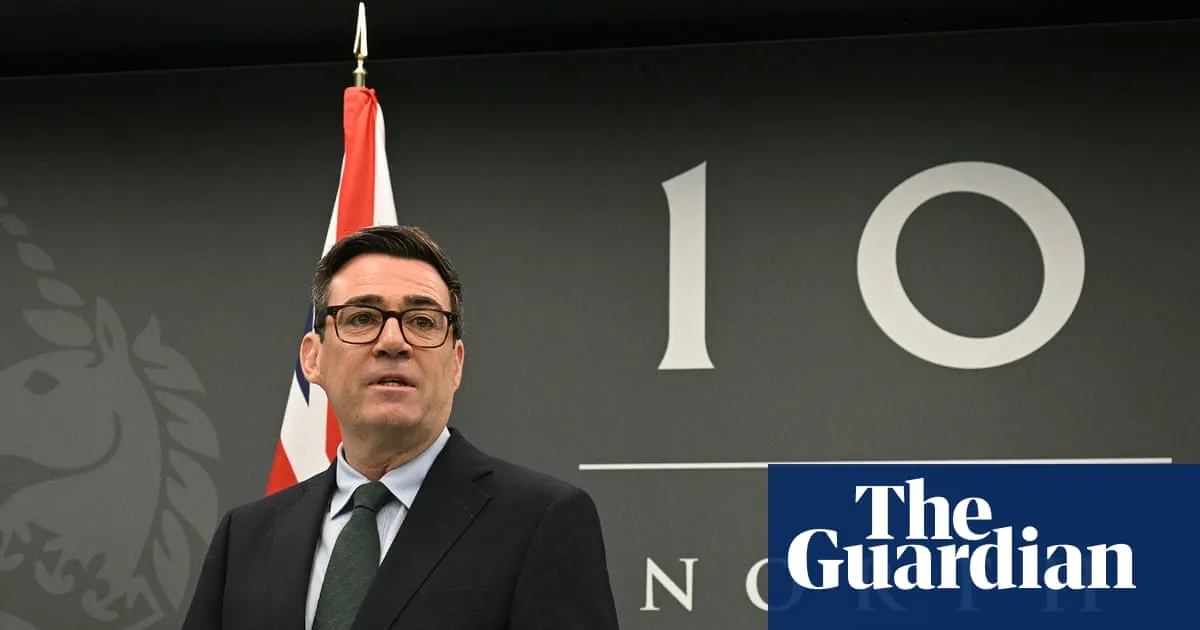
England’s mayors should face much greater official scrutiny to avoid Andy Burnham’s devolution agenda being “derailed by one bad decision”, a thinktank has said.Ministers will set out plans next month to give regional leaders control over potentially billions of pounds of additional funding under a “transformational” shift of power outside Whitehall.From 2028, mayors will be able to keep a share of income tax generated in their areas – giving them greater scope to borrow for major infrastructure projects – as well as retain business rates from 2027 and raise further funds through a “tourist tax”.IPPR North, whose researchers have worked closely with Burnham’s government, welcomed the “bold and ambitious” plans as a step towards “reversing decades of damaging over-centralisation that has held the country back”.It called for mayors to be allowed to keep a 5% share of income tax, which would move an extra £3.8bn a year out of Whitehall and roughly double the funding under their control.However, the thinktank said increasingly powerful mayors should be subject to much tougher oversight.In its 30-page report, IPPR North warned: “A bad decision or mismanaged funding from any one authority risks turning public opinion against devolution and undoing progress.”Its proposals include establishing new regional audit offices to scrutinise how money is spent and what it delivers. It is also proposed that each region should be overseen by a senior accounting officer, similar to the model of permanent secretaries running government departments.Larger mayoral authorities, such as London, Greater Manchester and the West Midlands, should be overseen by beefed-up accountability committees to guard against any “misuse of funds, corruption and elite capture by lobbying interests”, the thinktank said.Burnham, a former Greater Manchester mayor, has placed the transfer of power outside Whitehall at the heart of his government, establishing No 10 North in Manchester to act as the engine room of rapid devolution.Proposals outlined in a Cabinet Office paper in July, weeks after Burnham became prime minister, would represent the most dramatic shift of authority to the English regions in modern times.There are concerns, however, about the capacity of newer and smaller combined authorities to take on these expanded powers, which include employment support, local transport, housing, innovation, local energy and cultural investment.Regional mayors at Downing Street for a devolution meeting in July 2024. Photograph: ZUMA Press, Inc./AlamyWhile some mayoral authorities are well established, others, such as the Reform UK-led bodies in Hull and East Yorkshire and Greater Lincolnshire, were only founded last year. Several other planned mayoral authorities, spanning millions of people along the south coast and in north-west England, have not yet been established.Ministers are due to set out a timeline for fiscal devolution to the English regions in a white paper to be published alongside the autumn budget on 28 October.Aditi Sriram, the lead author of the IPPR North report, said Britain was at a “defining moment” in how it is governed and that accountability was essential to the success of devolution.“For too long, mayors have been expected to drive growth with one hand tied behind their backs, reliant on Whitehall for the money and permission to get things done,” she said. “Critics are loud, political trust is faltering, and the public wants to see action, so the devolution agenda cannot afford to fail.”Jim O’Neill, the former Treasury minister who advised Burnham before he became prime minister, said in a foreword to the report that critics would dismiss devolution as an “irrelevance and a probable source of wasted taxpayers’ money”.But he said the best answer to those “cynics” would be to hand mayors of the most populated areas the greatest powers. “This is assuming they have the capacity to cope, the desire to be accountable and, of course, just like Greater Manchester has had, the aspiration to be bold,” he said.
SRCThe Guardian - World News
LANGEN
LEANCenter-Left
WORDS628
ENT12
TUE · 2026-09-22 · 23:01 GMTBRIEF NSR-2026-0923-113323
NSR-2026-0923-113323News Report·EN·Political Strategy
England’s mayors should face greater scrutiny as powers expand, thinktank says
A thinktank, IPPR North, is calling for increased scrutiny of England's mayors as they are set to gain significant new powers and control over billions in funding. Ministers plan to give regional leaders more financial autonomy, including retaining a share of income tax and business rates, starting in 2027 and 2028.
Josh Halliday North of England editorThe Guardian - World NewsFiled 2026-09-22 · 23:01 GMTLean · Center-LeftRead · 3 min
The Guardian - World NewsFIG 01
Reading time
3min
Word count
628words
Sources cited
2cited
Entities identified
12entities
Quality score
100%
§ 01
Briefing Summary
AI-generatedNEWSAR · AI
A thinktank, IPPR North, is calling for increased scrutiny of England's mayors as they are set to gain significant new powers and control over billions in funding. Ministers plan to give regional leaders more financial autonomy, including retaining a share of income tax and business rates, starting in 2027 and 2028. IPPR North supports this devolution but warns that a single "bad decision" could jeopardize the entire agenda. To mitigate this risk, they propose establishing regional audit offices and appointing senior accounting officers to oversee spending. The thinktank also suggests enhanced accountability committees for larger mayoral authorities to prevent misuse of funds. These proposals aim to ensure the success of the "transformational" shift of power away from Whitehall.
Confidence 0.90Sources 2Claims 5Entities 12
§ 02
Article analysis
Model · rule-basedFraming
Political Strategy
Economic Impact
Tone
Measured
AI-assessed
CalmNeutralAlarmist
Factuality
0.70 / 1.00
Factual
LowHigh
Sources cited
2
Limited
FewMany
§ 03
Key claims
5 extracted01
IPPR North proposes new regional audit offices and senior accounting officers for mayoral oversight.
factualIPPR North
Confidence
1.00
02
England's mayors should face greater official scrutiny as their powers and funding expand.
quoteIPPR North
Confidence
1.00
03
From 2028, mayors could keep a share of income tax, retain business rates from 2027, and raise funds via a 'tourist tax'.
factualIPPR North
Confidence
0.90
04
Ministers plan to give regional leaders control over potentially billions of pounds in additional funding.
factualCabinet Office paper
Confidence
0.90
05
Concerns exist about the capacity of newer and smaller combined authorities to handle expanded powers.
factual
Confidence
0.80
§ 04
Full report
3 min read · 628 words§ 05
Entities
12 identifiedKey playerOppositionContextPositiveNeutralNegative
Organizations3
Locations5
§ 06
Keywords & salience
10 termsmayoral powers
1.00
devolution
1.00
greater scrutiny
0.90
thinktank
0.80
ippr north
0.70
funding control
0.70
whitehall
0.60
regional audit offices
0.50
andy burnham
0.50
income tax
0.40
§ 07
Topic connections
Interactive graph Network visualization showing 51 related topics
View Full Graph Person Organization Location Event|Click node to navigate|Edge numbers = shared articles