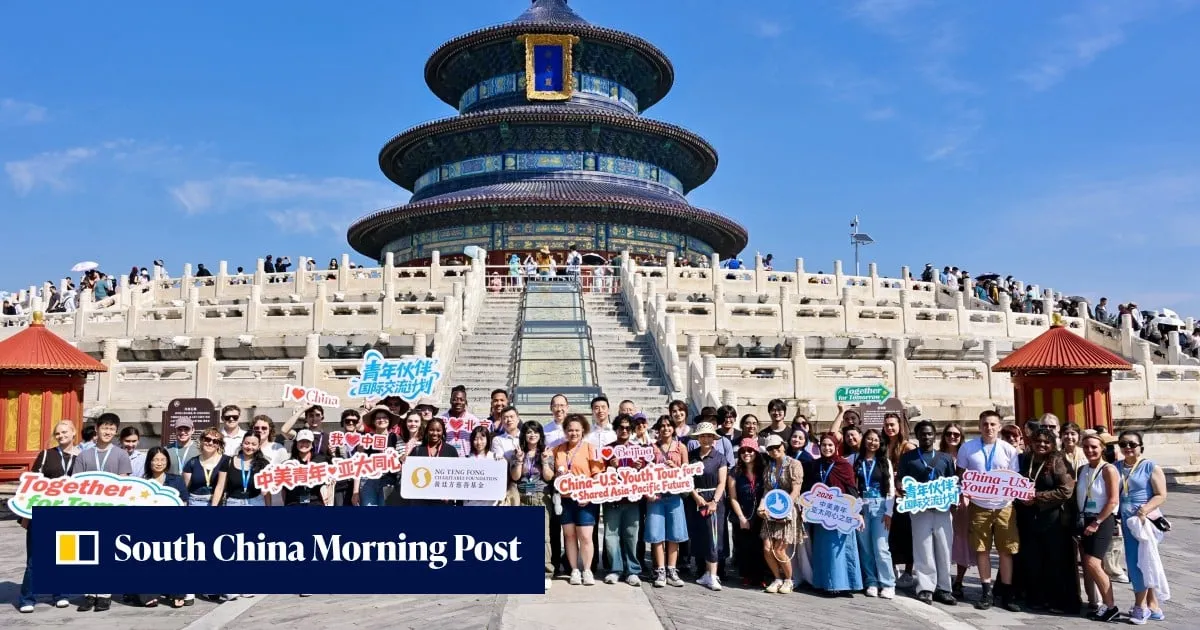
[The content of this article has been produced by our advertising partner.]Nearly 100 students from 10 US universities who travelled through China under Future Makers 2026 jointly wrote to President Xi Jinping after the programme, sharing what they had seen and experienced during the trip. In his reply to the students, Xi encouraged young people from both countries to promote friendship and co-operation and deepen mutual understanding between the two peoples.People-to-people exchanges can create space for that understanding by allowing participants to transcend impressions formed from afar, ask questions directly and discover common ground through everyday interaction. Over time, such encounters can help strengthen trust and create more channels for dialogue between the two societies.That role for people-to-people contact has received renewed attention at the highest level. During their meeting in Beijing in May, Xi and US President Donald Trump agreed that the two countries should expand exchanges and co-operation in areas including tourism and people-to-people ties.For 170 young people from China and the US, that principle became personal during a week travelling through Shandong and Beijing. Some arrived knowing China mainly through books, television, university courses or impressions formed thousands of miles away. Sometimes, seeing really is believing.Future Makers 2026 brought 100 students from 10 US universities together with 70 young people from Beijing and Shandong. Co-hosted by the Beijing-ngo-network-for-international-exchanges" class="entity-link entity-organization" data-entity-id="208315" data-entity-type="organization">Beijing NGO Network for International Exchanges and the Ng Teng Fong Charitable Foundation, the philanthropic arm of Sino Group, the programme combined cultural and technology visits with direct exchanges between students from both countries.We found we had a lot in common — the same games, the same films, the same jokes. It felt like talking to friends. Student, University of WashingtonChina–US Youth share reflections and best wishes.Seeing different sides of ChinaThe journey began in Jinan, where participants attended the Asia-Pacific Civil Society Conference during China’s 2026 APEC host year. They then travelled to Qufu, the birthplace of Confucius, visiting Nishan Sacred Land and the Temple and Mansion of Confucius, trying Chinese calligraphy and discussing “harmony in diversity” with students from Qufu Normal University.Beijing offered another encounter with China’s past at the Forbidden City, Temple of Heaven and Mutianyu section of the Great Wall, before the itinerary turned towards a very modern China. Students watched humanoid robots in action at Beijing E-Town Robot World, visited the Beijing High-Level Autonomous Driving Demonstration Area and toured Xiaomi’s EV factory.Within days, they had gone from Confucian thought to AI, and from imperial architecture to an EV production line.That juxtaposition of ancient traditions and modern China left participants with vivid memories. Asyifa Isvari, a Harvard Kennedy School student, said travelling through China offered perspectives that were different from discussing the country as an abstract subject in the classroom.Even though we come from different countries, it has been amazing to see those differences and still build such strong connections. Grace, Central Michigan UniversityFrom countries to peopleThe destinations provided the introduction. The conversations gave the journey its deeper purpose.At Qufu Normal University and Tsinghua University, dialogue sessions covered cultural identity, innovation, sustainability, youth leadership and Asia Pacific co-operation. Outside formal sessions, students had meals together, discussed university life and swapped favourite films, music and jokes.Some similarities were surprisingly ordinary. University of Washington students discovered that their Chinese peers followed basketball, played some of the same video games and watched some of the same films.Daryl Ng, Director of the Ng Teng Fong Charitable Foundation and Chairman of Sino Group, joined participants during their visit to the Temple of Heaven and over lunch, providing opportunities for more informal exchanges.Xi’s reply was a source of encouragement for the organisers and participants, said Ng, who also thanked the Beijing-ngo-network-for-international-exchanges" class="entity-link entity-organization" data-entity-id="208315" data-entity-type="organization">Beijing NGO Network for International Exchanges for its long-standing work in promoting international exchanges and providing opportunities for young people from different backgrounds to learn from one another.He also welcomed the students’ efforts to share their experiences after returning home, helping others gain a better understanding of China. The Foundation, he said, would continue supporting international youth exchanges and dialogue and make use of Hong Kong’s role as a “super-connector” to encourage further exchanges between China and the rest of the world.A UC Davis student recalled meeting Chinese students who began the week as strangers and became genuine friends. They spent time together, discovered common interests and formed relationships she intended to maintain after returning home.Planting for tomorrowChinese and American youth plant a friendship tree together at Yanqi Lake.The journey ended at Yanqi Lake, where Chinese and American participants planted trees in a “Forest for Tomorrow”.Yanqi Lake is where the APEC Economic Leaders’ Meeting was held in 2014, the previous time China hosted APEC. Twelve years later, the students returned during China’s 2026 APEC host year, this time with spades in their hands.The activity also introduced ecological conservation and green development into a week that had taken students through China’s history, culture and technology.The metaphor was not lost on the participants. One American University student spoke of planting trees while also planting the seeds of friendship. Another said the friendships established in China could continue growing long after the journey ended.The students later expressed a similar hope in their letter to Xi. They said the trip had deepened their understanding of China’s traditional culture and contemporary development, and that they hoped to share their experiences, friendships and changed perspectives with others after returning home.Future Makers 2026 participants take part in student exchanges, explore humanoid robotics and EV technology and experience traditional Chinese calligraphy during the week-long programme.
SRCSouth China Morning Post
LANGEN
LEANCenter-Right
WORDS914
ENT12
WED · 2026-09-23 · 04:42 GMTBRIEF NSR-2026-0923-113377
NSR-2026-0923-113377News Report·EN·Human Interest
President Xi encourages China-US youth ties after exchange
President Xi Jinping encouraged youth from China and the US to foster friendship and deepen mutual understanding following an exchange program. Nearly 100 American university students participated in "Future Makers 2026," a program that involved cultural and technological visits in Beijing and Shandong, alongside interactions with Chinese students.
Advertising partnerSouth China Morning PostFiled 2026-09-23 · 04:42 GMTLean · Center-RightRead · 4 min
South China Morning PostFIG 01
Reading time
4min
Word count
914words
Sources cited
2cited
Entities identified
12entities
Quality score
100%
§ 01
Briefing Summary
AI-generatedNEWSAR · AI
President Xi Jinping encouraged youth from China and the US to foster friendship and deepen mutual understanding following an exchange program. Nearly 100 American university students participated in "Future Makers 2026," a program that involved cultural and technological visits in Beijing and Shandong, alongside interactions with Chinese students. The students shared their experiences with President Xi, who emphasized the value of people-to-people exchanges in building trust and dialogue. The program, co-hosted by the Beijing NGO Network for International Exchanges and the Ng Teng Fong Charitable Foundation, aimed to bridge perceptions through direct interaction and discovery of common ground. Participants noted finding surprising similarities and forming strong connections with their Chinese peers.
Confidence 0.90Sources 2Claims 5Entities 12
§ 02
Article analysis
Model · rule-basedFraming
Human Interest
Diplomatic
Tone
Measured
AI-assessed
CalmNeutralAlarmist
Factuality
0.60 / 1.00
Mixed
LowHigh
Sources cited
2
Limited
FewMany
§ 03
Key claims
5 extracted01
A student from the University of Washington stated, 'We found we had a lot in common — the same games, the same films, the same jokes. It felt like talking to friends.'
quoteStudent, University of Washington
Confidence
1.00
02
The Future Makers 2026 program included visits to historical sites like the Forbidden City and modern sites like Xiaomi's EV factory.
factualarticle
Confidence
1.00
03
Xi and US President Trump agreed in May to expand exchanges and cooperation in tourism and people-to-people ties.
factualarticle
Confidence
1.00
04
President Xi Jinping replied to the students, encouraging youth from both countries to promote friendship and cooperation.
factualarticle
Confidence
1.00
05
Nearly 100 students from 10 US universities participated in the Future Makers 2026 program in China.
factualarticle
Confidence
1.00
§ 04
Full report
4 min read · 914 words§ 05
Entities
12 identifiedKey playerOppositionContextPositiveNeutralNegative
Organizations4
Locations4
§ 06
Keywords & salience
9 termschina-us relations
1.00
youth exchange
0.90
people-to-people exchanges
0.80
mutual understanding
0.70
xi jinping
0.60
future makers 2026
0.50
cooperation
0.50
cultural visits
0.40
dialogue
0.40
§ 07
Topic connections
Interactive graph Network visualization showing 51 related topics
View Full Graph Person Organization Location Event|Click node to navigate|Edge numbers = shared articles