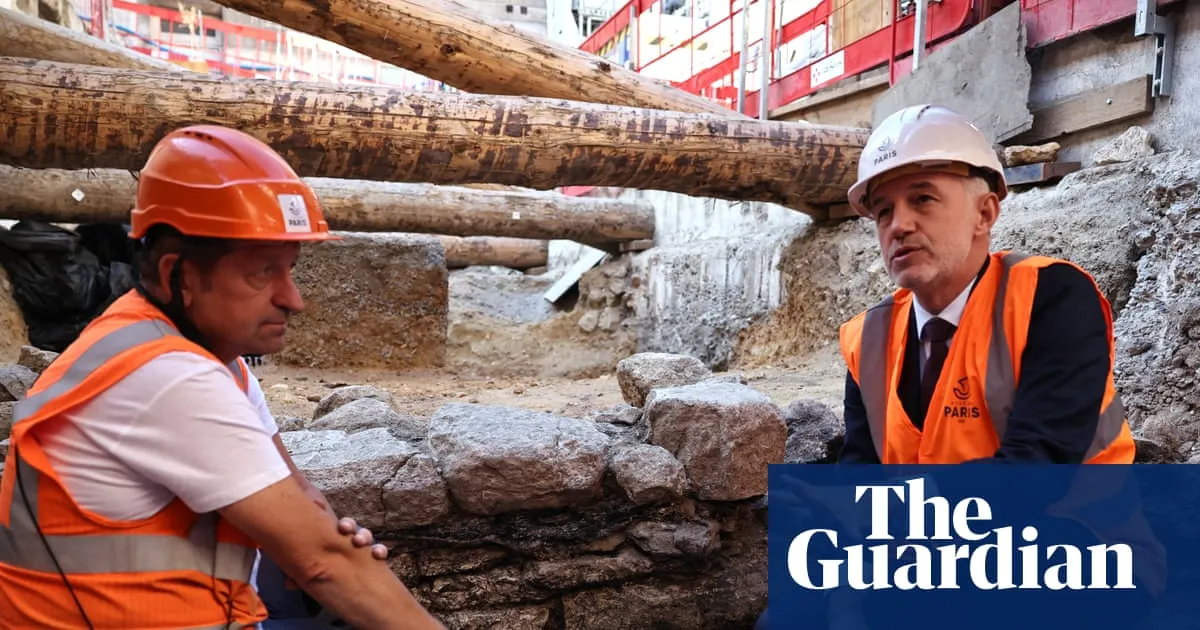
An ancient wall discovered beneath Paris has been described as a “major breakthrough” by France’s culture ministry, with the archaeological find possibly confirming the location of the city’s original settlement.A roughly 20-metre (65ft) stretch of wall dating from the Gallo-Roman period was discovered in Paris this summer beneath a building on the Île de la Cité, near Notre Dame Cathedral in the heart of the French capital.The stone-and-wood structure is thought to be a fragment of the ramparts of Lutetia – the ancient name for Paris – built by the Gallic Parisii tribe who lived along the River Seine in the iron age.The Île de la Cité has traditionally been regarded as the centre of Lutetia, but a rival theory, backed by some archaeological research, contends that it was in Nanterre, a suburb to the west.The Gallo-Roman period wall. Photograph: Simon Wohlfahrt/AFP/Getty Images“We may be looking at one of the most important remains ever discovered for understanding Gallic Lutetia,” the culture minister, Catherine Pégard, said in a statement on Wednesday. “Scientific caution still requires that we verify its function and its chronology, but the convergence of evidence is particularly remarkable at this stage.”Lutetia was first mentioned in book seven of Julius Caesar’s Gallic Wars series, where it was said to be on an island in the River Seine – a vague description that has given rise to many theories about its location.The wall, uncovered in the course of excavations beneath the Hôtel-Dieu hospital, bears traces of fire, which may correspond to Caesar’s account that the Gauls set fire to their town before the Battle of Lutetia against the Romans.Carbon dating of the charred evidence dated the find to between 200BC and 10BC, the ministry said in its statement – a timeframe that covers the Battle of Lutetia, in 52BC.The Île de la Cité is the largest island in the Seine in the Paris region and became the centre of the Roman settlement of Lutetia.
SRCThe Guardian - World News
LANGEN
LEANCenter-Left
WORDS324
ENT12
WED · 2026-09-23 · 12:06 GMTBRIEF NSR-2026-0923-113480
NSR-2026-0923-113480News Report·EN·Human Interest
Ancient wall found beneath Paris could confirm site of first settlement
A roughly 20-meter stretch of ancient wall, dating from the Gallo-Roman period, has been discovered beneath Paris on the Île de la Cité, near Notre Dame Cathedral. This find is considered a "major breakthrough" by France's culture ministry, as it may confirm the location of Lutetia, the ancient name for Paris, and its original settlement.
Agence France-Presse in ParisThe Guardian - World NewsFiled 2026-09-23 · 12:06 GMTLean · Center-LeftRead · 2 min
The Guardian - World NewsFIG 01
Reading time
2min
Word count
324words
Sources cited
2cited
Entities identified
12entities
Quality score
100%
§ 01
Briefing Summary
AI-generatedNEWSAR · AI
A roughly 20-meter stretch of ancient wall, dating from the Gallo-Roman period, has been discovered beneath Paris on the Île de la Cité, near Notre Dame Cathedral. This find is considered a "major breakthrough" by France's culture ministry, as it may confirm the location of Lutetia, the ancient name for Paris, and its original settlement. The stone-and-wood structure is believed to be a fragment of Lutetia's ramparts. Carbon dating of charred evidence on the wall places it between 200BC and 10BC, a period that includes the Battle of Lutetia in 52BC. The discovery, made during excavations beneath the Hôtel-Dieu hospital, bears traces of fire that could align with historical accounts of the Gauls setting fire to their town.
Confidence 0.90Sources 2Claims 5Entities 12
§ 02
Article analysis
Model · rule-basedFraming
Human Interest
Tone
Measured
AI-assessed
CalmNeutralAlarmist
Factuality
0.80 / 1.00
Factual
LowHigh
Sources cited
2
Limited
FewMany
§ 03
Key claims
5 extracted01
The discovery is described as a 'major breakthrough' for understanding Gallic Lutetia.
quoteFrance’s culture ministry
Confidence
1.00
02
Carbon dating of charred evidence places the find between 200BC and 10BC.
statisticFrance’s culture ministry
Confidence
1.00
03
An ancient wall dating from the Gallo-Roman period was discovered beneath Paris.
factual
Confidence
1.00
04
The wall bears traces of fire, potentially corresponding to Caesar's account of the Gauls burning their town.
factual
Confidence
0.80
05
The wall may confirm the location of Paris's original settlement, Lutetia.
factual
Confidence
0.70
§ 04
Full report
2 min read · 324 words§ 05
Entities
12 identifiedKey playerOppositionContextPositiveNeutralNegative
Organizations2
Locations7
§ 06
Keywords & salience
10 termsancient settlement
1.00
gallo-roman period
0.90
lutetia
0.90
archaeological find
0.80
île de la cité
0.70
paris
0.60
river seine
0.50
gallic parisii tribe
0.50
battle of lutetia
0.40
julius caesar
0.40
§ 07
Topic connections
Interactive graph Network visualization showing 51 related topics
View Full Graph Person Organization Location Event|Click node to navigate|Edge numbers = shared articles