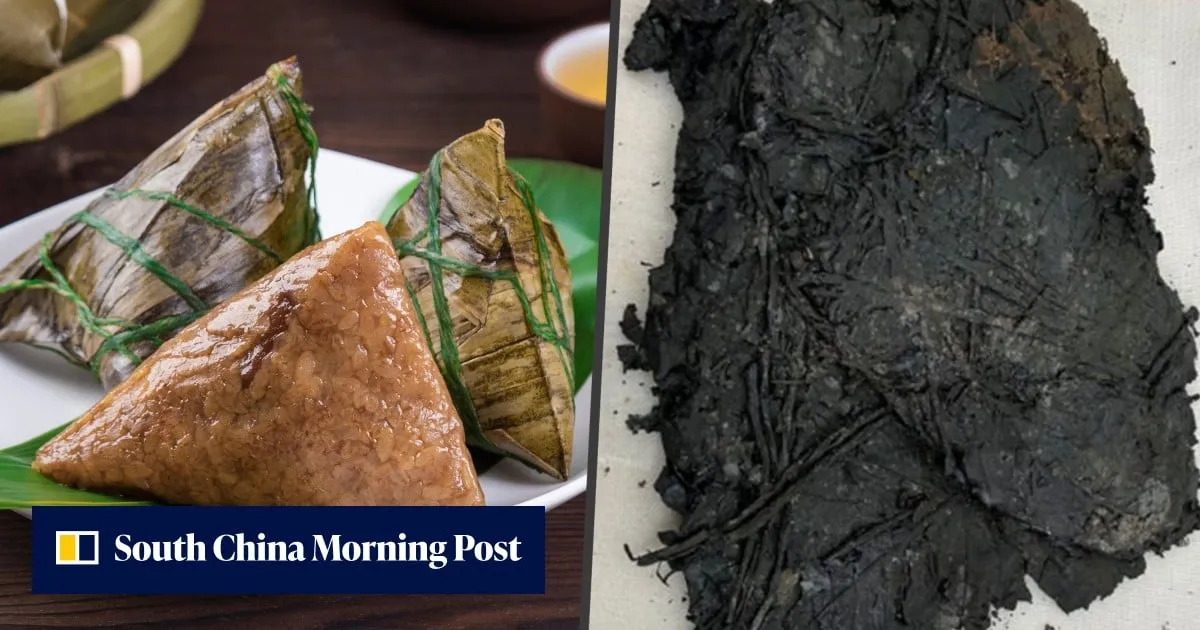
When the weather turns warm around June, people all across China gather for the annual Dragon Boat Festival, and one of the most famous dishes from the celebration is the zongzi.zongzi is a rice dumpling with a delicious filling, wrapped in bamboo leaves before being cooked. The leaves add aroma and flavour to the rice.In mid-August, a group of scientists from China announced they had discovered an ancient ancestor of zongzi made around 2,200 years ago.However, Yong Ge, a study author from the Institute of Vertebrate Palaeontology and Paleoanthropology at the Chinese Academy of Sciences, said it would be a stretch to “directly recognise” the food as zongzi, adding that the comparison is fair but “should not be overinterpreted.”“Well-preserved plant materials are rare, and we currently do not have a distinct route of zongzi evolution. The only unequivocal evidence of a zongzi belongs to the Song dynasty (960–1279), about 1,000 years later than our findings,” said Yong.Yong told the SCMP that what happened in the millennium between “remains a black box”. All that we know is the tradition was passed down, and the material, morphology and function were kept almost the same while spreading to other regions.The timing of the artefacts also aligns with that of Qu Yuan, whose legend is the backbone of the Dragon Boat Festival.
SRCSouth China Morning Post
LANGEN
LEANCenter-Right
WORDS218
ENT8
THU · 2026-09-24 · 02:45 GMTBRIEF NSR-2026-0924-113652
NSR-2026-0924-113652News Report·EN·Human Interest
Chinese archaeologists find 2,200-year-old ancestor of Dragon Boat Festival treat
Chinese archaeologists have discovered a food item dating back approximately 2,200 years that is considered an ancient ancestor of zongzi, a traditional treat for the Dragon Boat Festival. This ancient food, made from rice and wrapped in leaves, shares similarities with modern zongzi, which is a rice dumpling wrapped in bamboo leaves.
Kevin McSpaddenSouth China Morning PostFiled 2026-09-24 · 02:45 GMTLean · Center-RightRead · 1 min
South China Morning PostFIG 01
Reading time
1min
Word count
218words
Sources cited
1cited
Entities identified
8entities
Quality score
100%
§ 01
Briefing Summary
AI-generatedNEWSAR · AI
Chinese archaeologists have discovered a food item dating back approximately 2,200 years that is considered an ancient ancestor of zongzi, a traditional treat for the Dragon Boat Festival. This ancient food, made from rice and wrapped in leaves, shares similarities with modern zongzi, which is a rice dumpling wrapped in bamboo leaves. While the discovery is significant, researchers caution against directly identifying it as zongzi, as the direct evolutionary path of the dish remains unclear. The earliest definitive evidence of zongzi dates to the Song dynasty, about 1,000 years after these findings. The timing of the discovery also coincides with the legend of Qu Yuan, central to the Dragon Boat Festival.
Confidence 0.90Sources 1Claims 5Entities 8
§ 02
Article analysis
Model · rule-basedFraming
Human Interest
Social Justice
Tone
Measured
AI-assessed
CalmNeutralAlarmist
Factuality
0.70 / 1.00
Factual
LowHigh
Sources cited
1
Limited
FewMany
§ 03
Key claims
5 extracted01
The only unequivocal evidence of zongzi belongs to the Song dynasty (960–1279).
factualYong Ge
Confidence
1.00
02
It would be a stretch to directly recognize the ancient food as zongzi.
quoteYong Ge
Confidence
1.00
03
Chinese archaeologists discovered an ancient food item around 2,200 years old that is an ancestor of zongzi.
factualscientists from China
Confidence
0.90
04
The tradition of zongzi was passed down, with material, morphology, and function kept almost the same while spreading to other regions.
quoteYong Ge
Confidence
0.80
05
The timing of the ancient food artefacts aligns with that of Qu Yuan, whose legend is the backbone of the Dragon Boat Festival.
factualarticle
Confidence
0.70
§ 04
Full report
1 min read · 218 words§ 05
Entities
8 identifiedKey playerOppositionContextPositiveNeutralNegative
Organizations2
Locations1
Topics1
§ 06
Keywords & salience
8 termszongzi
1.00
dragon boat festival
1.00
archaeological discovery
0.90
ancient food
0.80
food evolution
0.70
chinese history
0.60
qu yuan
0.50
song dynasty
0.40
§ 07
Topic connections
Interactive graph Network visualization showing 51 related topics
View Full Graph Person Organization Location Event|Click node to navigate|Edge numbers = shared articles