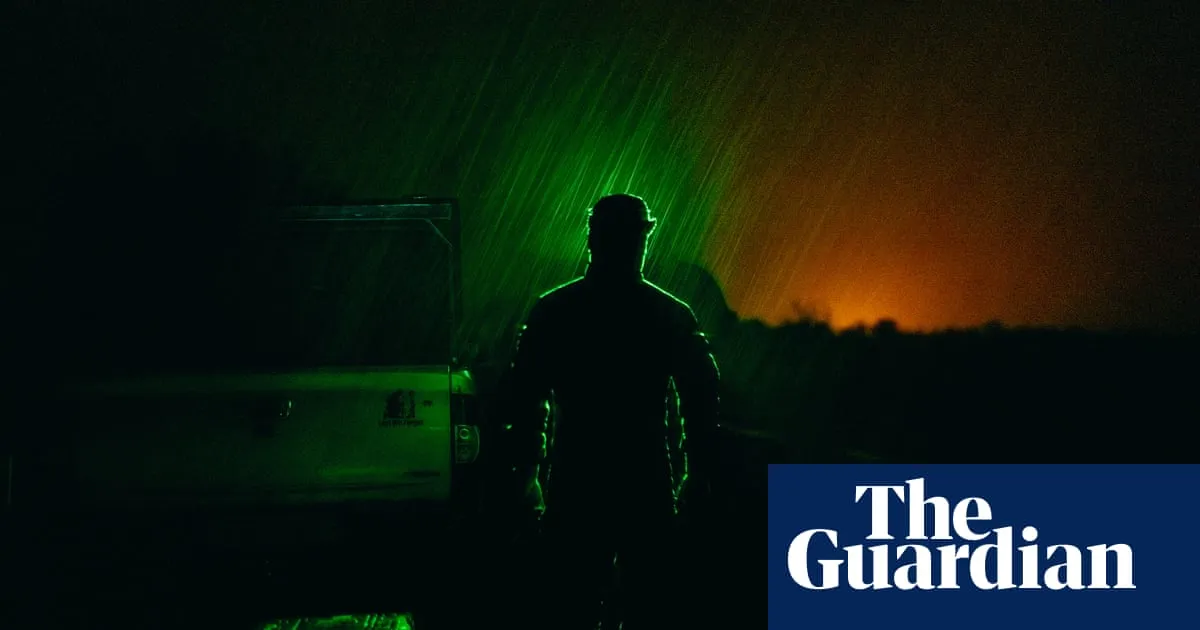
Finally, in the dead of night, the threat above has passed. The rain has eased and the Ukrainian drones are ready, prepared by a ground crew shrouded in hard-to-detect green and red lights. A small succession of Ukrainian Fire Point FP-2 craft, miniature monoplanes with a 6-metre wingspan and more than 100kg of explosive, line up for an attack mission into occupied Luhansk, over 200 miles away.The drone’s main piston engine is a familiar scooter’s buzz, but its launch booster is something else. The jet sound reverberates, almost painfully. A burst of fire lurches into the distance, the last of which signifies it is time for Ukraine’s 413 Raid drone regiment to pack and go. The launch of an FP-2 drone during the mission into occupied Luhansk It is a scene that is now played out nightly by dozens of Ukrainian crews, reflecting a fast-changing conflict that began with tanks, then artillery, but is now pivoting beyond a first generation of drones. Death and destruction are delivered by new weapons in growing volumes, hundreds of miles beyond the frontline, and at targets that are military, industrial and economic but that affect civilians too.But just as Ukraine has developed its drone and missile capability to almost match Russia’s – after its cities were subject at times to hundreds of drone strikes a day – Moscow has transformed its drone arsenal with a jet-powered revolution. The balance of power remains uncertain. Pilots of the 413 Raid drone regiment preparing an FP-2 for launch Raid is a specialist drone unit, created two years ago, and has been operating Ukrainian-designed and -built FP-2 attack drones since last autumn, according to Skipper, a former corporate IT worker with a master’s in computer science who is now one of its commanders. If, he says, there was only one crew that could run two missions a week when they started, today he says “we can do 10 times more, or even more”.Speaking in a car as the rain pelts down, Skipper cautions there is “a flipside” when asked if long-distance wars are easier to fight because nobody has to be killed visibly. “They can do it as well,” he says – Raid’s crew are targets too. “Maybe you don’t see the enemy with your own eyes, but still it’s a very dangerous game,” he adds.The FP-2 was only first publicly acknowledged by Ukraine last September. It is designed to attack hardened targets at a mid-range, to disrupt Russian logistics to the frontline. The success of Raid and others engaged in mid-strike bombing has helped grind the pace of the invaders’ advance to a near halt. Russia gained a modest 90 square kilometres of Ukraine in August, compared with 505 sq km a year earlier, and western officials estimate it is losing 6,000 more soldiers a month than it can recruit.In Ukraine’s sprawling military, the specialist drone units of the Unmanned System Forces, including Raid regiment, work and overlap with army units working closer to the frontline and special forces. A major attack, such as the attack that disabled the Moscow refinery about 300 miles from the border on 20 September, involves several working at once.A long-range attack could involve launching up to 300 drones, though the target is to be able to launch 1,000 a night, in what soldiers describe as an “orchestra”, where cheap drones identify an air corridor towards the final target. An employee walks past a plume of smoke rising from a fire at the Russian e-commerce firm Wildberries’ logistics complex near the town of Podolsk, outside Moscow, on 16 August. Photograph: Tatyana Makeyeva/AFP/Getty Images The long-range, $75,000 FP-1, sister to the FP-2, has been used to repeatedly attack warehouses, refineries and other military-economic sites at a depth of 1,800 miles inside Russia, causing the country’s crude oil production to fall by 7.7% in a year, according to figures from the International Energy Agency, and interest rates to remain at 14%. “Both sides are getting better at translating deep strikes into economic effects,” says Sidharth Kaushal, of the Royal United Services Institute. A refinery burning in Moscow after Ukrainian drones strikes, 21 September. Photograph: EyePress News/Shutterstock Mission planning is rarely shown, but a short-range drone unit operating in the eastern Donetsk front – Unit 17, Special Operations Centre – is happy to show their war work from their dacha. Znakhar, 33, a software coder before the full Russian invasion, is one of a squad of English-speaking men in their early 30s. During the day, he clicks on fresh, static targets – artillery, electronic jamming systems – that have been added to a common system from western satellites or Ukrainian reconnaissance drones, studying their pictures for extra information. Pilots of Unit 17, Special Operations Centre, posing for a portrait next to a Sych mid-strike drone The temporary base of pilots of Unit 17, Special Operations Centre. Right: the ‘drop bombs’ Unit 17 used for middle strikes At night, the crew use a $25,000 Sych drone, which looks like a large model aeroplane. If the rain holds off, they can fly two to six bombing runs, dozens of miles behind enemy lines. Znakhar, whose call sign means healer or herbalist, draws up an initial flight path in seconds with a few clicks on a map, then adjusts the route to avoid population centres, high ground and known interceptor drone launch sites. What’s changed recently? “More drones,” he says. “Russian drones.”Colleagues such as Ananas, 30, head out at night, taking more precautions than they did when the unit started drone work two years ago, preparing launches underground where once they could work in a field. He studied architecture, then worked as a 3D artist in a video game studio. “I play a lot of video games,” he says, “so I’m good with a gamepad. It’s a big plus because now I’m a pilot.” It’s a narrowing of the gap between fiction and reality.On the other side, Moscow always has ballistic and cruise missiles available, allowing it to bomb anywhere inside Ukraine since February 2022. It imported delta-winged Shahed drones from Iran in the war’s first year to boost its long-range attack numbers, and developed a family of cheap battlefield drones plus its own version of the Shahed. But since May there has been a notable set of upgrades, allowing Russian forces to strike Ukraine more effectively with fast, jet-engined drones, allied with a new ruthlessness of targeting. Firefighters working at the site of a Russian drone strike on Kyiv business centre on 23 September “Russia never stops,” Serhii Beskrestnov, Volodymyr Zelenskyy’s defence technology adviser, said during an interview in Kyiv punctuated by an air raid and explosions in the distance. The original Iranian delta wing Shahed (known by Russia as the Geran-2) has been redesigned and a jet engine added.The new Geran-4, with more aerodynamic wings, flies at anywhere from 300km/h (186mph) to 550km/h, while the cigar-shaped Geran-5 is even faster, at closer to 600km/h. It is similar in speed to a new light cruise missile, the Banderol. The prediction is that Russia will make 36,000 jet Shaheds in 2027, a further 10,000 Banderols, plus a similar number of cheap cruise missiles, the Dan-T. All could be used to bomb Ukraine’s strained electricity, heating and water systems this winter.The new weapons, whose Telefly engines are made in China, are faster than the Ukrainian interceptors, designed to stop the old piston-engined Shahed Geran-2s. Shahed interception rates, once over 90%, are down to 60% against Russia’s newer models, with predictable results. The aftermath of a Russian attack on ammunition storage in Myla village, Kyiv region, in August A mix of jet- and traditional-engined drones made a rare morning attack into the centre of Kyiv on Wednesday, bombing a market near the central railway station and business centre, killing two people and injuring 41. At the end of August, a Geran-4 hit an ammunition dump at Myla, outside Kyiv, killing 38 and destroying homes nearby.Another struck Ukraine’s SBU domestic intelligence agency in the centre of Kyiv, though it may have been controlled in its final phase by a Russian agent on the ground. Food supplies in Kyiv supermarkets are uneven after sustained attacks on warehouses in August; petrol stations in the capital were targeted in early September. The aftermath of a Russian Geran-5-type jet-powered drone strike on an Ukrnafta petrol station in the Holosiivskyi district of Kyiv, 15 September. Photograph: Libkos/Getty Images Ukrainian military propaganda is excellent at highlighting successful missions on social media, but the wider picture of the impact of its drone strikes on Russia is harder to discern. “This spring we had a really nice time and almost every night we could see one, two, three, four systems destroyed,” Skipper says. “Since June, July, they are just hiding.” Other Ukrainian military sources emphasise that Russia has improved its jamming capabilities, and cheap strike drones are simply not as accurate now.In this long-distance war, civilian casualties are climbing. New UN figures show 2,222 killed in Ukraine during the first eight months of 2026, more than in all of 2025. In August, 368 were killed in Ukraine and a further 113 reported dead in Russia. Warehouses owned by Ukrainian supermarkets, its Nova Poshta postal service and e-commerce groups were hit at least 32 times. Wildberries and Ozon warehouses in Russia were bombed 17 times by Ukraine. Firefighters at a warehouse in the Kyiv region after a Russian attack The impact could be harder for Ukraine. “Russia has advantages that Ukraine does not,” says Kaushal. “A more diversified range of long-range weapons, more of an air defence network and more slack as a society, because its people have not faced so much pressure for so long.” Ukraine, meanwhile, faces economic pressure at a time when its war budget is overspent and needs to find £40bn more next year.Yet, though war is escalating as the technology changes, neither side is close to defeat or a crisis. Tests will come if Russia tries to mobilise up to 300,000 men after parliamentary elections – and as Ukraine tries again to refinance and, most urgently, get through the winter.Back in their soldiers’ dacha, Ananas and Znakhar wonder if the war will ever end. “Sometimes I catch this feeling,” Ananas admits, then Znakhar comes in: “We just need to hang on one more day than them.”
SRCThe Guardian - World News
LANGEN
LEANCenter-Left
WORDS1 721
ENT9
THU · 2026-09-24 · 04:00 GMTBRIEF NSR-2026-0924-113664
NSR-2026-0924-113664News Report·EN·Conflict
The long-range drone war: Ukraine and Russia scramble for supremacy in the skies
The conflict between Ukraine and Russia is increasingly characterized by long-range drone warfare, targeting military, industrial, economic, and civilian sites hundreds of miles beyond the front lines. Ukraine has developed its drone capabilities, with units like the 413 Raid drone regiment using Ukrainian-designed Fire Point FP-2 drones for missions over 200 miles into occupied territories.
Dan Sabbagh in eastern Ukraine. With photographs by Julia KochetovaThe Guardian - World NewsFiled 2026-09-24 · 04:00 GMTLean · Center-LeftRead · 7 min
The Guardian - World NewsFIG 01
Reading time
7min
Word count
1 721words
Sources cited
2cited
Entities identified
9entities
Quality score
100%
§ 01
Briefing Summary
AI-generatedNEWSAR · AI
The conflict between Ukraine and Russia is increasingly characterized by long-range drone warfare, targeting military, industrial, economic, and civilian sites hundreds of miles beyond the front lines. Ukraine has developed its drone capabilities, with units like the 413 Raid drone regiment using Ukrainian-designed Fire Point FP-2 drones for missions over 200 miles into occupied territories. These strikes aim to disrupt Russian logistics and have contributed to a slowdown in Russian advances. Russia has also significantly advanced its drone arsenal, leading to an uncertain balance of power in the skies. Both sides are focusing on translating deep strikes into economic effects, with Ukrainian drones reportedly impacting Russia's crude oil production.
Confidence 0.90Sources 2Claims 5Entities 9
§ 02
Article analysis
Model · rule-basedFraming
Conflict
Technology
Tone
Mixed Tone
AI-assessed
CalmNeutralAlarmist
Factuality
0.70 / 1.00
Factual
LowHigh
Sources cited
2
Limited
FewMany
§ 03
Key claims
5 extracted01
Ukrainian Fire Point FP-2 drones, with a 6-meter wingspan and over 100kg of explosives, are used for attack missions over 200 miles away.
factual
Confidence
0.90
02
Western officials estimate Russia is losing 6,000 more soldiers a month than it can recruit.
statisticwestern officials
Confidence
0.80
03
Russia has transformed its drone arsenal with a jet-powered revolution.
factual
Confidence
0.80
04
Ukraine has developed its drone and missile capability to almost match Russia's after its cities faced hundreds of drone strikes daily.
factual
Confidence
0.80
05
The success of Ukrainian mid-strike bombing has helped grind the pace of Russian advance to a near halt.
factual
Confidence
0.70
§ 04
Full report
7 min read · 1 721 words§ 05
Entities
9 identifiedKey playerOppositionContextPositiveNeutralNegative
Events1
§ 06
Keywords & salience
10 termsdrone war
1.00
long-range drones
0.90
ukraine
0.80
russia
0.80
aerial supremacy
0.70
fp-2 drone
0.60
drone regiment
0.50
military technology
0.50
occupied luhansk
0.40
logistics disruption
0.40
§ 07
Topic connections
Interactive graph Network visualization showing 51 related topics
View Full Graph Person Organization Location Event|Click node to navigate|Edge numbers = shared articles