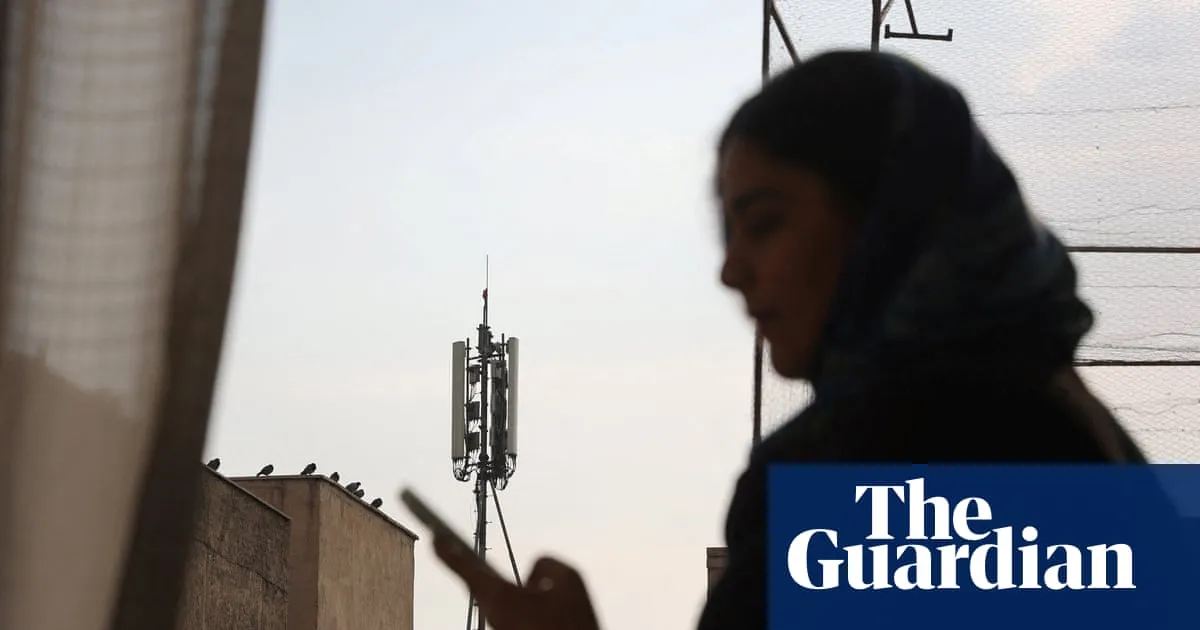
Iranian authorities appear to have relaxed – but not removed – internet restrictions, in what experts say is a sign of the mounting costs of the most severe internet blackout the regime has ever imposed.“There seems to be a real patchwork of connectivity. I think if most people have access, it’s some kind of degraded service,” said Doug Madory, the director of internet analysis at Kentik. “It’s almost like they’re developing a content blocking system by trial and error.”On Wednesday, previously unavailable Iranian Telegram channels came back online. Data from Cloudflare and Kentik show that an uneven restoration of internet traffic to Iran began on Tuesday morning – reaching about 60% of pre-shutdown levels at one point. The pattern of this internet traffic did not follow a smooth curve, Madory said, but rather had jagged peaks, indicating authorities were likely continuing to throttle connections.Iran internet use graphA report from Filterwatch, an organisation monitoring Iran’s internet traffic, suggests that certain services, such as Google, Bing and ChatGPT, are now available to some users on a province-to-province basis, but many are unstable and many social media and messaging platforms remain unusable.Iran’s internet shutdown began on 8 January, after nearly two weeks of escalating anti-government protests. The blackout has become one of the defining features of what may be the bloodiest weeks in Iran’s recent history.It has helped obscure extreme violence against Iran’s population, with accounts of mass burials and truckloads of bodies filtering out of the country only sporadically, and often days late, through journalists, activists and a few Telegram channels. It has also likely cost Iranian authorities a great deal of money due to lost economic output, with whole sectors of the economy unable to work.Nationwide protests against failing economic policies started in Tehran’s Grand Bazaar in late December. Photograph: MAHSA/Middle East Images/AFP/Getty ImagesDespite the regime’s efforts to whitelist certain websites and fine-tune their internet blockade, Iranian authorities have still said the shutdown has cost them up to $36m each day, according to a recent estimate by a government minister. This is on a par with previous research that has estimated the cost of various global internet blackouts to be hundreds of millions of dollars. The OECD put the cost of Egypt’s 2011 internet shutdown during the height of Tahrir protests at $90m.A report from an Iranian news outlet, confirmed by Iranian digital rights researchers, describes Iranian CEOs gathering in the dining hall of the Tehran Chamber of Commerce this week to access the internet – with all of their activity monitored by the government.Demand was so great that each businessperson was restricted to half an hour of access. One described the environment as “like an internet cafe from the 1980s or a university campus”.Two weeks ago, Iranian authorities appeared determined to continue the blackout for some time, perhaps indefinitely, with a government spokesperson reportedly saying the internet would be restricted until at least Nowruz, the Persian new year, on 20 March.Madory said authorities apppeared to be adjusting the shutdown, but not with an intention to end it. “It’s definitely not restored to pre-8 January levels,” he said. “Every day is different. Even within a day, it’s not consistent. It appears like they’re just developing this on the fly.”
SRCThe Guardian - World News
LANGEN
LEANCenter-Left
WORDS538
ENT12
WED · 2026-01-28 · 16:41 GMTBRIEF NSR-2026-0128-11371
NSR-2026-0128-11371News Report·EN·Economic Impact
Iran appears to ease internet blackout as cost of shutdown mounts
Iranian authorities appear to be easing, but not fully lifting, internet restrictions imposed on January 8th following escalating anti-government protests. Experts believe the partial restoration, which began around January 16th, signals the growing economic cost of the shutdown, estimated at up to $36 million per day.
Aisha DownThe Guardian - World NewsFiled 2026-01-28 · 16:41 GMTLean · Center-LeftRead · 3 min
The Guardian - World NewsFIG 01
Reading time
3min
Word count
538words
Sources cited
3cited
Entities identified
12entities
Quality score
100%
§ 01
Briefing Summary
AI-generatedNEWSAR · AI
Iranian authorities appear to be easing, but not fully lifting, internet restrictions imposed on January 8th following escalating anti-government protests. Experts believe the partial restoration, which began around January 16th, signals the growing economic cost of the shutdown, estimated at up to $36 million per day. While some services like Google, Bing, and ChatGPT are reportedly accessible to some users in certain provinces, many social media and messaging platforms remain blocked. Data shows uneven internet traffic patterns, suggesting continued throttling of connections. The blackout has obscured violence against the population and disrupted economic activity, prompting the regime to selectively restore access despite ongoing costs.
Confidence 0.90Sources 3Claims 5Entities 12
§ 02
Article analysis
Model · rule-basedFraming
Economic Impact
Human Rights
Tone
Mixed Tone
AI-assessed
CalmNeutralAlarmist
Factuality
0.70 / 1.00
Factual
LowHigh
Sources cited
3
Well sourced
FewMany
§ 03
Key claims
5 extracted01
An uneven restoration of internet traffic to Iran began on Tuesday morning.
factual
Confidence
0.90
02
Iranian authorities appear to have relaxed – but not removed – internet restrictions.
factual
Confidence
0.90
03
Certain services, such as Google, Bing and ChatGPT, are now available to some users on a province-to-province basis.
factualFilterwatch
Confidence
0.80
04
The shutdown has cost them up to $36m each day.
statistica government minister
Confidence
0.80
05
It’s almost like they’re developing a content blocking system by trial and error.
quoteDoug Madory, the director of internet analysis at Kentik
Confidence
0.70
§ 04
Full report
3 min read · 538 words§ 05
Entities
12 identifiedKey playerOppositionContextPositiveNeutralNegative
Organizations7
§ 06
Keywords & salience
9 termsinternet shutdown
1.00
iran
0.80
internet restrictions
0.80
internet access
0.70
anti-government protests
0.60
economic cost
0.60
content blocking
0.50
internet traffic
0.50
social media
0.40
§ 07
Topic connections
Interactive graph Network visualization showing 51 related topics
View Full Graph Person Organization Location Event|Click node to navigate|Edge numbers = shared articles