EXPLAINERWhy are Ireland vs Israel football matches so controversial?Ireland and Israel will play two football matches despite growing Irish calls for a boycott due to the genocide in Gaza.Demonstrators have held protests and marches to urge the Ireland" class="entity-link entity-organization" data-entity-id="123590" data-entity-type="organization">Football Association of Ireland (FAI) to boycott Ireland's upcoming UEFA-nations-league" class="entity-link entity-event" data-entity-id="123589" data-entity-type="event">UEFA Nations League matches against Israel [File: Clodagh Kilcoyne/Reuters]Published On 24 Sep 2026When European football’s governing body announced the schedule for its upcoming Nations League competition in February, one fixture became an instant point of contention.The Republic of Ireland and Israel were allocated the same group in League B of the UEFA-nations-league" class="entity-link entity-event" data-entity-id="123589" data-entity-type="event">UEFA Nations League 2026-27, provoking strong opposition from Irish fans, footballers and celebrities due to Israel’s genocidal war in Gaza. It also led to calls for a boycott of the fixture regardless of the consequences.Recommended Stories list of 3 itemslist 1 of 3The return of Palestinian football: ‘We are a people who must live’list 2 of 3‘It’s our time to shine’: India’s surfers look to make waves at Asian Gameslist 3 of 3Migrants ‘are not to blame’: How the Ceuta crisis engulfed Spanish footballend of listSeven months on, the Ireland vs Israel game is expected to be played as scheduled but amid vociferous criticism, louder calls for Irish football officials not to send a team to the game and bitter Israeli responses to the backlash.What’s happening between Ireland and Israel?They will play two matches in the space of eight days amid tense political relations and in the face of increasing opposition from the Irish public.The fixtures will be played on a home-and-away basis, with Ireland “hosting” its home leg in Debrecen, Hungary, on Sunday, September 27. Israel’s “home” match will be played in Serbia on October 4.Why does Ireland have to play against Israel?Ireland and Israel are members of UEFA, European football’s governing body. As UEFA members, and in order to progress to the top tier of European football competitions and improve their rankings in international football, both nations participate in UEFA-run tournaments.The UEFA-nations-league" class="entity-link entity-event" data-entity-id="123589" data-entity-type="event">UEFA Nations League pits closely ranked nations against each other in groups, where all teams face each other twice in round-robin-style matches.Ireland and Israel were drawn together in Group B3 along with Austria and Kosovo.Who is leading the calls to boycott the Ireland vs Israel match?Ever since the fixture was first confirmed on February 12, the Ireland" class="entity-link entity-organization" data-entity-id="123590" data-entity-type="organization">Football Association of Ireland has been under pressure to boycott the matches due to Israel’s genocide in Gaza and Ireland’s status as a Palestine ally.In May, leading Irish footballers joined celebrities in a campaign by Irish Sport for Palestine, urging Ireland to boycott the match against Israel. A United Nations inquiry confirmed in June 2025 that Israel was committing a genocide in Gaza.The campaign group says Israel has breached UEFA and FIFA statutes by allowing teams to play on occupied Palestinian land and should be stripped of its membership at both football bodies.Last November, 93 percent of FAI members voted for its leadership to pressure UEFA to suspend Israel under those statutes, a mandate campaigners say the Irish governing body should “respect and represent”.The letter, entitled “Stop the Game”, was signed by League of Ireland players, former men’s coach Brian Kerr and twice women’s player of the year Louise Quinn.The letter includes a statement from Shamrock Rovers captain and Professional Footballers’ Association of Ireland (PFA) chair, Roberto Lopes.International rights organisations have also called on UEFA and FIFA to exclude Israel from its competitions.“It’s unconscionable that Israel will participate despite clear evidence that Israel’s football association continues to support illegal settlements,” Amnesty International said in a statement.“When rules are broken, when occupation, apartheid and genocide are ongoing, we cannot look the other way,” it added.What have Ireland’s officials said about the match?Ireland’s Prime Minister Micheal Martin gave a green light to the matches, citing the challenges of mixing sport and politics.“We have been critics and have opposed very strongly Israeli government policy within Gaza in particular. We condemned the Hamas attack on Israel, which was absolutely horrific,” the Taoiseach told The Irish Times.“I think sport is an area that can be challenging when it crosses into the realm of politics.”In February, FAI Chief Executive David Courell said the national team had no choice but to fulfil its obligations or risk harming the long-term sporting interests of Irish football, including potential disqualification from future competitions.Last week, Ireland manager Heimir Hallgrimsson responded to the boycott calls, saying his team were not “playing with genocide”.“We’re playing against genocide,” Hallgrimsson said.What is the public sentiment in Ireland?The rights groups calling for a boycott of the match have cited several public polls, run by local newspapers, footballers’ bodies and individuals online, which indicate that a vast majority are in favour of opting out of the Nations League fixtures.A poll by the PFA in February showed that 63 percent of those surveyed did not want Ireland to play the fixtures. A similar poll by the Irish Mirror newspaper indicated that 71 percent of the public would support the FAI if they refused to play the game.Bohemian FC, an Irish football club with a strong pro-Palestine stance, have thrown their weight behind the calls for a boycott and have urged the FAI to call off their participation.Bohemian’s Director of Football Pat Fenlon believes it is up to the FAI to “take a stand for what’s happening in Gaza”.“What an opportunity it would be to be the first country to stand up and say this is totally wrong,” Fenlon told Irish Sport for Palestine.“The game shouldn’t be played,” he said.According to officials at the club, the Irish public is aware of the potential consequences but believe that boycotting is “the right thing to do”.“It is not acceptable to put a price on standing up for what is right and in solidarity with the Palestinian people,” the club’s communications director Luke O’Rodrian told Al Jazeera.He accused the FAI of showing “sheer cowardice”.O’Rodrian said the boycott calls have been supported by trade unions representing workers, particularly those employed by the FAI, the PFA and the Irish Football Supporters Partnership, who represent Ireland’s football supporters.In the country’s political sphere, Mary Lou McDonald, leader of Ireland’s main opposition party Sinn Fein, has also called for the FAI to “do the right thing by its players” by telling them not to take the field.How did Israel respond?The Israeli FA responded to Hallgrimsson’s statement on Monday by saying: “We are not playing with ignorance, hypocrisy and stupidity; we’re playing against the coach who embodies them”.Martin defended Hallgrimsson, describing Israel’s remarks as “unacceptable”, adding that “Israel can’t keep denying what the world knows”.Why are the matches being played in Hungary and Serbia?The first leg of the fixture will be held at the Nagyerdei Stadion in Debrecen, Hungary, and the second, which is Ireland’s “home” game, will be played at the TSC Arena in Backa Topola, Serbia.Israel has not played an international fixture at home since September 2023 as it has been barred by UEFA from hosting teams due to security concerns.While the October 4 fixture was scheduled to be held in Dublin, the FAI moved it following the protests and boycott calls. That game will be played behind closed doors.Irish state broadcaster RTE, which has contractual obligations to show the games, will provide stripped-back coverage.There will be no studio presentation or punditry and commentary will be taken from the international feed. RTE has not taken advertising or sponsorship around either game.
SRCAl Jazeera
LANGEN
LEANCenter
WORDS1 231
ENT12
THU · 2026-09-24 · 14:36 GMTBRIEF NSR-2026-0924-113807
NSR-2026-0924-113807News Report·EN·Social Justice
Why are Ireland vs Israel football matches so controversial?
Ireland and Israel are scheduled to play two UEFA Nations League football matches, sparking significant controversy in Ireland. Irish fans, footballers, and celebrities are calling for a boycott due to Israel's actions in Gaza, with a UN inquiry confirming genocide.
Hafsa AdilAl JazeeraFiled 2026-09-24 · 14:36 GMTLean · CenterRead · 5 min
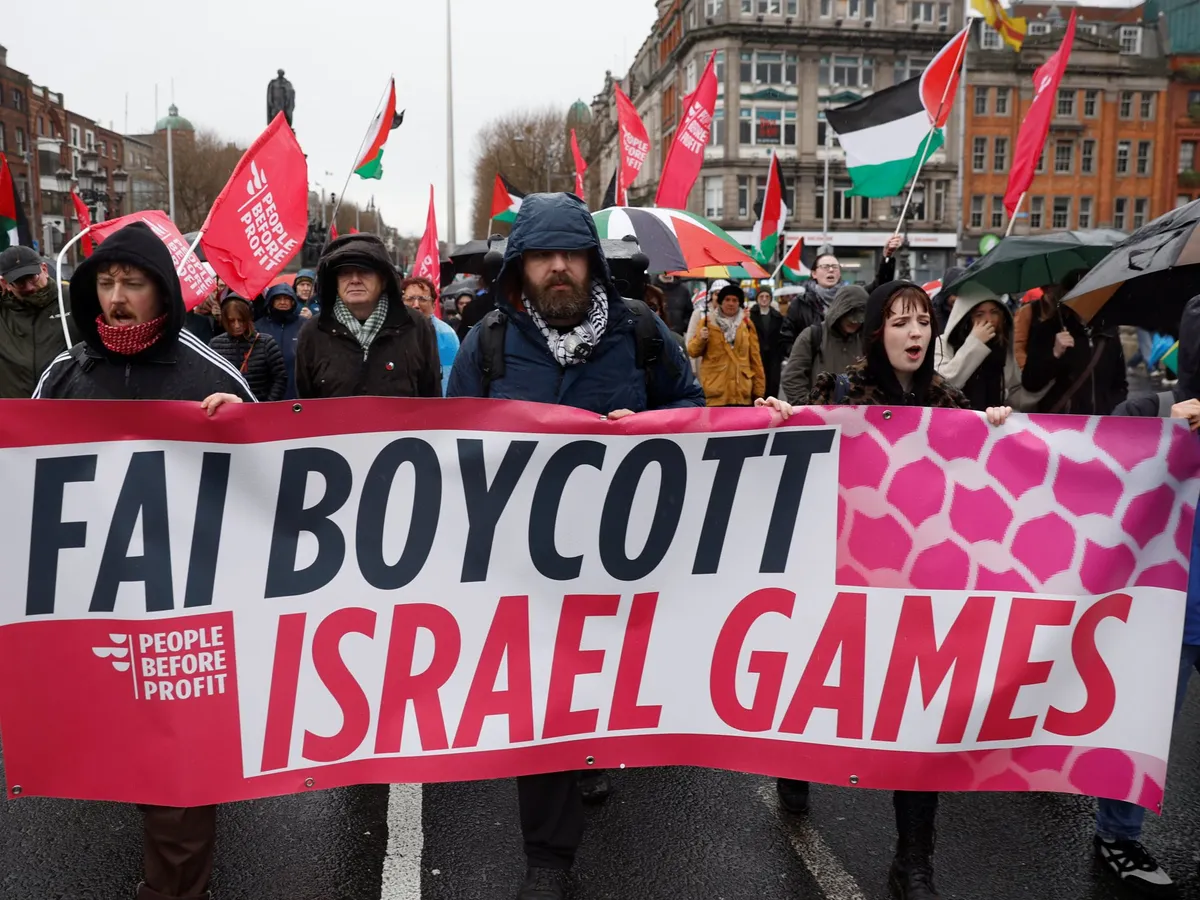
Al JazeeraFIG 01
Reading time
5min
Word count
1 231words
Sources cited
1cited
Entities identified
12entities
Quality score
100%
§ 01
Briefing Summary
AI-generatedNEWSAR · AI
Ireland and Israel are scheduled to play two UEFA Nations League football matches, sparking significant controversy in Ireland. Irish fans, footballers, and celebrities are calling for a boycott due to Israel's actions in Gaza, with a UN inquiry confirming genocide. Despite these calls, the Football Association of Ireland (FAI) is obligated to participate in the tournament as UEFA members. The matches will be played in Hungary and Serbia, as Ireland cannot host its home game. Irish officials, including the Prime Minister, have stated that mixing sport and politics is challenging, and the FAI CEO warned that boycotting could harm Ireland's future sporting interests. The Irish team manager clarified they are "playing against genocide," not "playing with genocide."
Confidence 0.90Sources 1Claims 5Entities 12
§ 02
Article analysis
Model · rule-basedFraming
Social Justice
Conflict
Tone
Mixed Tone
AI-assessed
CalmNeutralAlarmist
Factuality
0.40 / 1.00
Mixed
LowHigh
Sources cited
1
Limited
FewMany
§ 03
Key claims
5 extracted01
Irish Sport for Palestine campaign urges Ireland to boycott the match against Israel.
factualIrish Sport for Palestine
Confidence
1.00
02
Ireland's home leg will be played in Debrecen, Hungary, on September 27, and Israel's home match in Serbia on October 4.
factual
Confidence
1.00
03
Ireland and Israel will play two football matches in the UEFA Nations League despite calls for a boycott.
factual
Confidence
1.00
04
Irish fans, footballers, and celebrities oppose the matches due to Israel’s alleged genocidal war in Gaza.
factual
Confidence
0.90
05
A United Nations inquiry confirmed in June 2025 that Israel was committing genocide in Gaza.
factualUnited Nations inquiry
Confidence
0.80
§ 04
Full report
5 min read · 1 231 words§ 05
Entities
12 identifiedKey playerOppositionContextPositiveNeutralNegative
Locations8
§ 06
Keywords & salience
8 termsireland vs israel football
1.00
uefa nations league
0.90
gaza
0.80
boycott calls
0.70
genocide
0.60
political relations
0.50
football association of ireland
0.40
protests
0.40
§ 07
Topic connections
Interactive graph Network visualization showing 51 related topics
View Full Graph Person Organization Location Event|Click node to navigate|Edge numbers = shared articles