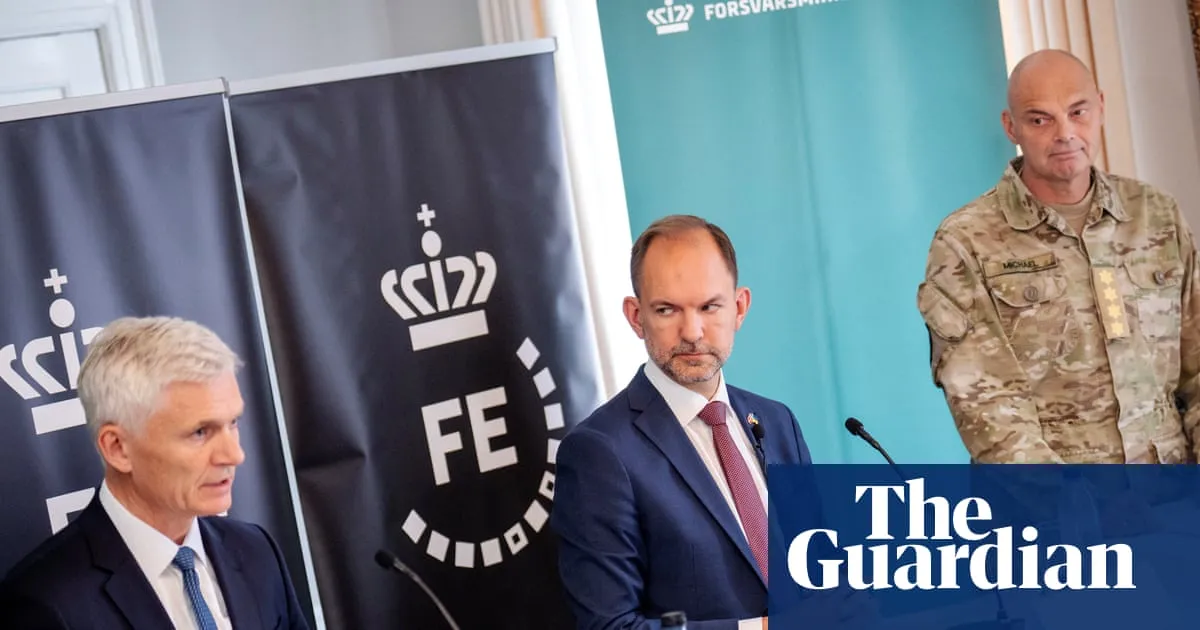
Russia could launch a limited military attack against a Nato country in the coming months, Danish intelligence said, in one of the starkest warnings yet by western security services.In a report published on Thursday, the Danish defence intelligence service warned of a “low but growing risk” that Russia could launch long-range strikes on Nato infrastructure supporting Ukraine, or carry out a limited incursion into a neighbouring country with a small number of troops, potentially operating without insignia.The report came hours after a fire at a Starlink satellite station in central Poland that local authorities described as an “act of sabotage”.Krzysztof Gawkowski, the deputy prime minister of Poland, said the blaze, which broke out overnight in the Masovian voivodeship, had been “deliberately designed to disable the station”, disrupting internet access for a number of institutions, including the Ukrainian military.The Starlink station in Wola Krobowska, Poland, April 2026. Photograph: Pleiades Neo © Airbus DS 2026/ReutersGawkowski said it had not been established who was responsible for the fire, but that “many signs suggest this aligns with Russia’s new doctrine of attack.“While everything is operational today, we must recognise, as prime minister [Donald] Tusk recently noted, that this is an element of hybrid warfare,” he said.Starlink has become a key part of Ukraine’s military communications, and the incident comes amid a spate of suspected Russian sabotage operations across European infrastructure supporting Ukraine.Earlier this month, Germany publicly blamed Russia for an attempted drone attack on Leipzig/Halle airport, while a series of other incidents – including fires at drone factories and sabotage targeting rail infrastructure – have also been investigated for possible links to Moscow. Russia has denied involvement in such attacks.In recent weeks, several European intelligence chiefs have warned that Russia may be preparing more assertive actions to test Nato countries’ commitment to supporting Ukraine, though officials differ over how imminent such a move may be.Russia is expected to intensify its hybrid attacks against European countries with “greater consequences” for those targeted in the coming months, the Danes warned, including “destructive cyber-attacks that cripple societal functions as well as sabotage attacks that carry a high risk of casualties”.A source familiar with Moscow’s thinking agreed that Russia was likely to step up its hybrid attacks.“Russian military top command is convinced some Nato countries are directly involved in the war against Russia – not just by supplying Ukraine with weapons and intelligence, but by helping to guide missiles and drones,” the source said, speaking on condition of anonymity.“They therefore believe Nato is already waging a hybrid war against Russia, and that Russia has the right to respond in kind,” the source added.“Hybrid attacks” are broad terms generally used to describe non-military tactics aimed at pressuring or destabilising an adversary, including cyber-attacks, sabotage and disinformation.The aim of Russia’s actions would be to divert European resources away from supporting Ukraine, and deepen divisions within Nato if the alliance failed to agree on a collective response, the report added.The service believes it remained “highly unlikely” that Russia would launch an outright invasion of a Nato country, but notably said it “cannot be ruled out”.The Danish services said Russia could seek to test Nato’s article 5, which commits members to collective defence. They warned there was “a risk that Russia assesses that the Nato countries will not respond collectively”, particularly if Moscow believes the US is unable or unwilling to support its European allies in a potential war with Russia.There have been ongoing jitters among Nato members over whether the alliance’s most powerful member, the US, would come to Europe’s defence under Donald Trump in the event of a Russian attack.Questions over unity within Europe are also growing. Last week, Slovakia’s prime minister, Robert Fico, who has maintained close ties with the Kremlin, cast doubt on his country’s commitment to Nato’s collective defence principle, saying he did not want Slovakia drawn into a military conflict “because of some article 5”.Speaking at the UN general assembly on Wednesday, Volodymyr Zelenskyy warned that Russia continued to threaten countries beyond Ukraine, including Moldova, Poland and the Baltic states, while showing “no respect” for the sovereignty of countries in the south Caucasus and central Asia.“The more freedom Putin has to act, the more dangerous the world becomes for everyone else,” he said.
SRCThe Guardian - World News
LANGEN
LEANCenter-Left
WORDS707
ENT12
THU · 2026-09-24 · 16:05 GMTBRIEF NSR-2026-0924-113843
NSR-2026-0924-113843News Report·EN·National Security
Russia could attack a Nato country within months, Danish intelligence says
Danish intelligence warns of a "low but growing risk" that Russia could launch limited military attacks against NATO countries in the coming months. These potential actions include long-range strikes on NATO infrastructure supporting Ukraine or limited incursions into neighboring countries with unmarked troops.
Pjotr Sauer in KyivThe Guardian - World NewsFiled 2026-09-24 · 16:05 GMTLean · Center-LeftRead · 3 min
The Guardian - World NewsFIG 01
Reading time
3min
Word count
707words
Sources cited
4cited
Entities identified
12entities
Quality score
100%
§ 01
Briefing Summary
AI-generatedNEWSAR · AI
Danish intelligence warns of a "low but growing risk" that Russia could launch limited military attacks against NATO countries in the coming months. These potential actions include long-range strikes on NATO infrastructure supporting Ukraine or limited incursions into neighboring countries with unmarked troops. This warning follows a recent fire at a Polish Starlink satellite station, which Poland's deputy prime minister described as an "act of sabotage" potentially aligning with Russia's new doctrine of attack. Russia is expected to intensify hybrid attacks, such as cyber and sabotage operations, to divert European resources from Ukraine and sow divisions within NATO. While an outright invasion is considered unlikely, Danish intelligence stated it "cannot be ruled out" and that Russia might test NATO's collective defense commitment.
Confidence 0.90Sources 4Claims 5Entities 12
§ 02
Article analysis
Model · rule-basedFraming
National Security
Conflict
Tone
Mixed Tone
AI-assessed
CalmNeutralAlarmist
Factuality
0.60 / 1.00
Mixed
LowHigh
Sources cited
4
Well sourced
FewMany
§ 03
Key claims
5 extracted01
A fire at a Starlink satellite station in central Poland was described by local authorities as an 'act of sabotage'.
factuallocal authorities
Confidence
0.80
02
Russia is expected to intensify its hybrid attacks against European countries with 'greater consequences' in the coming months.
predictionDanish intelligence
Confidence
0.70
03
Many signs suggest the Starlink station fire aligns with Russia’s new doctrine of attack, according to Poland's deputy prime minister.
quoteKrzysztof Gawkowski
Confidence
0.70
04
Russia could launch a limited military attack against a Nato country in the coming months, Danish intelligence said.
predictionDanish defence intelligence service
Confidence
0.70
05
Russia could launch long-range strikes on Nato infrastructure supporting Ukraine, or carry out a limited incursion into a neighbouring country.
predictionDanish defence intelligence service
Confidence
0.60
§ 04
Full report
3 min read · 707 words§ 05
Entities
12 identifiedKey playerOppositionContextPositiveNeutralNegative
Organizations3
Locations4
§ 06
Keywords & salience
8 termsrussia nato attack
1.00
hybrid warfare
0.90
danish intelligence
0.80
ukraine support
0.70
sabotage operations
0.70
starlink satellite
0.60
cyber-attacks
0.50
military attack
0.40
§ 07
Topic connections
Interactive graph Network visualization showing 51 related topics
View Full Graph Person Organization Location Event|Click node to navigate|Edge numbers = shared articles