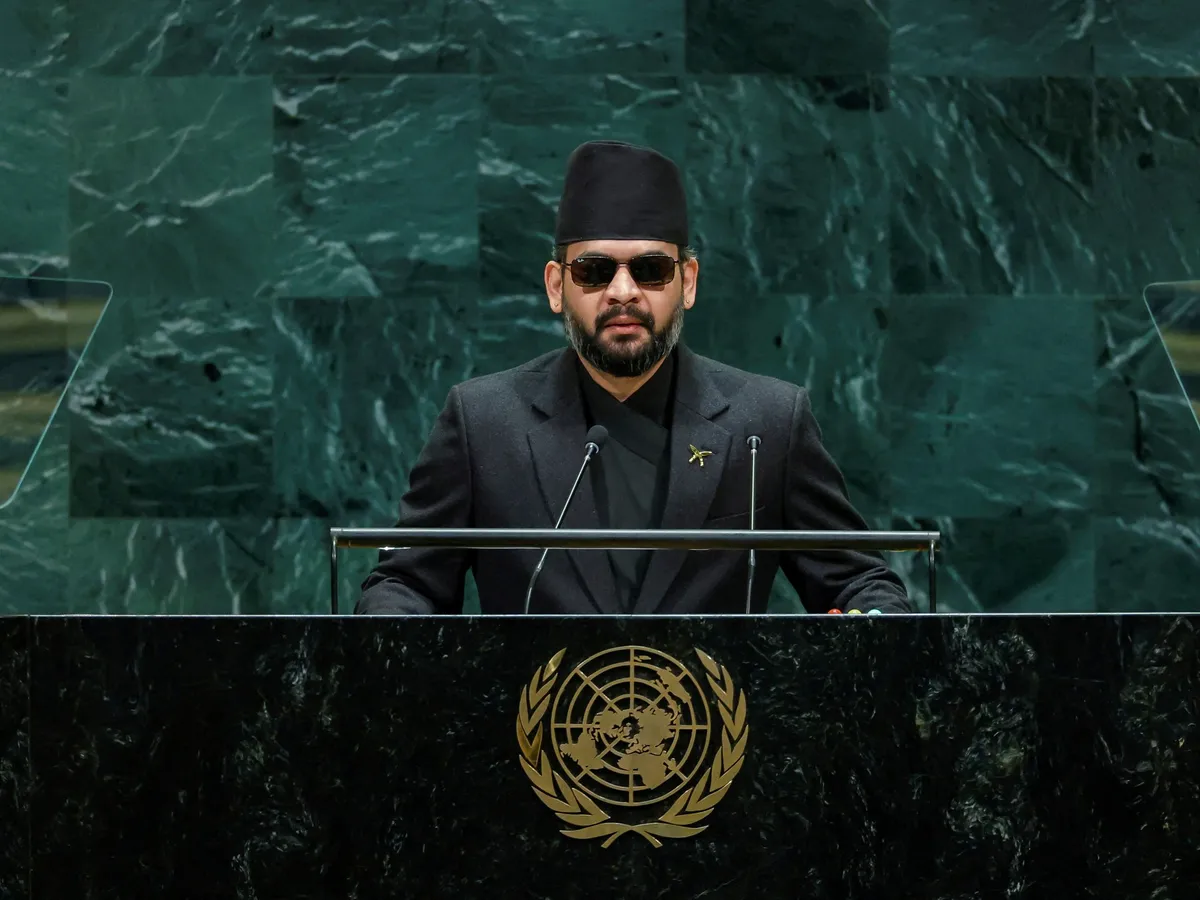
Prime Minister Balendra Shah told the UN that world leaders must act on Climate Change.Nepal’s Prime Minister Balendra Shah has appealed for action to combat the rising threat of Climate Change, calling the Flood that devastated his country last month “a warning to the world”.Shah made the comments during his address to the 81st Session of the United Nations General Assembly in New York on Thursday night. He told the gathering that the August disaster “was not just a local tragedy”, asking them the question, “Have you really heard that warning?”Recommended Stories list of 3 itemslist 1 of 3The Nepal floods question: When the Himalayas collapse, who gets warned?list 2 of 3Photos: Nepal Flood survivors find little trace of former liveslist 3 of 3‘Orphaned’ by floods, more than 500 Nepali children face uncertain futureend of listPolitical leaders “have been negligent to translate those warnings in action at the speed and scale that the vulnerable people require,” he said.An excavator clears mud from damaged houses following deadly flash floods and a mudslide, in Nuwakot district, Nepal, on September 21, 2026 [Navesh Chitrakar/Reuters]At least 1,453 people died when a torrent of mud, rock and water struck northern Nepal and the China-Tibet border on August 26, triggered by a Glacial collapse.According to Nepal’s National Disaster Risk Reduction and Management Authority, 5,500 people were still missing and 13,795 had been rescued.Researchers from the World Weather Attribution (WWA) group said in a report released last week that the disaster was not caused by a single extreme weather event, but rather a “compound crisis” shaped by long-term warming, glacier retreat, permafrost thaw and geological instability.Shah said Climate Change was hurting people not responsible for the crisis but who “are paying a colossal price for it”.He said Nepal contributed less than one-tenth of 1 percent of the heat-trapping gases behind Climate Change. About 99 percent of the country’s electricity comes from hydropower, and many workers were trapped in tunnels by the flooding.
SRCAl Jazeera
LANGEN
LEANCenter
WORDS325
ENT12
FRI · 2026-09-25 · 06:56 GMTBRIEF NSR-2026-0925-113977
NSR-2026-0925-113977News Report·EN·Environmental
Nepal’s leader labels devastating flood a ‘warning to the world’
Nepal's Prime Minister Balendra Shah addressed the UN General Assembly, describing the devastating August flood in his country as a "warning to the world" and urging global leaders to take more decisive action on climate change. The flood, triggered by a glacial collapse, resulted in at least 1,453 deaths and left thousands missing or rescued.
By AP and ReutersAl JazeeraFiled 2026-09-25 · 06:56 GMTLean · CenterRead · 2 min
Al JazeeraFIG 01
Reading time
2min
Word count
325words
Sources cited
2cited
Entities identified
12entities
Quality score
100%
§ 01
Briefing Summary
AI-generatedNEWSAR · AI
Nepal's Prime Minister Balendra Shah addressed the UN General Assembly, describing the devastating August flood in his country as a "warning to the world" and urging global leaders to take more decisive action on climate change. The flood, triggered by a glacial collapse, resulted in at least 1,453 deaths and left thousands missing or rescued. Shah highlighted that Nepal, which contributes minimally to climate-changing gases and relies heavily on hydropower, is disproportionately affected by the crisis. Researchers attribute the disaster to a "compound crisis" influenced by long-term warming and geological instability, emphasizing that vulnerable populations are bearing the brunt of climate change impacts.
Confidence 0.90Sources 2Claims 4Entities 12
§ 02
Article analysis
Model · rule-basedFraming
Environmental
Diplomatic
Tone
Measured
AI-assessed
CalmNeutralAlarmist
Factuality
0.70 / 1.00
Factual
LowHigh
Sources cited
2
Limited
FewMany
§ 03
Key claims
4 extracted01
Nepal contributes less than one-tenth of 1 percent of the heat-trapping gases behind climate change.
statisticBalendra Shah
Confidence
1.00
02
Researchers from the World Weather Attribution (WWA) group stated the disaster was a 'compound crisis' shaped by long-term warming and geological instability.
quoteWorld Weather Attribution (WWA)
Confidence
1.00
03
The flood in Nepal, triggered by a glacial collapse on August 26, resulted in at least 1,453 deaths.
statisticNepal’s National Disaster Risk Reduction and Management Authority
Confidence
1.00
04
Nepal's Prime Minister Balendra Shah called the recent devastating flood a 'warning to the world' regarding climate change.
quoteBalendra Shah
Confidence
1.00
§ 04
Full report
2 min read · 325 words§ 05
Entities
12 identifiedKey playerOppositionContextPositiveNeutralNegative
Organizations4
Locations4
Events1
§ 06
Keywords & salience
9 termsclimate change
1.00
devastating flood
0.90
warning to the world
0.80
united nations general assembly
0.70
compound crisis
0.60
glacial collapse
0.60
geological instability
0.50
long-term warming
0.50
vulnerable people
0.40
§ 07
Topic connections
Interactive graph Network visualization showing 12 related topics
View Full Graph Person Organization Location Event|Click node to navigate|Edge numbers = shared articles