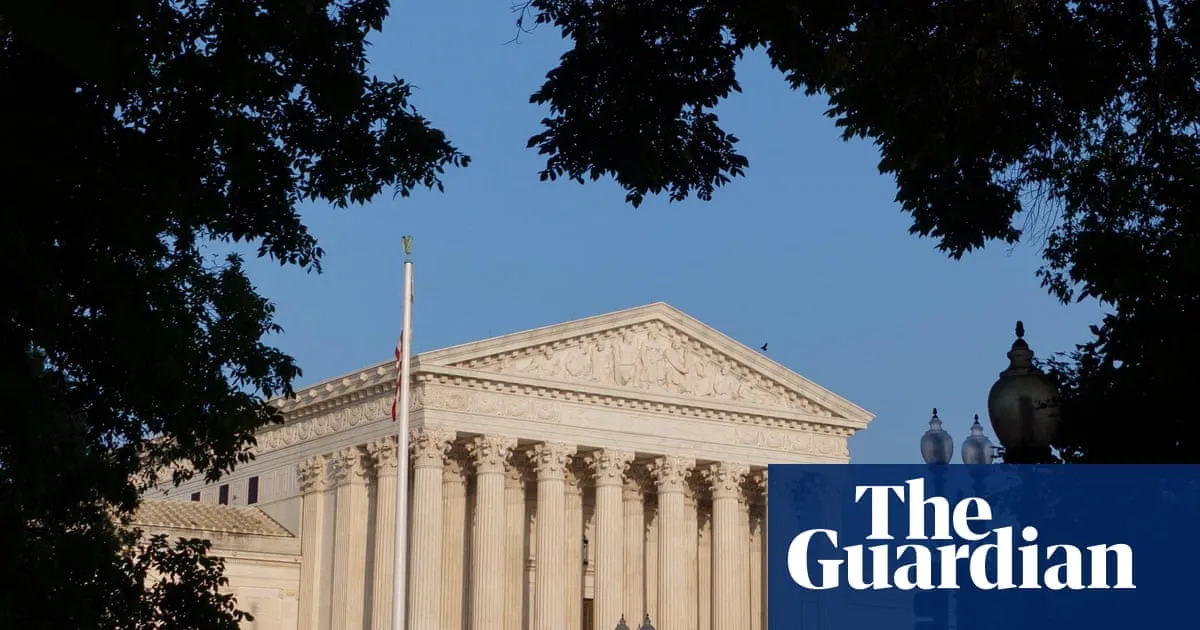
The US supreme court has lifted restrictions on a controversial federal database of voters as Donald Trump seeks to impose tougher restrictions on voting ahead of November’s midterm elections.The ruling issued Friday by the chief justice, John Roberts, in the name of the court temporarily sets aside an injunction issued by US district judge Sparkle L Sooknanan, who ruled on 22 June against the Trump administration’s plan to use the Systematic Alien Verification for Entitlements – Save – database to vet voter registration eligibility. A federal appeals court later declined to pause that ruling.The ruling sends the case back to the DC circuit court of appeals to be heard.“Today’s decision is profoundly disappointing, as it puts millions of Americans at risk of being unlawfully targeted by the administration’s unreliable voter purge database weeks before the midterm elections,” the League of Women Voters said in a prepared statement. “However, this case is not over. The D.C. district court ruled that the expanded SAVE program violated multiple laws. We will be doing everything in our power to protect Americans’ voting and privacy rights by ensuring that the district court decision stands.”The case stems from an executive order issued in March 2025 with the stated purpose of improving enforcement of laws barring noncitizens from voting in US elections. Among its provisions, the order directed the Department of Homeland Security (DHS) and other agencies to make federal databases of citizenship information available to state elections directors.Other provisions of that executive order, like its demand to states to turn over their voter rolls to the federal goverment, remain bottled up in court.The League of Women Voters, the Electronic Privacy Information Center and other groups sued to block the use of the Save database, arguing that it was riddled with inaccuracies, and that taking social security numbers from the Social Security Administration violation of the Privacy Act, Social Security Act, and the Administrative Procedure Act.State officials had used social security numbers and other information obtained by DHS to conduct sweeping checks of the citizenship status of registered voters against federal records.Federal law prevents state election administrators from systematically striking people from the voter rolls within 90 days of an election, with or without the use of the Save database.However, the Friday ruling notes that “all agree that the order prevents the Federal Government from using the modified SAVE program to conduct individualized inquiries, which are permitted under federal law during this period.”That distinction matters in light of a DHS whistleblower’s allegations that the department has as part of its “Unlawful Voter Initiative” directed federal agents to impersonate voters in violation of state laws, using social security numbers and other information to look up voter history on state websites.US senators Alex Padilla and Adam Schiff, both California Democrats, sent a letter Monday to the state’s attorney general, Rob Bonta, asking for an investigation.“As you know, the U.S. Department of Justice has been unsuccessful in its attempt to compel California to provide its voter information to the Trump Administration, raising serious questions about what this data is, how DHS obtained it, and whether they complied with the law in collecting and using this data,” the letter said. “The fact that the DHS data was compiled with something called ‘supplemental magic’ does not provide reassurance.”
SRCThe Guardian - World News
LANGEN
LEANCenter-Left
WORDS546
ENT12
FRI · 2026-09-25 · 15:52 GMTBRIEF NSR-2026-0925-114100
NSR-2026-0925-114100News Report·EN·Legal & Judicial
US supreme court lifts restrictions on controversial voter database
The US Supreme Court has temporarily lifted restrictions on a federal voter database, known as SAVE, allowing its use to vet voter registration eligibility. This decision by Chief Justice John Roberts sets aside a lower court injunction that had blocked the Trump administration's plan.
Guardian staff and agenciesThe Guardian - World NewsFiled 2026-09-25 · 15:52 GMTLean · Center-LeftRead · 3 min
The Guardian - World NewsFIG 01
Reading time
3min
Word count
546words
Sources cited
3cited
Entities identified
12entities
Quality score
100%
§ 01
Briefing Summary
AI-generatedNEWSAR · AI
The US Supreme Court has temporarily lifted restrictions on a federal voter database, known as SAVE, allowing its use to vet voter registration eligibility. This decision by Chief Justice John Roberts sets aside a lower court injunction that had blocked the Trump administration's plan. The administration claims the database combats noncitizen voting, but critics, including the League of Women Voters, argue it risks disenfranchising eligible voters due to alleged inaccuracies. The case stems from a 2025 executive order aiming to improve enforcement against noncitizen voting by providing federal citizenship data to states. The Supreme Court's ruling sends the case back to a federal appeals court for further review.
Confidence 0.90Sources 3Claims 5Entities 12
§ 02
Article analysis
Model · rule-basedFraming
Legal & Judicial
Political Strategy
Tone
Mixed Tone
AI-assessed
CalmNeutralAlarmist
Factuality
0.70 / 1.00
Factual
LowHigh
Sources cited
3
Well sourced
FewMany
§ 03
Key claims
5 extracted01
The League of Women Voters and other groups sued, arguing the SAVE database was riddled with inaccuracies and taking social security numbers violated multiple laws.
factual
Confidence
1.00
02
The case stems from an executive order issued in March 2025 with the stated purpose of improving enforcement of laws barring noncitizens from voting in US elections.
factual
Confidence
1.00
03
The League of Women Voters stated the decision puts millions of Americans at risk of being unlawfully targeted by the administration’s unreliable voter purge database.
quoteLeague of Women Voters
Confidence
1.00
04
The ruling temporarily sets aside an injunction issued by US district judge Sparkle L Sooknanan against the Trump administration’s plan to use the SAVE database to vet voter registration eligibility.
factual
Confidence
1.00
05
The US Supreme Court lifted restrictions on a controversial federal database of voters.
factual
Confidence
1.00
§ 04
Full report
3 min read · 546 words§ 05
Entities
12 identifiedKey playerOppositionContextPositiveNeutralNegative
Organizations4
Locations1
§ 06
Keywords & salience
9 termsvoter database
1.00
voting restrictions
0.90
supreme court
0.80
midterm elections
0.70
save database
0.60
voter registration
0.60
privacy rights
0.50
citizenship status
0.40
league of women voters
0.40
§ 07
Topic connections
Interactive graph Network visualization showing 49 related topics
View Full Graph Person Organization Location Event|Click node to navigate|Edge numbers = shared articles