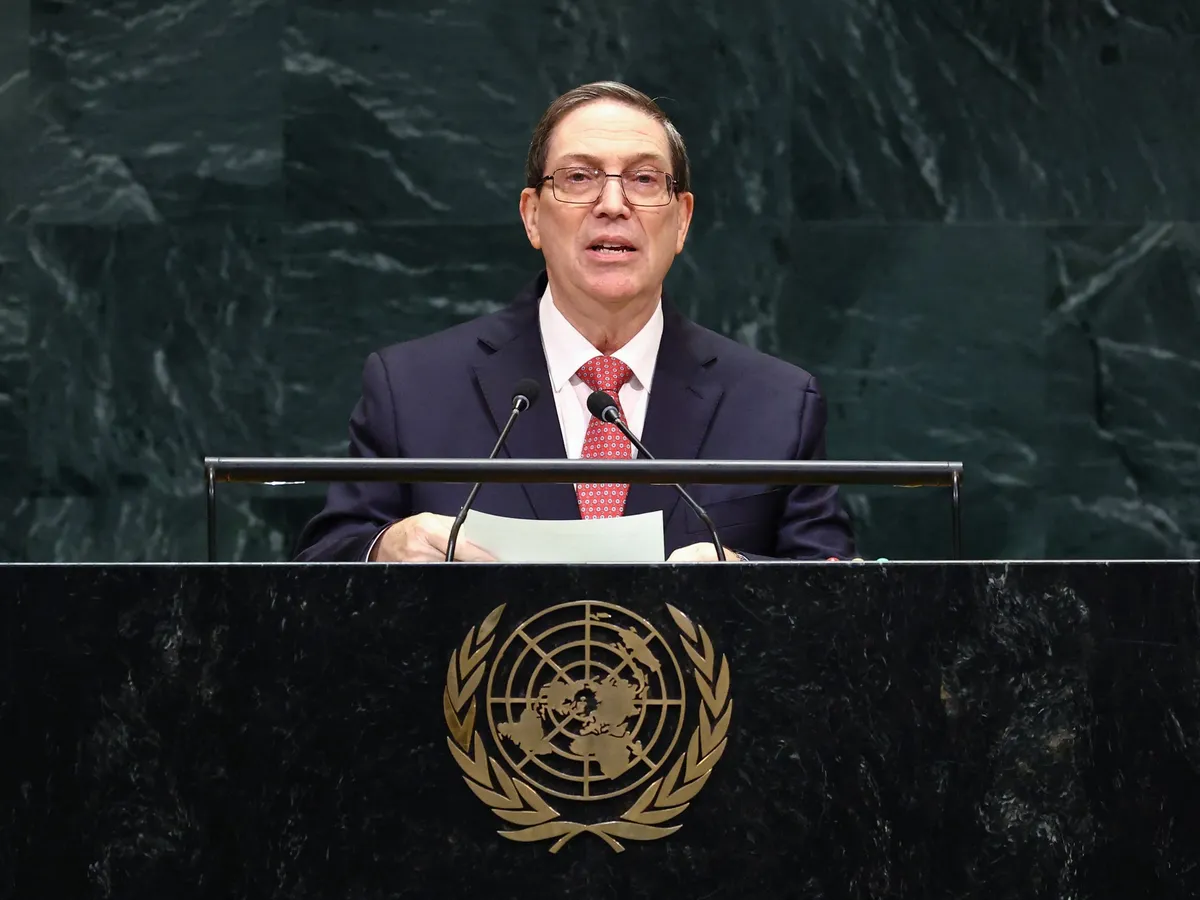
The foreign minister’s comments come days after the US told the UN that ‘freedom will be coming’ to Cuba.Cuban Foreign Minister Bruno Rodriguez has condemned the United States’s oil blockade against his country during his speech at the United Nations General Assembly (UNGA), calling it an “act of collective punishment” intended to trigger a humanitarian crisis.His comments on Saturday come as tensions between Washington and Havana remain high and as US President Donald Trump predicted that the two countries would reach an agreement, while saying he did not believe military action would be necessary.Recommended Stories list of 3 itemslist 1 of 3US open to Cuba talks on government change, Marco Rubio sayslist 2 of 3Cuba works to restore power after another major nationwide blackoutlist 3 of 3Rubio heads to Ecuador, Colombia, Peru after right-wing victories in regionend of list“I would say that Cuba and us will make a deal,” Trump told reporters at the White House on Saturday. “I don’t think we’ll need the military. Cuba is failing very badly. We want to help Cuba.”In his UNGA speech, Rodriguez said Havana remained open to negotiations.“We have always been and will always be prepared for dialogue with the government of the United States in order to try to find solutions to the various bilateral differences that we have,” he said, adding that talks would have to be based on “sovereign equality” and take place “without preconditions”.Rodriguez also addressed the possibility of US military action, saying it would cause huge destruction.“Let’s hope that this never happens,” he said.Earlier this week, Trump called Cuba an “absolutely failed state” during his own UN address and said “freedom will be coming” to the island. Cuba’s delegation walked out during the speech.The US has maintained an economic embargo on Cuba for more than 60 years. The Trump administration has previously said that it wants a change in Cuba’s government. Since earlier this year, the US has additionally imposed an oil blockade that has put the country under severe pressure, dealing with fuel shortages and ongoing blackouts. Cuban officials have also blamed it on problems providing food and other basic needs for its population.
SRCAl Jazeera
LANGEN
LEANCenter
WORDS357
ENT10
SAT · 2026-09-26 · 17:22 GMTBRIEF NSR-2026-0926-114315
NSR-2026-0926-114315News Report·EN·Diplomatic
Cuba condemns US ‘collective punishment’ as Trump predicts deal
Cuban Foreign Minister Bruno Rodriguez condemned the U.S. oil blockade at the United Nations General Assembly, calling it "collective punishment" aimed at creating a humanitarian crisis.
Al Jazeera StaffAl JazeeraFiled 2026-09-26 · 17:22 GMTLean · CenterRead · 2 min
Al JazeeraFIG 01
Reading time
2min
Word count
357words
Sources cited
2cited
Entities identified
10entities
Quality score
100%
§ 01
Briefing Summary
AI-generatedNEWSAR · AI
Cuban Foreign Minister Bruno Rodriguez condemned the U.S. oil blockade at the United Nations General Assembly, calling it "collective punishment" aimed at creating a humanitarian crisis. This comes after the U.S. told the UN that "freedom will be coming" to Cuba and President Donald Trump predicted a deal between the two nations, stating military action would not be necessary. Rodriguez affirmed Cuba's openness to dialogue with the U.S. on bilateral differences, provided it's based on sovereign equality and without preconditions. The U.S. has maintained a long-standing economic embargo and recently imposed an oil blockade, which Cuban officials attribute to fuel shortages and difficulties in providing basic necessities.
Confidence 0.90Sources 2Claims 5Entities 10
§ 02
Article analysis
Model · rule-basedFraming
Diplomatic
Economic Impact
Tone
Measured
AI-assessed
CalmNeutralAlarmist
Factuality
0.60 / 1.00
Mixed
LowHigh
Sources cited
2
Limited
FewMany
§ 03
Key claims
5 extracted01
Donald Trump stated that "freedom will be coming" to Cuba.
quoteDonald Trump
Confidence
1.00
02
The US has maintained an economic embargo on Cuba for over 60 years and recently imposed an oil blockade causing fuel shortages and blackouts.
factual
Confidence
1.00
03
Cuba remains open to negotiations with the US based on "sovereign equality" and "without preconditions".
quoteBruno Rodriguez
Confidence
1.00
04
US President Donald Trump predicted that the two countries would reach an agreement, stating military action would not be necessary.
quoteDonald Trump
Confidence
1.00
05
Cuban Foreign Minister Bruno Rodriguez condemned the United States’s oil blockade against his country, calling it an “act of collective punishment” intended to trigger a humanitarian crisis.
quoteBruno Rodriguez
Confidence
1.00
§ 04
Full report
2 min read · 357 words§ 05
Entities
10 identifiedKey playerOppositionContextPositiveNeutralNegative
People3
Organizations2
Locations3
§ 06
Keywords & salience
10 termsus oil blockade
1.00
collective punishment
0.90
humanitarian crisis
0.80
united nations general assembly
0.70
us-cuba relations
0.70
economic embargo
0.60
fuel shortages
0.50
sovereign equality
0.50
donald trump
0.40
bruno rodriguez
0.40
§ 07
Topic connections
Interactive graph Network visualization showing 51 related topics
View Full Graph Person Organization Location Event|Click node to navigate|Edge numbers = shared articles