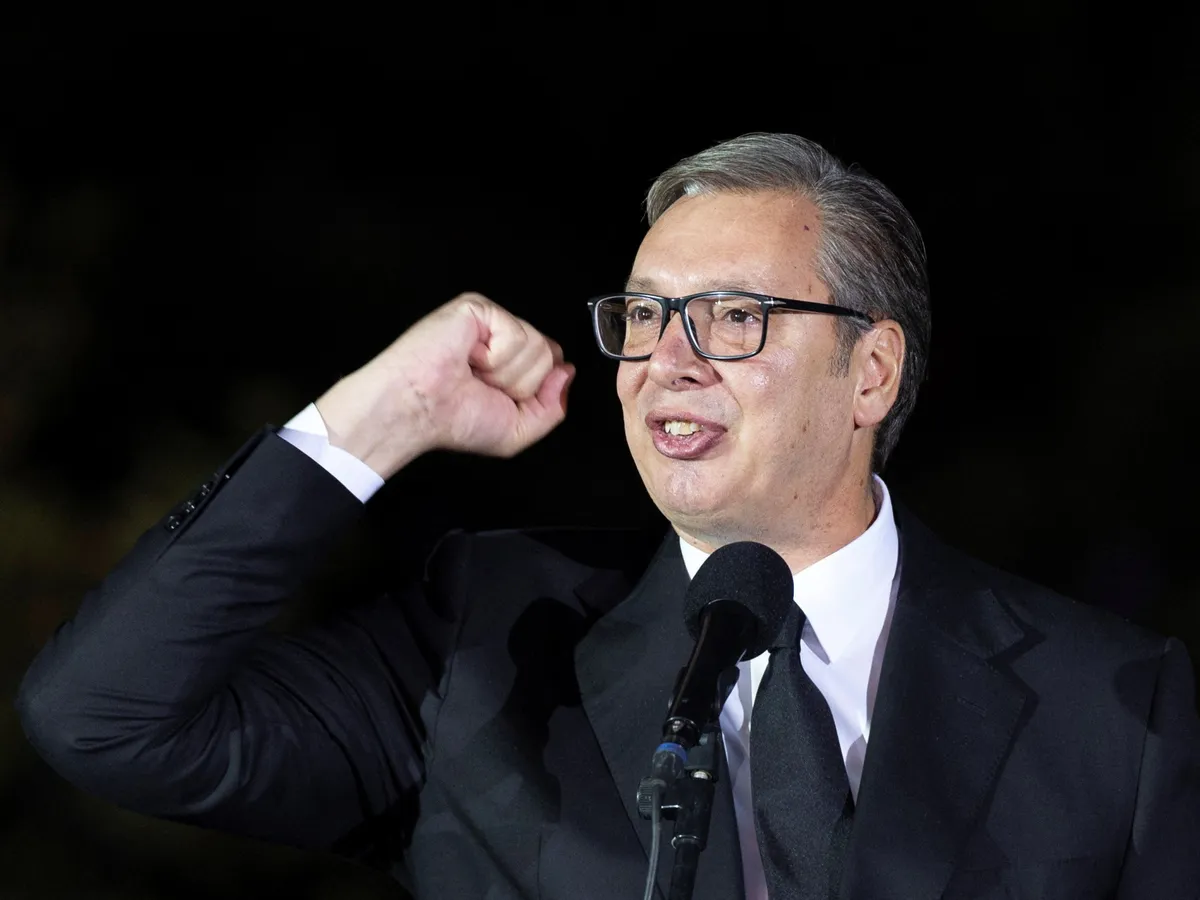
Despite student-led protests and political unrest challenging his rule, Vucic intends to run in the snap elections.Serbian President Aleksandar Vucic moments before formally submitting his resignation on Sunday to end his second and final five-year term [Reuters/Djordje Kojadinovic]Published On 27 Sep 2026Serbian President Aleksandar Vucic has resigned to seek the prime minister’s post in a snap parliamentary election on October 25, as a student-led movement mounts the most serious challenge to his rule in more than a decade.Vucic, on the Serbian Progressive Party (SNS) ballot, has dominated Serbian politics as president or prime minister since 2014. Barred from seeking a third presidential term, he is now seeking to extend his hold on power through the parliamentary vote.Recommended Stories list of 3 itemslist 1 of 3A year after student protests shook Valjevo: Serbia at a crossroadslist 2 of 3Bosnian Serbs strengthen ties with Israel amid tensionslist 3 of 3Serbia opens factory to assemble Israeli-made dronesend of listParliament Speaker Ana Brnabic, a close ally, will serve as acting president pending a presidential election. Vucic said one of his final acts in office was to pardon 49 people, including 23 convicted in connection with the protests.Protests triggered by railway station disasterThe election follows nearly two years of demonstrations prompted by the killing of 16 people when a concrete canopy collapsed at a railway station in the northern city of Novi Sad on November 1, 2024.Students have since organised some of Serbia’s largest demonstrations in decades, drawing hundreds of thousands of people onto the streets.Protesters have accused the government of corruption, a lack of transparency and political interference in state institutions.Vucic and his allies reject the allegations that they are responsible for the problems highlighted by the protesters.The student movement is contesting the parliamentary election under the banner “Students Win”, with the backing of several opposition parties, including the Democratic Party, which was once led by former Serbian President Boris Tadic.Its list of 250 candidates includes mostly university professors and professionals from a range of fields. Its platform calls for investigations into allegedly ill-gotten property, measures against corruption and political interference in public institutions and greater transparency in the use of public funds.Some polls suggest that the student-backed movement could pose a serious threat to Vucic’s Serbian Progressive Party, although the authenticity and methodology of some of the polls are difficult to independently verify.Belgrade-based editor and columnist Dejan Ilic told Al Jazeera that Vucic should not be credited with choosing to hold an early election.“Vucic is not the only actor in this country. People have said that Serbia is in a bad state, they demanded elections and they forced elections,” Ilic said.‘The crisis could begin after the election’Aida Corovic, a former Serbian parliamentarian and human rights activist, said the anger extended beyond the student movement.“Serbia has been undergoing internal change in recent months,” Corovic told Al Jazeera.“I fear that the crisis in Serbia could only begin after the October 25 elections,” she said. “This government has taken over the institutions, it is deeply intertwined with organised crime and it will try every possible way to remain in power.”A few hours before his resignation, Vucic told CNN that if the opposition won, he would acknowledge the results and congratulate his opponents that same evening.A vote watched across the regionThe political crisis in Serbia is being closely watched across the Western Balkans.Belgrade maintains close political, economic and cultural ties with Serbian communities in Bosnia and Herzegovina, Montenegro and Kosovo, giving developments in Belgrade significant influence beyond its borders.Tanja Topic, head of the Friedrich Ebert Foundation office in neighbouring Banja Luka, Bosnia and Herzegovina, said a change in Serbia’s political direction could ease tensions across the region.“It is crucial that the paradigm in Serbia’s politics changes because it would bring relief to the entire region,” Topic told Al Jazeera.She said Belgrade has for years sent mixed messages to its neighbours, presenting itself as a supporter of peace, stability and prosperity while, in her view, contributing to political tensions in the region.That influence has been particularly significant in Bosnia and Herzegovina, Topic said, while relations between Serbia and Croatia have also deteriorated in recent years.“We should not expect miracles overnight,” Topic remarked.“Changing the value system would be a long and difficult process, but I think that disappointment if change does not come could have more serious and damaging consequences, both in Serbia and across the region.”Economy under pressureWith a population of about six million, Serbia is the largest country in the Western Balkans with one of the region’s largest economies.Vucic has promoted the country as an emerging economic success story, pointing to Chinese investment, energy supplies from Russia and, more recently, growing cooperation with Israel.But average wages remain below those in neighbouring European Union member states.According to official statistics, the average net monthly salary in Serbia was 1,032 euros ($1,174) in April, compared with 1,555 euros ($1,770) in neighbouring Croatia – a difference of about 51 percent compared with the EU member.The contrast in living standards is one of several issues shaping public debate as voters prepare to return to the polls.A legacy of warSerbia’s current political crisis is unfolding against the backdrop of the country’s unresolved wartime legacy.More than two decades ago, NATO launched a bombing campaign against the then Federal Republic of Yugoslavia during the Kosovo war. At the time, Serbia was ruled by Slobodan Milosevic.The legacy of the Balkans wars of the 1990s remains politically sensitive.In early September, Ratko Mladic, the former commander of the Bosnian Serb army who was convicted by an international tribunal of genocide and war crimes committed during the war in Bosnia and Herzegovina, was buried in Belgrade.His funeral, which was attended by several Serbian government ministers and included military honours, prompted international criticism.The EU’s foreign policy chief Kaja Kallas and European Commission President Ursula von der Leyen said the bloc had no place for those who glorify war crimes.The October election will therefore be watched not only as a contest over Serbia’s domestic political future, but also for what it may signal about the country’s direction and its relationship with the rest of the Western Balkans.
SRCAl Jazeera
LANGEN
LEANCenter
WORDS1 016
ENT12
SUN · 2026-09-27 · 20:29 GMTBRIEF NSR-2026-0927-114545
NSR-2026-0927-114545News Report·EN·Political Strategy
Serbian President Aleksandar Vucic resigns amid prolonged protests
Serbian President Aleksandar Vucic has resigned to run for prime minister in snap parliamentary elections scheduled for October 25. This move comes amid prolonged student-led protests challenging his decade-long rule, fueled by anger over a railway station disaster and accusations of corruption and lack of transparency.
By Armin AljovicAl JazeeraFiled 2026-09-27 · 20:29 GMTLean · CenterRead · 5 min
Al JazeeraFIG 01
Reading time
5min
Word count
1 016words
Sources cited
2cited
Entities identified
12entities
Quality score
100%
§ 01
Briefing Summary
AI-generatedNEWSAR · AI
Serbian President Aleksandar Vucic has resigned to run for prime minister in snap parliamentary elections scheduled for October 25. This move comes amid prolonged student-led protests challenging his decade-long rule, fueled by anger over a railway station disaster and accusations of corruption and lack of transparency. Parliament Speaker Ana Brnabic will serve as acting president. The student movement, contesting the election under the banner "Students Win" with opposition backing, advocates for investigations into alleged corruption and greater transparency. The outcome of these elections is being closely watched across the Western Balkans due to Serbia's regional influence.
Confidence 0.90Sources 2Claims 5Entities 12
§ 02
Article analysis
Model · rule-basedFraming
Political Strategy
Social Justice
Tone
Measured
AI-assessed
CalmNeutralAlarmist
Factuality
0.70 / 1.00
Factual
LowHigh
Sources cited
2
Limited
FewMany
§ 03
Key claims
5 extracted01
Protesters have accused the government of corruption, a lack of transparency and political interference in state institutions.
factualProtesters
Confidence
1.00
02
Protests were prompted by the killing of 16 people when a concrete canopy collapsed at a railway station in Novi Sad on November 1, 2024.
factual
Confidence
1.00
03
Vucic has dominated Serbian politics as president or prime minister since 2014.
factual
Confidence
1.00
04
Serbian President Aleksandar Vucic resigned to seek the prime minister’s post in a snap parliamentary election.
factual
Confidence
1.00
05
Some polls suggest that the student-backed movement could pose a serious threat to Vucic’s Serbian Progressive Party, although the authenticity and methodology of some of the polls are difficult to independently verify.
factual
Confidence
0.80
§ 04
Full report
5 min read · 1 016 words§ 05
Entities
12 identifiedKey playerOppositionContextPositiveNeutralNegative
People3
Organizations2
Events3
Topics1
§ 06
Keywords & salience
10 termsserbian politics
1.00
snap elections
0.90
student protests
0.90
corruption allegations
0.80
political unrest
0.70
aleksandar vucic
0.70
parliamentary election
0.60
government transparency
0.50
opposition parties
0.40
railway station disaster
0.40
§ 07
Topic connections
Interactive graph Network visualization showing 51 related topics
View Full Graph Person Organization Location Event|Click node to navigate|Edge numbers = shared articles