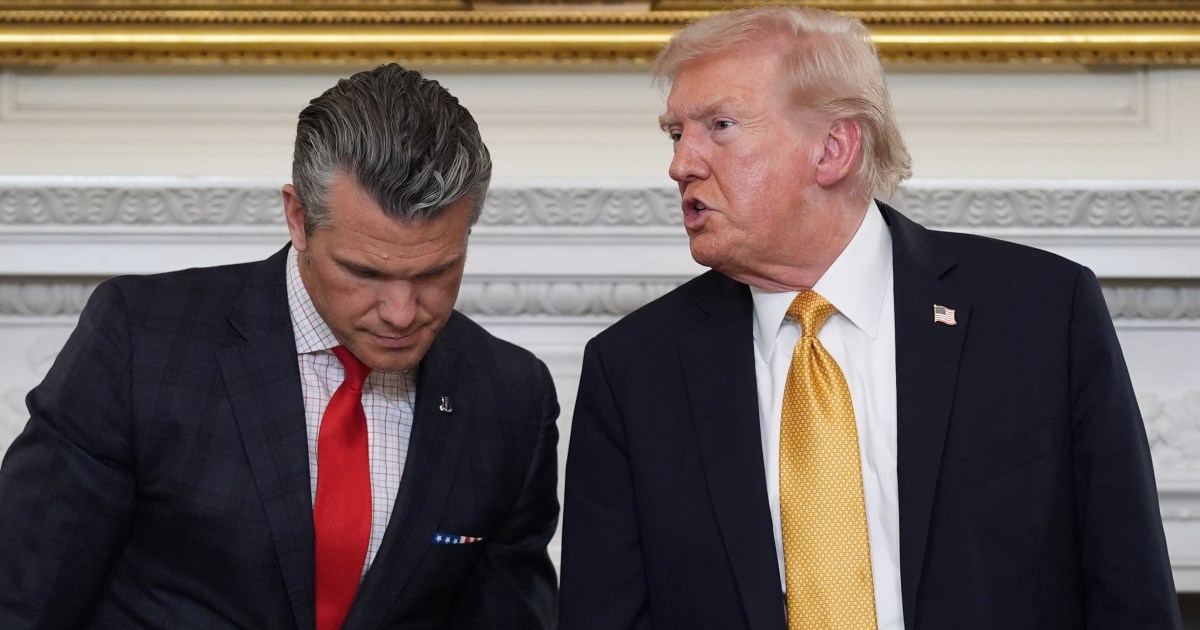
At least 86 people have been killed in strikes on alleged drug trafficking boats that experts call illegal killings.President Donald Trump talks with Defense Secretary Pete Hegseth after a roundtable on criminal cartels in the White House on October 23 [Evan Vucci/AP Photo]Published On 5 Dec 2025Since early September, the United States has carried out at least 22 declared military strikes targeting alleged drug-trafficking vessels off the coast of Latin America.Legal experts and international officials say that the attacks, which have killed at least 86 people, are a violation of the law and represent acts of extrajudicial killing.Recommended Stories list of 3 itemslist 1 of 3US military kills four in latest strike on boat in the Caribbeanlist 2 of 3Family of man slain in a US boat strike in the Caribbean lodges complaintlist 3 of 3In boat strike, Trump repurposes ‘war on terror’ for Latin American crimeend of listBut despite what scholars describe as clear-cut illegality, Trump’s lethal campaign has shown few signs of slowing down, and critics see an alarming shift towards the use of military force against criminal activities.“I was utterly shocked that the United States would do this,” Ben Saul, the United Nations special rapporteur on counterterrorism and human rights, told Al Jazeera in a telephone interview.“It shows that the Trump administration has no respect for international law or conventions around the use of force.”The situation points to a trend of impunity for powerful countries. Though there may be a broad consensus that Trump is breaking international law, it is unclear what legal or political mechanisms could halt his bombing campaign.“Certainly, trying to rein in a superpower like the United States is something very difficult,” Saul said. “This has to stop from within the US itself.”‘Guardrails have been eroded’Experts say that oversight could potentially come from a number of sources.On the domestic front, the US Congress has the ability to pass legislation barring military strikes or cut off funds for the campaign.Military members involved in the attacks could also refuse to carry out what they see as unlawful orders.Foreign leaders could limit or pause intelligence cooperation with the US.Thus far, however, few meaningful restraints have been placed on the Trump administration.Twice, the US Senate has voted to defeat legislation that would have required the White House to obtain congressional support for its bombing campaign.In October, the first bill failed by a vote of 51 to 48. In November, the second was voted down by a margin of 51 to 49.On the international side, there have also been reports that the United Kingdom and Colombia considered whether to stop sharing intelligence from the Caribbean with the US.But officials from both countries have downplayed those reports, with Colombian Interior Minister Armando Benedetti calling the situation a “misunderstanding”.Other mechanisms meant to assess the legality of the Trump administration’s military actions have faced political pressure.News outlets such as CNN and NBC News reported that US military lawyers — known as judge advocates general or JAG officers — who questioned the legality of the bombing campaign were sidelined or fired.Secretary of Defense Pete Hegseth has previously said that he does not want military lawyers acting as “roadblocks” to Trump’s policies.“Military lawyers are only roadblocks if you want to break the law,” said Sarah Harrison, an analyst at the International Crisis Group.Harrison previously served as an associate general counsel at the Department of Defense, where she advised the military on questions of international law. She said the Trump administration has deliberately weakened institutional norms and legal safeguards meant to prevent the abuse of military power.“They have established a blueprint to direct the military to commit an unlawful order without resistance,” she said.“The guardrails inside have been eroded.”‘Unlimited authority’Numerous laws, however, exist to prohibit extrajudicial killings like those Trump is currently carrying out in the Caribbean Sea and eastern Pacific.Article Two of the UN Charter, for instance, largely prohibits countries from using force internationally, barring an act of self-defence.The Geneva Conventions, a cornerstone of humanitarian law, also bar military violence against “persons taking no active part” in hostilities.The Trump administration’s use of “double-tap” strikes — where a second attack is conducted to kill survivors from the first — has raised additional legal concerns.The Hague Convention explicitly outlaws “no quarter given” policies, wherein soldiers are ordered to execute those who could otherwise be taken prisoner.The Trump administration nevertheless denied that any of its strikes violate international or domestic law.Instead, it argues that the vessels it bombed contained deadly narcotics, and that drug-traffickers are ‘unlawful combatants’ whose transportation of narcotics represents an attack on the US.“Our current operations in the Caribbean are lawful under both US and international law, with all actions in complete compliance with the law of armed conflict,” Pentagon spokesperson Sean Parnell said.“Lawyers up and down the chain of command have been thoroughly involved in reviewing these operations prior to execution.”But legal scholars say that the administration’s claims do not hold water.Rebecca Ingber, a professor at Cardozo School of Law at Yeshiva University who previously served as an adviser to the US Department of State, said that the Trump administration has tried to erase the distinction between criminal activity and an armed attack that would justify a military response.She compared the administration’s reasoning to the kind of garbled legal analysis an AI assistant like Grok might produce.“It feels to me that some political actors inside the executive branch have taken all of the statements and memos about the use of force over the last 25 years, jumbled up the words, thrown them into Grok, and asked it to come up with a legal argument,” said Ingber.“They think they can throw around words like ‘armed conflict’ and ‘terrorist’, and that if they label someone as such, it can give them unlimited authority,” she added.A pliant CongressTrump is not the first president to spur concerns about his broad use of military force.After the attacks on September 11, 2001, presidents including George W Bush and Barack Obama carried out military strikes in countries like Iraq, Afghanistan, Somalia and Yemen, as part of a global “war on terror”.Both men drew on congressional authorisations for military force (AUMFs) that had been narrowly drafted to respond to the September 11 attacks.Those authorisations were applied over time to an expanding list of organisations and conflicts.Critics, however, have argued that this growing use of military force extends presidential authority beyond its constitutional limits and has weakened oversight and transparency.Trump has continued the trend of presidents deploying the military without Congress’s approval first.Normally, the power to declare war and authorise military action falls to Congress, not the president, and Congress retains the authority to rein in presidential military deployments.Many conservative lawmakers, however, have been hesitant to challenge Trump, who maintains a firm hold over the Republican Party. Others accept the administration’s depiction of the air strikes as an anti-narcotics campaign.Only two Republican senators, Rand Paul of Kentucky and Lisa Murkowski of Alaska, voted with Democrats in their recent attempts to stop the boat bombings.“From the bombing of Iran to possible attacks on Venezuela, there are some entrepreneurial figures on the right willing to criticise the administration when it carries out interventionist policies,” said Curt Mills, the director of the American Conservative magazine, which advocates for a more restrained foreign policy.
SRCAl Jazeera
LANGEN
LEANCenter
WORDS1 208
ENT4
FRI · 2025-12-05 · 21:44 GMTBRIEF NSR-2025-1205-1148
NSR-2025-1205-1148News Report·EN·Legal & Judicial
Experts say US boat strikes are illegal killings. Can they be stopped?
Since early September 2025, the US military, under President Trump, has conducted at least 22 strikes on alleged drug-trafficking boats off the Latin American coast, resulting in at least 86 deaths. Legal experts and international officials, including a UN special rapporteur, are calling these strikes illegal extrajudicial killings, violating international law.
Brian OsgoodAl JazeeraFiled 2025-12-05 · 21:44 GMTLean · CenterRead · 5 min
Al JazeeraFIG 01
Reading time
5min
Word count
1 208words
Sources cited
2cited
Entities identified
4entities
Quality score
100%
§ 01
Briefing Summary
AI-generatedNEWSAR · AI
Since early September 2025, the US military, under President Trump, has conducted at least 22 strikes on alleged drug-trafficking boats off the Latin American coast, resulting in at least 86 deaths. Legal experts and international officials, including a UN special rapporteur, are calling these strikes illegal extrajudicial killings, violating international law. Despite the criticism, the strikes continue, highlighting a potential trend of impunity for powerful nations. While Congress could pass legislation, military members could refuse orders, or foreign leaders could limit cooperation, meaningful restraints on the Trump administration have been limited. The US Senate has twice defeated legislation that would have required congressional support for the bombing campaign.
Confidence 0.90Sources 2Claims 5Entities 4
§ 02
Article analysis
Model · rule-basedFraming
Legal & Judicial
Human Rights
Tone
Mixed Tone
AI-assessed
CalmNeutralAlarmist
Factuality
0.70 / 1.00
Factual
LowHigh
Sources cited
2
Limited
FewMany
§ 03
Key claims
5 extracted01
US Senate has twice voted to defeat legislation that would have required the White House to obtain congressional support for its bombing campaign.
factualArticle
Confidence
1.00
02
The United States has carried out at least 22 declared military strikes targeting alleged drug-trafficking vessels off the coast of Latin America since early September.
factualArticle
Confidence
1.00
03
At least 86 people have been killed in strikes on alleged drug trafficking boats.
factualArticle
Confidence
1.00
04
Legal experts and international officials say that the attacks are a violation of the law and represent acts of extrajudicial killing.
quoteArticle
Confidence
0.90
05
The Trump administration has no respect for international law or conventions around the use of force.
quoteBen Saul, the United Nations special rapporteur on counterterrorism and human rights
Confidence
0.80
§ 04
Full report
5 min read · 1 208 words§ 05
Entities
4 identified§ 06
Keywords & salience
9 termsillegal killings
0.90
us boat strikes
0.80
drug trafficking
0.70
international law
0.70
military strikes
0.60
extrajudicial killing
0.60
use of force
0.50
trump administration
0.50
united states
0.40
§ 07
Topic connections
Interactive graph Network visualization showing 51 related topics
View Full Graph Person Organization Location Event|Click node to navigate|Edge numbers = shared articles