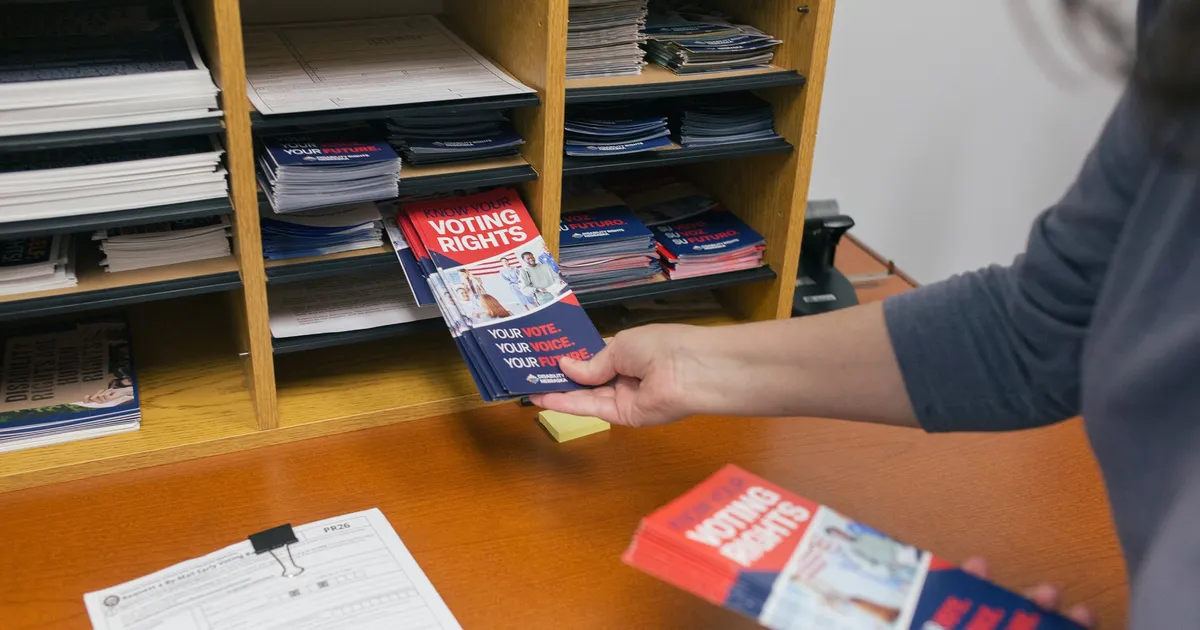
Without Amy Miller, some elderly and disabled people wouldn’t be able to vote. The attorney for Disability Rights Nebraska travels the state, investigating the quality of nursing homes and assisted living facilities. As she reminds the residents how they can report abuse or neglect, she also offers voter registration forms. Last month, she helped a veteran with a traumatic brain injury fill out change-of-address paperwork so he could vote in the upcoming midterm elections. “He 100% knew who he wanted to vote for,” Miller said, but he struggled to write with a pen. Congress funds her organization’s efforts to ensure that even people who might not have access to the internet or transportation have the opportunity to participate in elections. Now a White House proposal threatens that work. The White House Office of Management and Budget wants to change spending rules to prohibit anyone from using federal grant money for voter registration drives or what it vaguely calls “related activities.” The office is headed by Russell Vought, who has long criticized the use of taxpayer money for voter registration efforts and who more recently used his position to cancel, freeze or redirect vast amounts of federal funding in defiance of Congress’ orders. Miller, who has worked at her nonprofit for six years, said she’s never faced regulators wanting to impede her work. “Shutting that down and making it more difficult for these Americans to access the ballot box is bewildering to me,” she said. The proposal is part of the Trump administration’s broader assault on federal efforts to expand access to voting, especially among groups that have historically faced discrimination and disenfranchisement. Miller speaks with a co-worker at Disability Rights Nebraska. Allison Hess for ProPublica President Donald Trump has championed the SAVE America Act, a bill that would require people to provide documents proving their citizenship when registering to vote, and that may require everyone to deliver that proof in person, which would effectively end voter registration drives. Last year, the Trump administration banned nongovernmental organizations from conducting registration drives at naturalization ceremonies, though the agency temporarily lifted the ban amid litigation over the policy change. The Department of Education also sent a letter to colleges and universities stating that they could not use federal work-study dollars to support voting-related work. (The directive has been contested.) Previously, those funds were used to pay students who had part-time jobs to conduct voter registration on campus and in neighboring communities. Thousands more nonprofits receive federal funds for other services but provide voter outreach using private donations. Nonprofit experts said the confusion over which groups the ban affects and the burden of proving an organization is in compliance could lead many to pause or curb registration efforts ahead of the 2028 election. Colleges and universities that help students navigate registering to vote while away from home could be similarly affected. But it is nonprofits like Disability Rights Nebraska and the people they serve that will be among the most directly hit. “I don’t really think this rule had in mind that we are going to disenfranchise voters with disabilities. But it’s going to have that kind of effect,” said Rabia Belt, a Stanford law professor who’s an expert on disability and citizenship. In 2002, Congress helped tackle the challenges people with disabilities face in voting when it passed the Help America Vote Act. The legislation was designed to upgrade states’ voting systems and improve security in the wake of the controversial 2000 election, when close results in Florida triggered a recount, followed by lawsuits that ultimately ended with a U.S. Supreme Court decision that led to George W. Bush being declared the winner. The Help America Vote Act, signed by Bush, created grants to assist people with disabilities in registering to vote, casting their ballots and accessing polling places. That funding continues to this day. In recent years, Congress has budgeted $10 million a year, which is spread among 57 nonprofit groups that together cover every state as well as Washington, D.C., Puerto Rico, Native American communities and U.S. territories. That funding has narrowed the gap in casting ballots between those with disabilities and those without, according to an April 2024 report from Rutgers University’s Program for Disability Research that was written for the Election Assistance Commission, a bipartisan panel that helps implement the reforms put in place by the Help America Vote Act. Disability Rights Nebraska often registers voters at public events, such as at this National Night Out event in Scottsbluff, Nebraska. Courtesy of Amy Miller But challenges persist when it comes to voter registration. During the 2024 election, 3.6% of registered voters with disabilities reported difficulties with registering, compared to 1.4% of registered voters without disabilities, according to survey data from Rutgers. That gap may sound small, but it is statistically significant and represents the experiences of about 740,000 registered voters with disabilities, said Douglas Kruse, one of the Rutgers professors who compiled the survey. The draft version of the OMB proposal was published in May. It is part of an extensive attempt to remake the rules governing federal grants. Once OMB’s final rule is released, it will almost certainly be subject to litigation. Legal experts said some lawsuits will likely focus on how the rule contradicts existing laws and policies, like the grants that were enshrined in the 2002 law and repeatedly approved by Congress. Samuel Bagenstos, who served as general counsel of the OMB for part of Biden’s administration, said the proposal disregards how the Constitution gives Congress the “power of the purse.” The legislative branch sets the budget and gives dozens of federal agencies instructions on distributing those funds; the agencies create detailed policies to select grant applicants and get the money out the door. Vought understands that federal funding provides a tool to consolidate power into the White House, said Bagenstos, who is now a law professor at the University of Michigan, specializing in disability and appropriations law. “This is not even a surgical power grab,” he said. “It’s just a massive across-the-board power grab.” Disability Rights Nebraska was awarded $141,000 in voter accessibility funds this year. When the organization heard about the proposed rule, it submitted a public comment in opposition. Such a change “would affect the ability of nonprofits such as ours to conduct” voter registration drives, which are “an invaluable service to Nebraskans with disabilities who are otherwise locked out of the voting experience,” the group wrote. The organization’s work is strictly nonpartisan as mandated by law, the letter said. During a visit in June to a rural assisted living facility, the group wrote, 30% of the new voters its staff helped register identified as Republican, 20% as Democrat and 50% as nonpartisan or affiliated with a third party. To ensure their drives are nonpartisan, Miller said she and her colleagues conduct the work in pairs, with each person representing a different party, as required by law. Many of the residents she speaks with are essentially cloistered, Miller said. She recalled one visit to a rural assisted living facility in early 2024. The community is so small it doesn’t have a library or a gas station. The nearest election commissioner’s office is a 30-minute drive away. Disability Rights Nebraska had put up a poster inside the building, listing key facts about voting access for people with disabilities. At one point, Miller said, a young man in a baggy T-shirt pointed at the poster. “Is this true?” He asked her. Yes, she told him. “You can,” Miller said. “Do you want to register?” He did. Miller said he knew what party he wanted to register with, though she declined to identify the party publicly or give personal details about him to respect his privacy. She said he told her he had lived at the home for a couple of years and this was the first time someone had offered to walk him through the registration process. Miller said she wished the politicians making rules about voting rights could witness such moments. “If I could just bring a politician with me to stand in the front hall of a nursing home” and see how people react when they realize they can vote again, she said. “I wish they could see that and realize how important the work is.”
SRCProPublica
LANGEN
LEANCenter-Left
WORDS1 383
ENT10
TUE · 2026-09-29 · 09:00 GMTBRIEF NSR-2026-0929-114908
NSR-2026-0929-114908News Report·EN·Social Justice
“A Massive Power Grab”: White House Proposal Threatens Funding That Helps Disabled Americans Vote
A White House proposal from the Office of Management and Budget aims to prohibit the use of federal grant money for voter registration drives and related activities. This change, championed by Russell Vought, could significantly impact organizations like Disability Rights Nebraska, which use federal funds to help disabled and elderly Americans register to vote.
Lisa SongProPublicaFiled 2026-09-29 · 09:00 GMTLean · Center-LeftRead · 6 min
ProPublicaFIG 01
Reading time
6min
Word count
1 383words
Sources cited
3cited
Entities identified
10entities
Quality score
100%
§ 01
Briefing Summary
AI-generatedNEWSAR · AI
A White House proposal from the Office of Management and Budget aims to prohibit the use of federal grant money for voter registration drives and related activities. This change, championed by Russell Vought, could significantly impact organizations like Disability Rights Nebraska, which use federal funds to help disabled and elderly Americans register to vote. Such efforts are crucial as people with disabilities face greater challenges in voter registration. The proposal is part of broader administration actions that critics argue restrict voting access. Existing federal law, such as the Help America Vote Act, provides grants specifically for assisting disabled individuals with voting, and this new proposal could conflict with those established programs. Legal experts suggest the rule may face litigation for potentially contradicting congressional intent and the Constitution's power of the purse.
Confidence 0.90Sources 3Claims 5Entities 10
§ 02
Article analysis
Model · rule-basedFraming
Social Justice
Political Strategy
Tone
Mixed Tone
AI-assessed
CalmNeutralAlarmist
Factuality
0.70 / 1.00
Factual
LowHigh
Sources cited
3
Well sourced
FewMany
§ 03
Key claims
5 extracted01
The Trump administration previously banned voter registration drives at naturalization ceremonies and restricted federal work-study funds for voting-related work.
factual
Confidence
1.00
02
Amy Miller of Disability Rights Nebraska helps elderly and disabled individuals register to vote, including a veteran with a traumatic brain injury.
quoteAmy Miller
Confidence
1.00
03
A White House proposal seeks to prohibit the use of federal grant money for voter registration drives or "related activities."
factualWhite House Office of Management and Budget
Confidence
1.00
04
The SAVE America Act would require proof of citizenship for voter registration and potentially in-person delivery, which could end registration drives.
factualDonald Trump
Confidence
0.90
05
The proposal is part of the Trump administration's efforts to expand access to voting, especially among historically discriminated groups.
factual
Confidence
0.90
§ 04
Full report
6 min read · 1 383 words§ 05
Entities
10 identifiedKey playerOppositionContextPositiveNeutralNegative
People3
Organizations5
Locations1
§ 06
Keywords & salience
9 termsvoting rights
1.00
disabled americans
0.90
voter registration
0.90
federal funding
0.80
white house proposal
0.80
election access
0.70
trump administration
0.60
disability rights nebraska
0.50
save america act
0.40
§ 07
Topic connections
Interactive graph No topic relationship data available yet. This graph will appear once topic relationships have been computed.