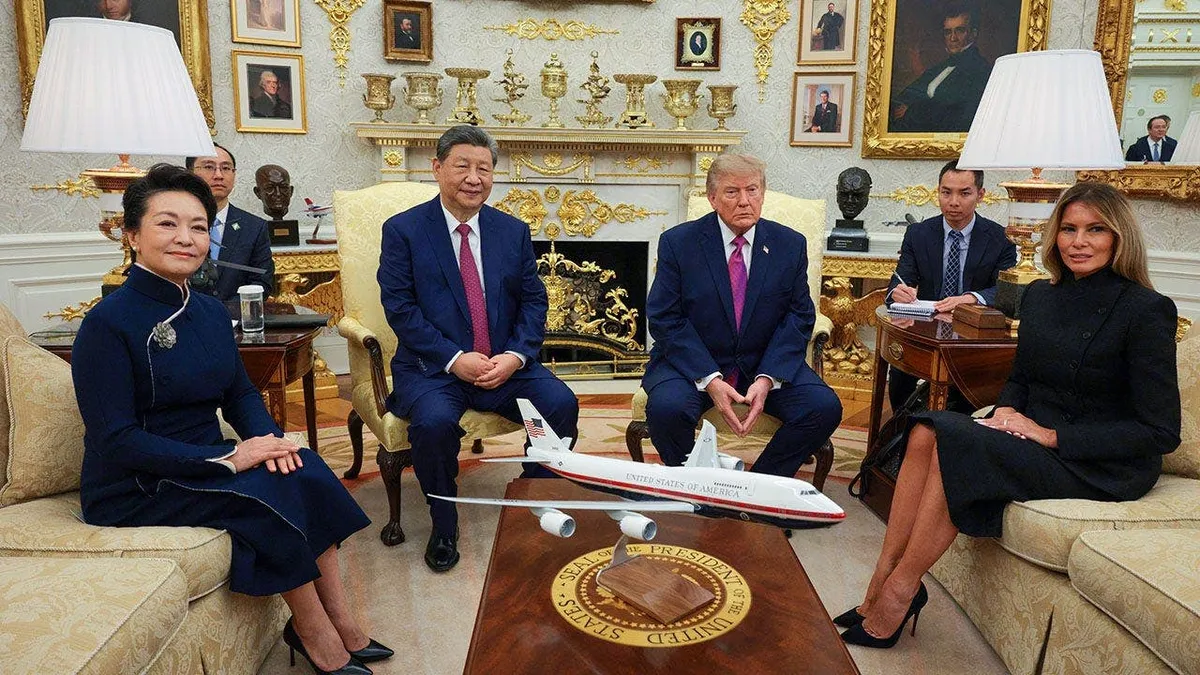
close Video XI YOU LATER: Trump’s summit with China’s leader comes to a close The Chinese president departed the United States after a two-and-a-half-day summit that covered everything from AI to the future of Taiwan. NEWYou can now listen to Fox News articles! Hören Sie sich diesen Artikel an 6 Min TAIPEI — Taiwanese officials were watching carefully for signs of policy changes toward the island as President Donald Trump hosted Chinese President Xi Jinping for a state visit last week in Washington, D.C. Xi’s visit was of high interest in Taiwan, a regular target of China’s threats. On Saturday, a panel that included scholars, a retired U.S. military officer and Taiwan’s deputy foreign minister at the Institute for National Policy Research (INPR) in Taipei assessed what the third Trump–Xi meeting of Trump’s current term means for Taiwan. Most expect no change in U.S. policy toward Taiwan. "Both of them got what they want and what they need," Kuo Yu-jen, INPR’s vice president and a professor at National Sun Yat-sen University’s Institute of China and Asia-Pacific Studies, told Fox News Digital. Trump can point to economic results from negotiating with Xi, while Xi can return to Beijing with the prestige of a high-profile U.S. reception, Kuo said. He called claims by some that Trump had "sold out" Taiwan excessive speculation. XI PRAISES US STATE VISIT 'PERFECTION' AS TRUMP CALLS MEETINGS 'VERY PRODUCTIVE' China's President Xi Jinping arrives to welcome President Donald Trump at the Great Hall of the People, Thursday, May 14, 2026, in Beijing. (Mark Schiefelbein/AP Photo) As expected, Xi reportedly pressed Trump to say the United States opposes Taiwan-independence" class="entity-link entity-topic" data-entity-id="127684" data-entity-type="topic">Taiwan independence. Washington’s preferred description is that it does not support Taiwan-independence" class="entity-link entity-topic" data-entity-id="127684" data-entity-type="topic">Taiwan independence, a distinction that, much to the relief of Taiwan government officials, Trump maintained. Speaking exclusively to Fox News Digital after the forum, Taiwan’s Deputy Foreign Minister François Wu said Beijing wants more than a change in diplomatic language. It wants the world to view Taiwan as a domestic Chinese issue. If that argument succeeds, Wu said, Beijing could claim other countries have no right to respond to its actions against the island. Taiwan’s Deputy Foreign Minister François Wu speaks at the Institute for National Policy Research (INPR) in Taipei on Sept. 26, 2026. (Eryk Michael Smith for Fox News Digital) "The so-called independence of Taiwan is just an issue made specifically by the Chinese government," Wu said. Taiwan already has a president and government elected by its people, territory and its own currency, he said. "We just don’t need to declare any independence. We are a sovereign country." Wu had expressed concerns prior to Trump’s visit to China in May, when he told Bloomberg that "What we are most afraid of is to put Taiwan on the menu of the talk between Xi Jinping and President Trump." China’s Foreign Ministry claims Xi urged Trump to maintain the "correct position" to oppose Taiwan-independence" class="entity-link entity-topic" data-entity-id="127684" data-entity-type="topic">Taiwan independence. Taiwan’s Foreign Ministry rushed out an objection on a public holiday in Taiwan, and repeated Taiwan’s own clear position on its sovereignty. China DEPLOYED OVER 100 VESSELS NEAR Taiwan IN THE WAKE OF TRUMP-XI SUMMIT, Taiwan SECURITY OFFICIAL CLAIMS Soldiers pose for group photos with a Taiwan flag after a preparedness enhancement drill simulating the defense against Beijing's military intrusions, ahead of the Lunar New Year in Kaohsiung City, Taiwan, on Jan. 11, 2023. (Daniel Ceng/AP Photo) The White House summary of Xi’s visit announced no change in Taiwan policy and instead emphasized more favorable tariff treatment for $30 billion in goods in each direction, an AI incident communication channel and U.S. concerns about rare earth and critical-mineral supplies. The visit nonetheless raised questions in Taiwan about what Xi might have obtained from Trump in private. Analysts cautioned that if there was a deal over Taiwan, it would only become clear in the coming months. Taiwan awaits Trump’s approval for more arms sales, visits to Taiwan by senior U.S. officials and a potential transit stop in the U.S. for Taiwan’s president. China objects to all of these, so how Trump handles them must balance relations with China, maintaining support for Taiwan and Trump’s priorities. Dong Li-wen, executive director of the government-funded Foundation on Asia-Pacific Peace Studies, described the leaders’ shared approach as delaying difficult decisions while waiting for circumstances to change. For Xi, Dong argued, that is a longer-term strategy. For Trump, it is a temporary tactic. The two sides can keep talking and set aside issues they cannot settle, but their underlying competition remains. The argument over Taiwan’s status is almost 80 years old. China claims the island as its territory, but the People’s Republic of China has not governed it for even a single day. The Republic of China government relocated to Taiwan after the Chinese Nationalists lost the civil war to Mao Zedong’s Communists in 1949. President Donald Trump suggested Monday that U.S. arms sales to Taiwan could factor into broader negotiations with China, drawing a swift response from Taiwan’s president and reigniting debate in Washington over the future of longstanding U.S. policy toward the island. (Ann Wang/File Photo/Reuters) The governing Democratic Progressive Party’s 1999 Resolution on Taiwan’s Future described Taiwan as an independent sovereign state called the Republic of China under its existing constitution. All of Taiwan’s democratically elected presidents have said something similar in interviews with international media, including Lee Teng-hui to The Washington Post in 1997, Chen Shui-bian to the BBC in 2010, Ma Ying-jeou to CNN in 2010, and Tsai Ing-wen to the BBC in 2020. Current President William Lai Ching-te said the same thing to Time in 2024, adding an oft-repeated insistence that the Republic of China and the People’s Republic of China are not subordinate to each other. That status quo — which amounts to Taiwan being a de facto independent state — is what Taiwan intends to defend, according to Deputy Foreign Minister Wu. Xi left Washington having restated China’s demands. Analysts at the gathering said whether Xi managed to nudge U.S. policy in any way will soon be tested in decisions over arms sales and other issues, with some predicting weapons packages could be scaled down or "unbundled." Speaking separately to Fox News Digital, Ross Darrell Feingold, a political analyst and assistant professor at Tamkang University’s Department of Diplomacy and International Relations, noted that with a local election in Taiwan this November, followed by presidential and legislative elections in January 2028, Taiwan’s domestic politics could also be a factor in U.S. decisions. "Although the U.S. is likely to back President Lai’s re-election; agreeing to arms sales, visits by Trump administration officials or Lai’s desired transit stop in the U.S. will need to be balanced against coming across as too blatantly interfering in Taiwan’s election, as well as the inevitable anger from China." Eryk Michael Smith is a Taiwan-based correspondent who since 2007, has worked both as a broadcast journalist for the island's only English-language radio station, ICRT, as well as with numerous other publications and local news outlets. Smith's journalism focuses on Taiwan-China relations, local politics, as well as science and technology developments in the greater China region. He is based in Taiwan's largest southern city, Kaohsiung. He can be followed @ErykSmithTaiwan
SRCFox News - World
LANGEN
LEANCenter-Right
WORDS1 199
ENT12
WED · 2026-09-30 · 10:51 GMTBRIEF NSR-2026-0930-115240
NSR-2026-0930-115240News Report·EN·Diplomatic
Taiwan analysts say Trump-Xi summit produced no policy shift but real test lies ahead
Taiwanese analysts believe President Trump's summit with Chinese President Xi Jinping in Washington D.C. did not result in a policy shift regarding Taiwan.
Fox News - WorldFiled 2026-09-30 · 10:51 GMTLean · Center-RightRead · 5 min
Fox News - WorldFIG 01
Reading time
5min
Word count
1 199words
Sources cited
3cited
Entities identified
12entities
Quality score
100%
§ 01
Briefing Summary
AI-generatedNEWSAR · AI
Taiwanese analysts believe President Trump's summit with Chinese President Xi Jinping in Washington D.C. did not result in a policy shift regarding Taiwan. While Xi pressed Trump to oppose Taiwan's independence, Trump maintained the U.S. does not support it. Both leaders achieved their objectives: Trump with economic negotiations and Xi with a high-profile reception. Taiwan's Deputy Foreign Minister François Wu stated Beijing desires the world to view Taiwan as a Chinese domestic issue, which would legitimize its actions against the island. The White House announced no change in Taiwan policy, focusing instead on trade and communication channels. However, analysts caution that any potential private agreements concerning Taiwan may become apparent in future decisions on arms sales and official visits, which will test the balance between U.S. support for Taiwan and relations with China.
Confidence 0.90Sources 3Claims 5Entities 12
§ 02
Article analysis
Model · rule-basedFraming
Diplomatic
Political Strategy
Tone
Measured
AI-assessed
CalmNeutralAlarmist
Factuality
0.60 / 1.00
Mixed
LowHigh
Sources cited
3
Well sourced
FewMany
§ 03
Key claims
5 extracted01
Beijing wants the world to view Taiwan as a domestic Chinese issue, which would allow it to claim other countries have no right to respond to its actions against the island.
quoteFrançois Wu (Taiwan's Deputy Foreign Minister)
Confidence
0.90
02
Washington’s preferred description is that it does not support Taiwan independence, a distinction that Trump maintained.
factual
Confidence
0.90
03
Trump can point to economic results from negotiating with Xi, while Xi can return to Beijing with the prestige of a high-profile U.S. reception.
quoteKuo Yu-jen (INPR)
Confidence
0.90
04
Taiwanese officials were watching carefully for signs of policy changes toward the island as President Donald Trump hosted Chinese President Xi Jinping.
factual
Confidence
0.90
05
Most expect no change in U.S. policy toward Taiwan following the Trump-Xi summit.
predictionTaiwanese officials and scholars (via INPR panel)
Confidence
0.80
§ 04
Full report
5 min read · 1 199 words§ 05
Entities
12 identifiedKey playerOppositionContextPositiveNeutralNegative
People4
Organizations1
Locations5
§ 06
Keywords & salience
9 termstaiwan policy
1.00
trump-xi summit
1.00
us-china relations
0.90
taiwan independence
0.80
diplomatic language
0.70
national policy research
0.60
economic results
0.50
state visit
0.50
ai
0.40
§ 07
Topic connections
Interactive graph Network visualization showing 51 related topics
View Full Graph Person Organization Location Event|Click node to navigate|Edge numbers = shared articles