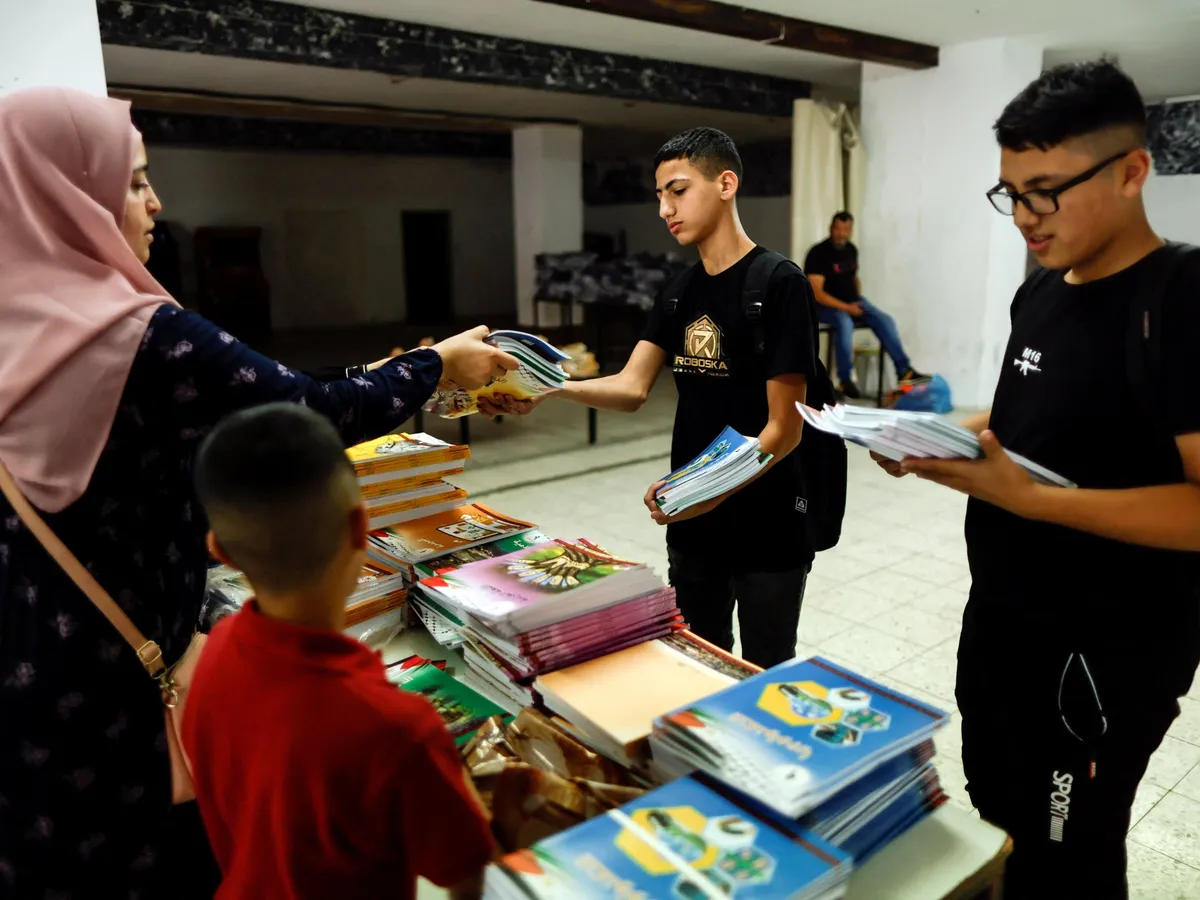
The occupation authorities are trying to censor Palestinian school curricula because they teach national consciousness.Published On 30 Sep 2026Schoolboys collect unedited textbooks as part of a protest by Palestinian parents of what they say is Israeli censorship of school textbooks in Shuafat refugee camp in occupied East Jerusalem on October 1, 2022 [File: Ammar Awad/Reuters]The school year started in occupied East Jerusalem with the news that 45,000 Palestinian children are now studying a curriculum put together by the Israeli authorities. That is more than a third of the Palestinian students in the occupied territory and almost double the number from the previous year.Meanwhile, Christian schools started the school year with a strike, as many of their teachers who live in the occupied West Bank were not granted permits to enter the city.For the Palestinian population of occupied East Jerusalem, this is yet another form of encroachment on their national rights by the occupation authorities. For Israel, this is a justified intervention because Palestinian textbooks produced by the Palestinian-ministry-of-education" class="entity-link entity-organization" data-entity-id="211722" data-entity-type="organization">Palestinian Ministry of Education and Palestinian teachers trained in Palestinian-authority" class="entity-link entity-organization" data-entity-id="6001" data-entity-type="organization">Palestinian Authority (PA) institutions “teach hate”.According to international humanitarian law, an occupying power must facilitate the normal operation of educational institutions and avoid interference in their affairs. Recently updated commentary by the International Committee of the Red Cross, the institution tasked with overseeing the application of the Geneva Convention, says an occupying power must not replace the existing education system with its own structures or impose new curricula.Yet Israeli interference in Palestinian education is extensive and reaches well beyond occupied East Jerusalem – into the occupied West Bank and, more recently, the Gaza Strip. For years, successive Israeli governments have demanded that the United States and European governments pressure the PA to revise its textbooks by conditioning aid. Meanwhile, the devastation of Gaza’s education system has allowed NGOs funded by Western donors to introduce curriculums approved by Israel.The Israeli argument that all this is necessary to prevent Palestinian children from learning “to hate” in school does not stand up to scrutiny.Academic research, including a study funded by the US Department of State and prepared by both Palestinian and Israeli scholars, found that Palestinian textbooks do not promote hate and dehumanisation of Israelis.So what is Israel actually looking to revise in Palestinian textbooks?Studies comparing Palestinian textbooks with the Israeli-edited versions used in occupied East Jerusalem have documented the removal or alteration of references to Palestinian national symbols, such as the national flag and anthem, Palestinian sovereignty and history.A 2025 study of primary-school textbooks found that Israeli modifications included replacing “Palestine” with “Israel” in some contexts and removing passages about the realities of occupation.Israel wants references to the occupation, Palestinian history and self-determination erased from Palestinian textbooks not because they “teach hate”, but because they teach Palestinian children national consciousness – something Israel has fought against since its own creation, claiming “there is no such thing as a Palestinian people”.This is why Palestinian resistance to curriculum changes in East Jerusalem should not be understood only as resistance to an Israeli textbook. For many parents, teachers and schools, the fear is that accepting the Israeli curriculum also means accepting the Israeli annexation of Jerusalem and its erasure of Palestinian identity inside it.Removing concepts such as the occupation, the Nakba, refugees, the right of return, Palestinian sovereignty and national symbols from education materials can gradually detach Palestinian political identity from the historical narrative that gives those claims meaning.While Israel gets to censor and shape Palestinian curriculums, there is little scrutiny by its Western allies of what Israeli curriculums teach Israeli children.For her book Palestine in Israeli School Books, Israeli philologist Nurit Peled-Elhanan studied Israeli history and geography textbooks published in the post-Oslo years and discovered the extensive use of racist tropes and erasure of Palestinians. In the conclusion, she expressed concern that Israeli students graduate from Israeli schools and enter mandatory military service having “been taught to resent and fear” Palestinians and having no knowledge of their “life-world”.Another more recent study of 123 textbooks used in Jewish Israeli schools by Israeli scholar Yael Teff-Seker found strong ethnocentric framing, a persistent sense of Jewish victimhood and relatively little space for Palestinian narratives. The author notes that while the concept of peace with Arab nations is described positively, the occupation is “described impartially, without judgement”, while the occupied Palestinian territory is sometimes referred to with Israeli names, for example, Judea and Samaria instead of the occupied West Bank.A research paper coauthored by another Israeli academic, Roy Weintraub, explores how Israeli state curricula cover the Nakba, one of the central events that shapes Palestinian identity and political realities. The term is “partially present” in Israeli textbooks and teaching materials and “most teaching materials justify the actions taken by Israeli forces during the 1948 War”. The paper concludes: “Inclusion of difficult histories in the curriculum does not necessarily encourage a critical understanding of the suffering and injustices experienced.”The issue with the curricula in Israel-Palestine is larger than education. It is about power. When one side controls land, movement, permits, budgets and institutions, and can also influence the language through which the other side describes that reality to its children, the classroom becomes another arena of the conflict itself.The struggle over Palestinian textbooks is not only about what children should learn. It is also about who has the authority to decide what counts as legitimate history in the first place.The views expressed in this article are the author’s own and do not necessarily reflect Al Jazeera’s editorial stance.
SRCAl Jazeera
LANGEN
LEANCenter
WORDS915
ENT12
WED · 2026-09-30 · 13:22 GMTBRIEF NSR-2026-0930-115289
NSR-2026-0930-115289Analysis·EN·Human Rights
Why Israel is interfering in Palestinian education
Israeli authorities are increasingly interfering with Palestinian education, particularly in occupied East Jerusalem, by imposing curricula that censor national consciousness. This year, 45,000 Palestinian children are studying Israeli-approved materials, a significant increase from previous years.
Ehab JabareenAl JazeeraFiled 2026-09-30 · 13:22 GMTLean · CenterRead · 4 min
Al JazeeraFIG 01
Reading time
4min
Word count
915words
Sources cited
3cited
Entities identified
12entities
Quality score
100%
§ 01
Briefing Summary
AI-generatedNEWSAR · AI
Israeli authorities are increasingly interfering with Palestinian education, particularly in occupied East Jerusalem, by imposing curricula that censor national consciousness. This year, 45,000 Palestinian children are studying Israeli-approved materials, a significant increase from previous years. Israel claims this is necessary to prevent Palestinian textbooks from teaching "hate," but research, including a US State Department-funded study, indicates Palestinian textbooks do not promote hate. Instead, Israeli modifications remove references to Palestinian national symbols, sovereignty, history, and the realities of occupation. This interference aims to erase Palestinian identity and national consciousness, while Israeli textbooks themselves have been found to contain ethnocentric framing and erase Palestinian narratives.
Confidence 0.90Sources 3Claims 4Entities 12
§ 02
Article analysis
Model · rule-basedFraming
Human Rights
Conflict
Tone
Mixed Tone
AI-assessed
CalmNeutralAlarmist
Factuality
0.60 / 1.00
Mixed
LowHigh
Sources cited
3
Well sourced
FewMany
§ 03
Key claims
4 extracted01
Israeli modifications to Palestinian textbooks include removing references to national symbols, sovereignty, and history, and sometimes replacing 'Palestine' with 'Israel'.
factual
Confidence
1.00
02
Academic research, including a US Department of State-funded study, found Palestinian textbooks do not promote hate or dehumanization of Israelis.
factualUS Department of State-funded study
Confidence
1.00
03
International humanitarian law, as interpreted by the ICRC, states an occupying power must facilitate normal educational operations and avoid interference, not impose new curricula.
factualInternational Committee of the Red Cross (ICRC)
Confidence
1.00
04
45,000 Palestinian children in occupied East Jerusalem are studying a curriculum put together by Israeli authorities, an increase from the previous year.
statistic
Confidence
1.00
§ 04
Full report
4 min read · 915 words§ 05
Entities
12 identifiedKey playerOppositionContextPositiveNeutralNegative
Organizations5
Locations6
§ 06
Keywords & salience
10 termspalestinian education
1.00
israeli interference
0.90
occupied east jerusalem
0.80
curriculum censorship
0.80
national consciousness
0.70
occupation authorities
0.60
international humanitarian law
0.60
palestinian textbooks
0.50
occupied west bank
0.40
gaza strip
0.40
§ 07
Topic connections
Interactive graph Network visualization showing 51 related topics
View Full Graph Person Organization Location Event|Click node to navigate|Edge numbers = shared articles