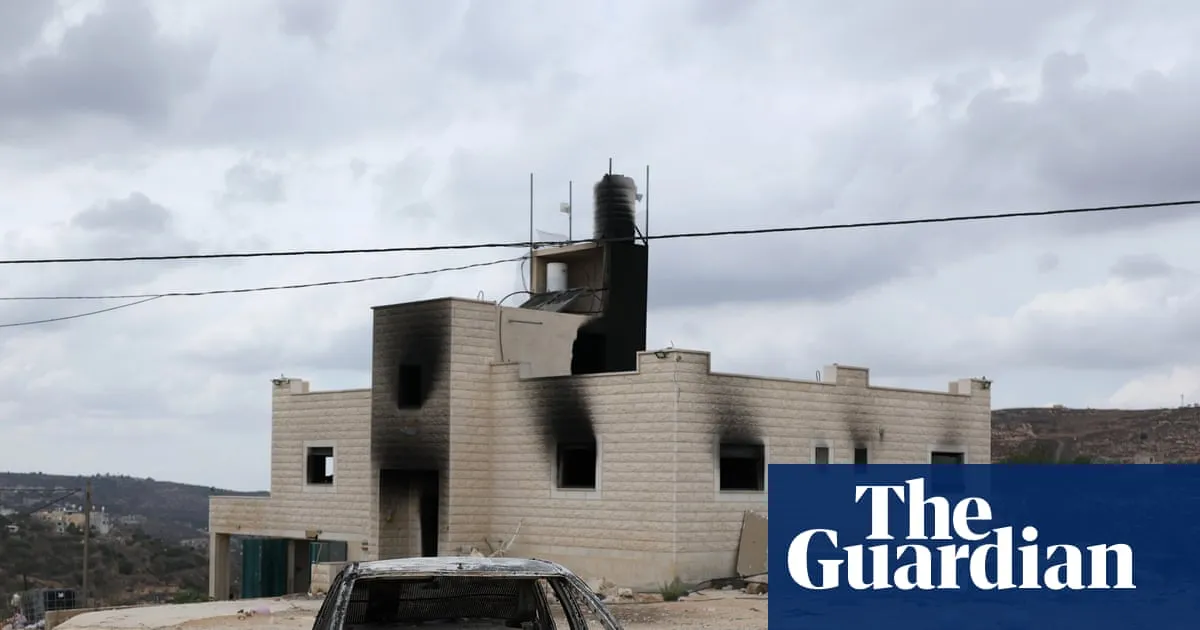
Israeli settlers attacked the West Bank village of Jalud, south of Nablus, early on Tuesday. Photograph: Atef Safadi/EPA View image in fullscreen Israeli settlers attacked the West Bank village of Jalud, south of Nablus, early on Tuesday. Photograph: Atef Safadi/EPA Israeli forces overwhelmed by violent settlers in ‘terrorist attack’ on Palestinian family settler violence in West Bank makes everyday life ‘untenable’ for Palestinians, says ICRC after assault on family trying to return home in Jalud The International Committee of the Red Cross (ICRC) has said Israeli settler violence in the West Bank has made everyday life for Palestinians “untenable”, as a mob attack on Palestinians trying to return home prompted one of Benjamin Netanyahu’s main rivals to warn of a campaign of settler terror. More than 100 militant settlers overwhelmed Israeli security forces early on Tuesday to attack a Palestinian family as they attempted to reclaim their homes which had been seized by settlers in the West Bank village of Jalud. Three Israeli security officials were injured and houses were set on fire. The impotence of the Israeli military, the scale of the assault and the injuries inflicted on Israeli security officers by settlers prompted unusually harsh condemnation from Israeli politicians and commenters. Israel is facing unprecedented international pressure over surging violence in the occupied West Bank, where settler militants backed by cabinet ministers have accelerated a campaign of ethnic cleansing ahead of Israel’s elections next month. Israel’s president, Isaac Herzog, condemned the attacks in Jalud as a “moral stain”. Gadi Eisenkot, a former military chief and Netanyahu’s leading challenger in the upcoming elections, called for action to halt a “campaign of terror and violence”. Deadlier attacks by Israeli settlers, including ones targeting Palestinian children, have drawn less attention inside Israel. “Palestinian rights or safety are not the concern, even for people who are in the opposition,” said Mairav Zonszein, a senior analyst on Israel-Palestine with International Crisis Group. “The settler violence is an issue [for them] because it’s making Israel look bad, and also the idea that the military is losing control.” View image in fullscreen A Palestinian family were attacked as they attempted to reclaim their homes which had been seized by settlers in Jalud. Photograph: Atef Safadi/EPA The ICRC said attacks, settlement expansion and severe restrictions on movement were making everyday life untenable for Palestinian civilians and violated Israel’s obligations under international law. “The frequent and severe violence must be brought to an end,” said Julien Lerisson, the head of the ICRC’s delegation for Israel and Palestine. “What international humanitarian law says on the protection of private and public property, and on the population’s access to essential services, must be respected.” A bar on imports of settlement goods came into force in the Netherlands last week, the UK has announced plans for even broader controls on trade and financing of settlements, and a similar bill will be introduced in the US legislature on Thursday. On Tuesday, a Senate bill demanding a human rights report on Israel’s occupation of the West Bank was narrowly defeated after winning backing from all but one Democrat. “Tonight a disaster was averted, but the barrier has been broken,” the Israeli analyst Roy Sharon wrote on social media after the vote, warning that “anarchy in the West Bank” may cost Israel military aid from the US and its international legitimacy. A cartoon in Israel’s largest-circulation newspaper, Yedioth Ahronoth, on Wednesday showed two soldiers watching an arson attack on a Palestinian home. “They’re going to ruin my trip to Amsterdam,” one says to the other. More than 60 Palestinian communities in the occupied West Bank have been wiped off the map since October 2023 and 18 others have been partly displaced, according to the Israeli rights group B’Tselem. Nearly 5,000 people have been forced from their homes, almost half of them children. View image in fullscreen Mahmod Tubasi, 60, and his wife, Aedah, 51, and their family had been forced out of their homes this summer by settler militants. Photograph: Ammar Awad/Reuters The Tubasi family, whose homes were burned in Jalud, had been forced out this summer after a weeks-long siege by settler militants. Last week they secured a high court ruling ordering the Israeli state to evict settlers and secure their return. Late on Monday the Israeli military told the family that about 15 military police officers would escort them home immediately, Israel’s Haaretz newspaper reported. That was a small number given that Israel is celebrating the Sukkot holiday. The number of violent extremists in illegal settlements usually rises during festivals, and the force was outnumbered by a violent crowd within minutes of arriving. “To carry out an operation such as this, and during the holiday of Sukkot when the [settler] outposts are packed, is madness,” a security source said. The military had not informed national police and the Shin Bet domestic intelligence service of their plans, so they had no security backup. Settlers attacked a house when the Tubasi family arrived, forcing them to the roof, before the military decided to evacuate them in armoured military vehicles. The crowd then set the homes on fire, blocked roads and threw stones at Israeli security forces, injuring three personnel. The two houses “were damaged beyond description”, said Wael Tubasi. “They damaged everything – the doors, the tiles were removed, the stairs were removed. They smashed the bathrooms, doors and windows. They left nothing, everything was broken,” he told Reuters. View image in fullscreen The Tubasi family’s homes were ‘damaged beyond description’, said Wael Tubasi. ‘Everything was broken.’ Photograph: Ammar Awad/Reuters Earlier this year the former prime minister Ehud Olmert called for the international criminal court to intervene to stop settler violence because the state had failed. Netanyahu condemned the “violent riots” and called for prosecution of the attackers, but defended the illegal settler movement. “The handful of rioters are not representative of the law-abiding settler public in Judea and Samaria,” the prime minister said, using an Israeli term for the occupied West Bank. A landmark 2024 ruling from the UN’s international court of justice found that the occupation violated international law, a position the British government has endorsed. An Israeli military spokesperson said two suspects had been detained, and called for action to tackle settler militants who targeted Israeli security forces. “The violence directed at soldiers while they were carrying out their duties crosses a clear red line and is unacceptable,” the spokesperson said. “There is no place for such incidents in the state of Israel, and they must not be allowed to become the norm. Such phenomena must be addressed at their root.” On Wednesday, some in Israel questioned whether the army and the state had the capacity to do that. “We have to look reality squarely in the eye: this was a terrorist attack and a failure by the Israeli defence establishment in its entirety,” Avi Ashkenazi wrote in the Maariv newspaper. “It is clear at this point that the real sovereign in Judea and Samaria are the extreme rightwing terrorist activists.” Explore more on these topics West Bank Palestine Israel International Committee of the Red Cross (ICRC) Middle East and north Africa news Share Reuse this content
SRCThe Guardian - World News
LANGEN
LEANCenter-Left
WORDS1 196
ENT12
WED · 2026-09-30 · 14:54 GMTBRIEF NSR-2026-0930-115306
NSR-2026-0930-115306News Report·EN·Conflict
Israeli forces overwhelmed by violent settlers in ‘terrorist attack’ on Palestinian family
Israeli settlers attacked a Palestinian family attempting to return to their homes in the West Bank village of Jalud. Over 100 settlers overwhelmed Israeli security forces, injuring three officers and setting houses on fire.
Emma Graham-Harrison in JerusalemThe Guardian - World NewsFiled 2026-09-30 · 14:54 GMTLean · Center-LeftRead · 5 min
The Guardian - World NewsFIG 01
Reading time
5min
Word count
1 196words
Sources cited
4cited
Entities identified
12entities
Quality score
100%
§ 01
Briefing Summary
AI-generatedNEWSAR · AI
Israeli settlers attacked a Palestinian family attempting to return to their homes in the West Bank village of Jalud. Over 100 settlers overwhelmed Israeli security forces, injuring three officers and setting houses on fire. The International Committee of the Red Cross stated that settler violence is making life "untenable" for Palestinians and violates international law. Israeli politicians condemned the attack, with one rival of Prime Minister Netanyahu warning of a "campaign of terror and violence." The incident highlights escalating settler violence and international pressure on Israel regarding the occupied West Bank.
Confidence 0.90Sources 4Claims 5Entities 12
§ 02
Article analysis
Model · rule-basedFraming
Conflict
Human Rights
Tone
Mixed Tone
AI-assessed
CalmNeutralAlarmist
Factuality
0.70 / 1.00
Factual
LowHigh
Sources cited
4
Well sourced
FewMany
§ 03
Key claims
5 extracted01
Israeli settler violence in the West Bank has made everyday life for Palestinians 'untenable'.
quoteICRC
Confidence
1.00
02
Three Israeli security officials were injured and houses were set on fire during the settler attack.
factual
Confidence
0.90
03
Over 100 militant settlers overwhelmed Israeli security forces to attack a Palestinian family trying to reclaim their homes in Jalud.
factual
Confidence
0.90
04
Israeli politicians and commenters issued unusually harsh condemnation of the settler attack.
factual
Confidence
0.80
05
Settler militants backed by cabinet ministers have accelerated a campaign of ethnic cleansing in the occupied West Bank.
factual
Confidence
0.70
§ 04
Full report
5 min read · 1 196 words§ 05
Entities
12 identifiedKey playerOppositionContextPositiveNeutralNegative
People4
Organizations2
Locations4
§ 06
Keywords & salience
9 termssettler violence
1.00
west bank
0.90
palestinian family
0.80
ethnic cleansing
0.70
icrc
0.60
terrorist attack
0.50
israeli forces
0.50
settlement expansion
0.40
benjamin netanyahu
0.40
§ 07
Topic connections
Interactive graph Network visualization showing 9 related topics
View Full Graph Person Organization Location Event|Click node to navigate|Edge numbers = shared articles