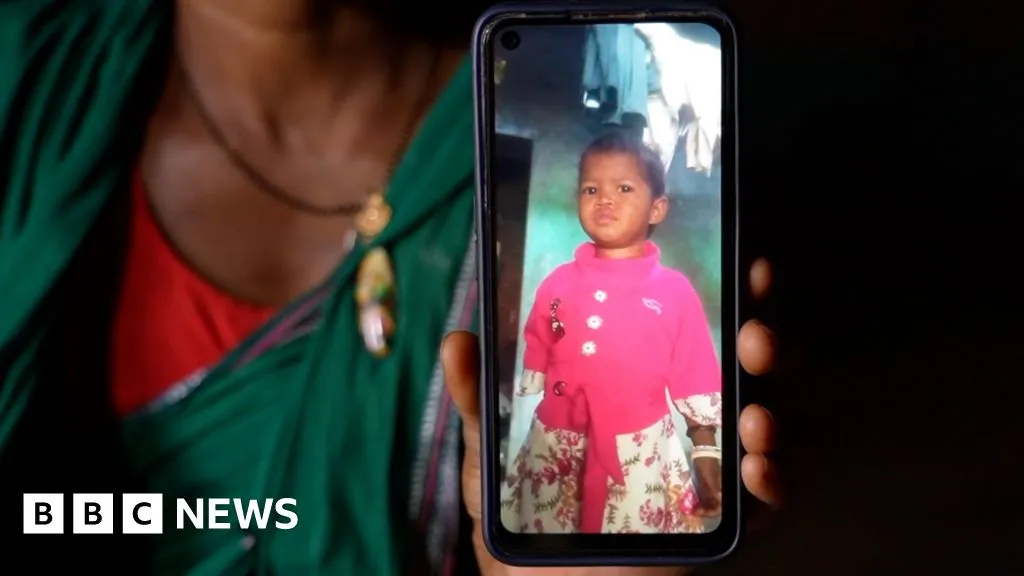
Anahita Sachdev/BBCKoushila Markam holds a photograph of her daughter, Bamita, who died aged threeWarning: This article contains details some readers may find distressingAt about 3am one morning in May, Bamita Markam began convulsing.The three-year-old had spent days with a high fever and angry red sores on her body. Her mother, Koushila, had first taken her to a doctor, who prescribed an ointment.Bamita seemed to recover, then became ill again. A faith healer, called to the house in Matla village, gave her syrups and tablets. Nothing worked. By dawn, Bamita was dead."She cried a lot," Koushila recalls. "She convulsed all night." The family tried to make her drink water. At one point she vomited blood. They buried her in a jungle after midday.Bamita's death was one of at least 32 child deaths recorded since May in a cluster of remote villages in Balaghat district in India's Madhya Pradesh state, officials say. The victims ranged from babies just three or four months old to an 18-year-old, and most were Baiga, one of India's 75 "particularly vulnerable tribal groups". Anahita Sachdev/BBCAtilal Dhurwey holds a framed photograph of his 17-year-old brother Rooplal, who died in June. Rooplal died days after developing a fever and rash.Officials attribute the deaths to mainly measles and malaria, possibly aggravated by malnutrition and delays in treatment. They believe eight to 10 deaths were associated with measles, roughly another 10 with malaria, with several children suffering more than one infection. The precise cause of every death is less certain."I have never seen an outbreak like this. My father was a two-term lawmaker, and I have served three terms, but neither of us has seen so many children die in such a short time," Sanjay Uikey, who has represented the area since 2013, told me.But disease is only part of the story. In remote, forested parts of Balaghat, where Maoist insurgency once took root, reaching a health centre can be a challenge in itself.In the monsoon, the terrain can make that journey harder. Paddy fields glow against red earth and low, forested hills. Narrow dirt tracks wind between fields and mud homes, often becoming slippery and impassable in heavy rain.The countryside is lush, but the homes are sparse. Most Baiga houses have low mud walls, rough timber and bamboo, and tiled or thatched roofs patched with plastic against the rain.Some homes are accessible only by these tracks. Doctors investigating the deaths have travelled through the mud in tractors. On a recent visit, we walked nearly 2km (1.2 miles) uphill to reach some of the more remote homes. The surrounding jungle was dotted with the graves of children who had died.Anahita Sachdev/BBCBehru Markam lives with his wife and four children in a mud hut. His daughter, Preeti, died of a suspected measles attack.The nearest state hospital, a 100-bed facility in Birsa, is about 70km away. For families without vehicles, reaching it can mean muddy tracks, a makeshift bamboo stretcher or a motorcycle - and a day's lost wages.When Bamita became seriously ill, the family did not get her to hospital. It was raining heavily. The tracks were muddy and slippery, and the family had no way of transporting her."If I was able to take her to hospital she might have lived," Koushila says.Her other daughter, Ankita, keeps asking what happened to her sister. The six-year-old has been told what many children in these villages are told: "Mata aa gayi" - the goddess has arrived. For some Baiga families, some illnesses - like chicken pox - are seen as the arrival of a disease goddess, who must be appeased rather than treated. Families perform a seven to nine-day ritual of bathing and offering cool water and neem leaves to the local disease goddess. Many believe that treating the patient before the ritual is completed could cause death.Anahita Sachdev/BBCThe Dhurwey family home in Bondari village is nearly 2km uphill from the nearest roadFor weeks, such beliefs shaped how families responded to sick children. Then the scale of the deaths began to emerge.On 21 July, Parshuram Dhurwey, a local village council chief, heard that two children in the same household in Bondari village had died. The next morning, he heard of another death. He called local officials and went to the area. They found a grim picture."Every other child was sick," Dhurwey says. "They had fever, they had rashes. Many were undernourished."When government medical officer Nimish Gautam arrived, he found severely dehydrated children. The first case he saw was a teenage girl with several days of fever and rash, whose blood sugar appeared dangerously low. Her family refused to let the health team examine her properly."Police were brought in to persuade them to take her to a health centre. The family still refused," Gautam told me. "They said if we took her for treatment, she would die. So we kept her under observation, and she recovered."Soutik Biswas/BBCMahasingh Parte, who lives in Matla village, lost two children within two days of each other In one village, Dhurwey says, officials forcibly entered homes and took five seriously ill children to hospital. All recovered.By the time the outbreak became unmistakable to local authorities, children had already been dying for weeks. By September, Dhurwey says, 10 children aged about 18 months to 14 years had died across the four villages in his council - Adori, Kundekasa, Bondari and Usri.The symptoms were frighteningly similar and frustratingly non-specific: fever, rashes, weakness, dehydration and, in some cases, seizures. Some children had scabies, fungal infections or bacterial skin infections alongside suspected measles and malaria. In a district where malaria is endemic, fever could mean several things at once.Sagnibai of Bondari lost two children within 24 hours. Her daughter, Lamnin, 12, died on 26 June. Her one-year-old son, Sahil, died the following day. A local healer told the family it was Mata. They also had no money or vehicle to take the children to a doctor.Her husband, Samaroo Dhurwey, remembers nights in which the children's bodies seemed to be "on fire". They could not digest food. They died at home.Mahasingh Parte of Matla village lost two children - a six-year-old girl and a four-year-old boy - within two days of each other. The family followed a faith healer's instructions. "He said don't take them to hospital," Parte recalls.Anahita Sachdev/BBCKoushila Markam visits the grave of her three-year-old daughter, Bamita, marked by a pile of large rocks beside a paddy fieldParte is a landless farm labourer who earns about 200 rupees ($2; £1.58) on a good day, he said. Work is scarce in the monsoon, and although a small primary health centre is just 5km away, he had never been there. Poverty and remoteness had stacked the odds against his children.The question of what was making children sick became harder to answer as the deaths mounted. An investigation by the ICMR-National Institute for Tribal Health Research (NIRTH) tested 10 samples collected from the affected villages on 7 August. Six tested positive for measles; four were negative. measles is highly contagious, causing high fever, cough, runny nose and red, watery eyes, followed by a rash. Most children recover, but malnutrition can make measles far more dangerous, increasing the risk of pneumonia, severe diarrhoea and dehydration, and inflammation of the brain. The infection also weakens the immune system, leaving children vulnerable to other infections. malaria can compound that risk.But doctors cautioned that malaria did not necessarily follow measles, and not every fever and rash was measles. Instead, several infections and vulnerabilities collided.Anahita Sachdeva/BBCSick children were brought to a health camp in Kondekasa village during the outbreak"Sometimes there is no single factor behind the deaths," Gautam said. "There are malnourished children and there's zero health education and hygiene at home." The Baiga villages are not entirely disconnected from modern India. Seasonal migration takes families to other states for chilli picking and other work. Children watch reels on smartphones, while many families have minimum single-bulb solar-powered electricity, bank accounts and, in some homes, piped water. Yet malnutrition remains widespread, with children often poorly fed. A five-year-old who died recently of measles weighed around 5kg.Gautam believes malnutrition is driven by early marriage and motherhood, with some girls becoming mothers at 16 or 17, when their bodies are still developing. Closely spaced pregnancies, premature births and low birth weight can follow, while young mothers struggle to breastfeed and care for their children. Diet is another problem: many families rely heavily on rice and lentil soup, with too little protein and dietary variety. Studies on Baiga households have found widespread nutritional deficiencies, compounded by poor uptake of public services.The gap between services on paper and on the ground was stark: the state response came weeks after deaths began, while health teams struggled to reach and persuade families.Anahita SachdevMalnutrition remains widespread among children in Balaghat's Baiga communityOnce the outbreak was recognised, health workers began door-to-door screening in affected villages. Mobile medical units carrying oxygen, nebulisers, suction equipment, malaria tests and medicines visited more than 20 affected villages.One mobile doctor, Neeraj Sharma, says teams routinely saw more than 50 patients a day, about half of them children. They conducted 10 or more malaria tests daily, sometimes finding two positive cases a day.More than 6,200 patients - mostly children - were eventually treated at home, according to Gautam. More than 630 were referred to district hospitals. About 600 returned home, while around 30 remain admitted.Vaccination became an emergency response. Although official records suggested 90-95% coverage in some areas, health workers found children without records and families reluctant to vaccinate. Authorities therefore offered the measles-rubella (MR) vaccine to all children under 15, regardless of recorded status. Of about 40,000 children identified in Birsa, roughly 27,000 had been vaccinated, Gautam said. Of the area's 180 villages, some 67 are predominantly Baiga and among the most vulnerable.But vaccination is only one part of the protection children need. There are wider questions about whether basic nutrition and other health services are reaching those most at risk. A 2024 audit by India's Comptroller and Auditor General found "serious irregularities" in Madhya Pradesh's distribution of take-home rations meant to supplement the diets of children aged six months to three years, pregnant women and lactating mothers, including problems with beneficiary identification, production, transport and distribution.The outbreak has now subsided. Officials say the last child death was more than two weeks before their late-September assessment, while teams continue visiting villages. In Kundekasa, a medical camp that once saw about 120 children a day was seeing fewer than 10.Back in Matla, Bamita's mother speaks about the child who would ask for money for snacks, play with her sister and run inside whenever cars approached because vehicles frightened her."I had hope she'd study and make something of herself. I never regretted I didn't have a boy," Koushila says.Then she looks at Ankita, the surviving sister."I want more kids," she says. "I feel alone. Ankita is alone. She keeps crying for her sister."
SRCBBC News - World
LANGEN
LEANCenter
WORDS1 816
ENT12
WED · 2026-09-30 · 23:41 GMTBRIEF NSR-2026-1001-115404
NSR-2026-1001-115404News Report·EN·Public Health
The children dying in India's remote tribal heartland
At least 32 children have died in remote villages in Balaghat district, India, since May due to outbreaks of measles and malaria, exacerbated by malnutrition and delayed treatment. The victims, primarily from the Baiga tribal group, ranged in age from infants to an 18-year-old.
19 minutes agoShareSaveAdd as preferred on GoogleSoutik BiswasIndia correspondentBBC News - WorldFiled 2026-09-30 · 23:41 GMTLean · CenterRead · 8 min
BBC News - WorldFIG 01
Reading time
8min
Word count
1 816words
Sources cited
3cited
Entities identified
12entities
Quality score
100%
§ 01
Briefing Summary
AI-generatedNEWSAR · AI
At least 32 children have died in remote villages in Balaghat district, India, since May due to outbreaks of measles and malaria, exacerbated by malnutrition and delayed treatment. The victims, primarily from the Baiga tribal group, ranged in age from infants to an 18-year-old. Difficult terrain, poor road access, and a lack of transportation hinder access to healthcare facilities, which are often a day's journey away. Some families also adhere to traditional beliefs that view certain illnesses as the arrival of a disease goddess, delaying medical intervention. Officials are investigating the deaths, with some attributing them to measles and malaria, while others note the challenges in reaching remote communities for timely medical care.
Confidence 0.90Sources 3Claims 5Entities 12
§ 02
Article analysis
Model · rule-basedFraming
Public Health
Human Interest
Tone
Mixed Tone
AI-assessed
CalmNeutralAlarmist
Factuality
0.70 / 1.00
Factual
LowHigh
Sources cited
3
Well sourced
FewMany
§ 03
Key claims
5 extracted01
Most victims were Baiga, one of India's 75 'particularly vulnerable tribal groups'.
factualarticle
Confidence
0.95
02
The nearest state hospital is about 70km away, and reaching it can be difficult for families without vehicles.
factualarticle
Confidence
0.90
03
Reaching a health center can be a challenge in remote, forested parts of Balaghat due to terrain and monsoon conditions.
factualarticle
Confidence
0.90
04
At least 32 child deaths were recorded since May in remote villages in Balaghat district, Madhya Pradesh.
statisticofficials
Confidence
0.90
05
Officials attribute the deaths mainly to measles and malaria, possibly aggravated by malnutrition and delays in treatment.
factualofficials
Confidence
0.85
§ 04
Full report
8 min read · 1 816 words§ 05
Entities
12 identifiedKey playerOppositionContextPositiveNeutralNegative
People5
Locations4
§ 06
Keywords & salience
10 termschild mortality
1.00
tribal communities
0.90
healthcare access
0.80
infectious diseases
0.70
malnutrition
0.60
remote villages
0.50
baiga tribe
0.40
measles
0.40
malaria
0.40
india
0.40
§ 07
Topic connections
Interactive graph No topic relationship data available yet. This graph will appear once topic relationships have been computed.