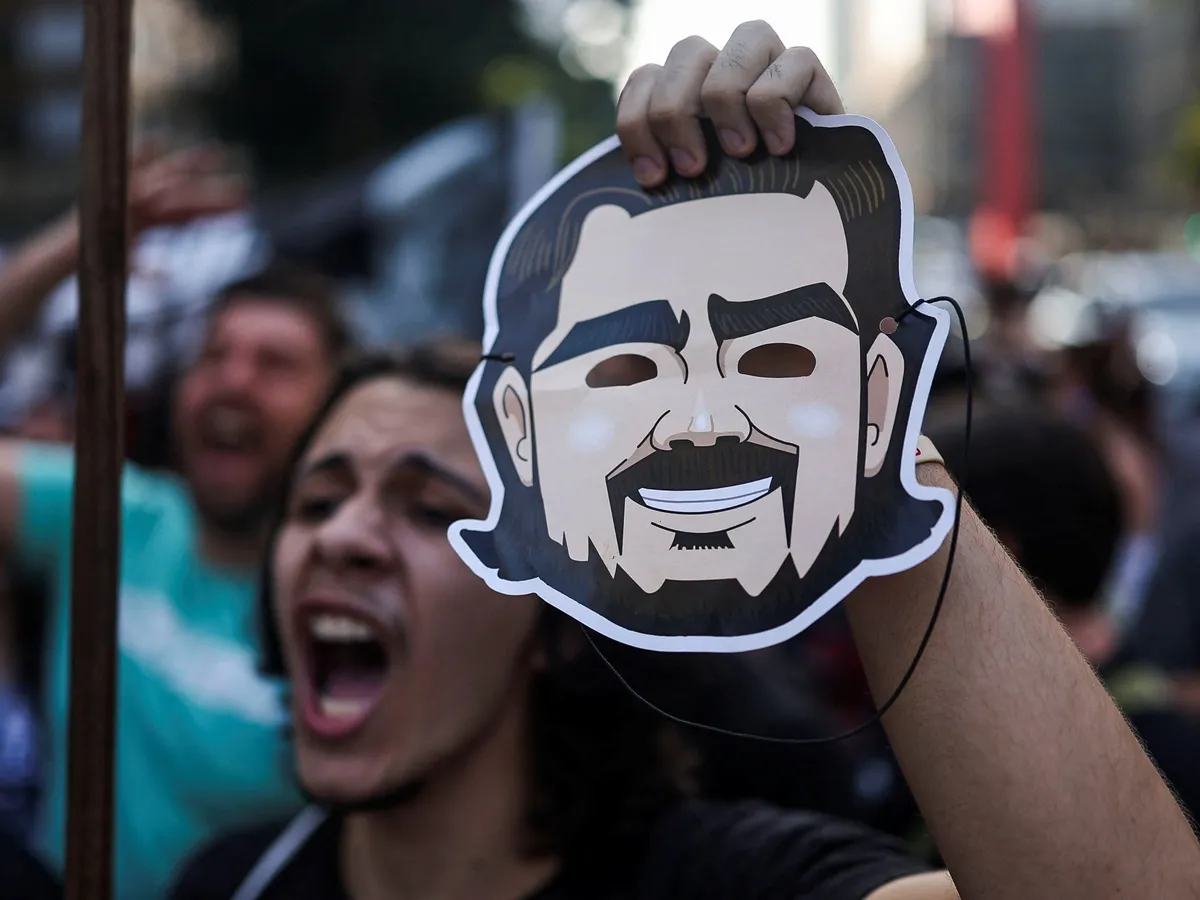
President Luiz Inacio Lula da Silva is in a tight race against right-wing Senator Flavio Bolsonaro. Will a banking scandal tip the vote?Supporters of Brazil's President Luiz Inacio Lula da Silva protest with a banner that ties rival candidate Flavio Bolsonaro to the Banco Master scandal in Belem, Brazil, on September 14 [Marx Vasconcelos/Reuters]Supporters of Brazil's President Luiz Inacio Lula da Silva protest with a banner that ties rival candidate Flavio Bolsonaro to the Banco Master scandal in Belem, Brazil, on September 14 [Marx Vasconcelos/Reuters]Published On 2 Oct 2026Sao Paulo, Brazil – It is one of the largest fraud scandals in modern Brazilian history. And experts say it may play a role in the nail-biter race unfolding for Brazil's presidency.On Sunday, Brazilian voters will head to the polls for the first round of the country's presidential vote.Centre-left incumbent Luiz Inacio Lula da Silva, 80, is currently the frontrunner. He is seeking an unprecedented fourth term, after previously leading the country from 2003 to 2011.His main challenger is far-right Senator Flavio Bolsonaro, 45, the eldest son of embattled former President Jair Bolsonaro, who is serving a 27-year prison sentence for an alleged coup attempt.The two candidates are locked in a neck-and-neck race. But both have faced fallout from the Banco Master scandal, a sprawling financial scheme that has cast a shadow over Brazil's political sphere.“I get the sense that the bases of both of these candidacies are not that happy with how the campaigns have gone," said Anthony W Pereira, head of the Stone Center for Latin American Studies at Tulane University.He pointed to the high levels of rejection Brazilian voters have expressed for both candidates.In late September, the pollster Quaest found that 56 percent of respondents said they would refuse to vote for Bolsonaro. About 54 percent said the same about Lula.“Rates of rejection are really high for both candidates. That helps explain why mobilisation and enthusiasm are fairly low,” Pereira said.A right-wing protester holds a mask depicting businessman Daniel Vorcaro in Sao Paulo, Brazil, on March 21 [Amanda Perobelli/Reuters]A right-wing protester holds a mask depicting businessman Daniel Vorcaro in Sao Paulo, Brazil, on March 21 [Amanda Perobelli/Reuters]A historic collapseOne factor in the widespread disillusionment has been the Banco Master scandal. The financial imbroglio has delivered a black eye to both ends of Brazil's political spectrum.A range of business leaders, political figures, regulators and judges have been swept up in the scandal.A mid-sized lender, Banco Master grew aggressively over the last decade by selling high-yield deposit certificates. Some of those certificates offered returns of up to 140 percent relative to Brazil’s benchmark interbank rate.But Banco Master did not have the assets needed to sustain that output.It lacked the money to pay back its risky loans, and what assets it did have were diverted to shell accounts, according to prosecutors.Brazil's Central Bank ultimately liquidated Banco Master in 2025, as the lender faced a major funding squeeze.Its owner, Daniel Vorcaro, was subsequently arrested, accused of an array of financial crimes, including money laundering and fraud.The collapse of Banco Master triggered a nearly $7.7bn payout from Brazil's Credit Guarantee Fund, the largest disbursement in the nonprofit insurance's history.Investigators have suggested that Vorcaro protected his fraud scheme by cultivating influence among power brokers among Brazil's elite.Among those implicated in the scandal is Senator Flavio Bolsonaro, the presidential candidate.Last month, the Supreme Court unsealed documents showing he is under investigation for alleged corruption and money laundering in connection with Vorcaro.Audio recordings have also surfaced, appearing to show Bolsonaro soliciting the disgraced bank leader for millions in funding. The money was slated as financing for Dark Horse, a film about his imprisoned father, Jair Bolsonaro.Flavio Bolsonaro has denied any wrongdoing. He described the interaction as a private sponsorship opportunity, unrelated to the Banco Master scandal.Senator Flavio Bolsonaro, a right-wing candidate for president, campaigns in Sao Paulo, Brazil, on September 29 [Andre Penner/AP Photo]Senator Flavio Bolsonaro, a right-wing candidate for president, campaigns in Sao Paulo, Brazil, on September 29 [Andre Penner/AP Photo]A greater association with the leftBut while Bolsonaro appears to have direct ties to the scandal, polling suggests that left-wing campaigns like Lula's may suffer more.In September, the polling institute Datafolha released a survey that found 34 percent of respondents associated the Banco Master scandal more with left-wing politicians than with any other kind of political leaning.Only 27 percent believed it involved more right-wing politicians.Another 13 percent associated the scandal with politicians of all stripes, and 16 percent said they did not know how to answer the question.Leonardo Paz, a political scientist at the Getulio Vargas Foundation (FGV), a think tank, said that Brazilian media shares part of the blame for the public's perception of the scandal.“Make no mistake, this is a corruption scandal that predominantly involves the right," Paz said.He argues that the news coverage created a false equivalency between Lula's involvement and Bolsonaro's.“Flavio’s up to his neck in this scandal, but the press’s need to come across as impartial has ended up generating this inaccurate perception that the Master case affects everyone equally,” Paz explained.Brazilian President Luiz Inacio Lula da Silva, who is running for reelection, greets supporters in Sao Goncalo, Brazil, on September 24 [Silvia Izquierdo/AP Photo]Brazilian President Luiz Inacio Lula da Silva, who is running for reelection, greets supporters in Sao Goncalo, Brazil, on September 24 [Silvia Izquierdo/AP Photo]A justice's scandalLula has not been directly linked to the Banco Master scandal.But revelations have emerged regarding Supreme Court Justice Alexandre de Moraes, a frequent target of right-wing criticism.Earlier this year, a rival justice released a document purporting to show Vorcaro composing messages to de Moraes, in some cases asking for legal advice.De Moraes has denied exchanging any messages with the banker. He has also called the accusations an "incriminating farce for political and electoral purposes".The justice was appointed to the court in 2017, under then-President Michel Temer, a centre-right figure. But in recent years, de Moraes played an instrumental role in blocking Jair Bolsonaro's attempts to overturn his defeat to Lula in the 2022 election.De Moraes ultimately oversaw the criminal case that landed the elder Bolsonaro in prison. Bolsonaro's right-wing allies have called that case a political "witch hunt", accusing de Moraes of being beholden to Lula."Anyone voting for Lula is voting for Alexandre de Moraes," Flavio Bolsonaro said on the campaign trail this year.Pereira, the Latin American studies director at Tulane, explained that some members of the public have conflated Lula and de Moraes as a result of the prosecution.Flavio Bolsonaro has successfully leveraged that perception, Pereira added.“Flavio is far more implicated [in the Banco Master scandal], but he’s gotten lucky,” he said. “Some lazily assume that Alexandre de Moraes is more or less the same as Lula, so it becomes a wash.”Supreme Court Justice Alexandre de Moraes is among the high-profile figures implicated in the Banco Master scandal [File: Eraldo Peres/AP Photo]Supreme Court Justice Alexandre de Moraes is among the high-profile figures implicated in the Banco Master scandal [File: Eraldo Peres/AP Photo]A wild cardWith Brazil's presidential race expected to be tight, experts warn that even small fluctuations in voter intent could affect the outcome.Neither Bolsonaro nor Lula is expected to cross the 50-percent threshold needed to avoid a run-off on October 25.Jorge Chaloub, a political scientist at the Federal University of Rio de Janeiro, said the race may ultimately come down to the voters currently backing other candidates.Also in the running are self-help author Augusto Cury and right-wing figures Ronaldo Caiado, Renan Santos and Romeu Zema.Combined, they are polling at a little more than 10 percent support. Their second-round endorsements could end up deciding the election, according to Chaloub.“Ideologically, the other candidates are more to the right, and you’d expect them to side with Flavio," Chaloub said.But, he added, the scandal-plagued race has been volatile so far. Chaloub warned that voters looking for right-wing alternatives may not ultimately side with Bolsonaro, should a run-off occur.“There’s a reason that those voters didn’t choose Flavio Bolsonaro in the first place," he said.
SRCAl Jazeera
LANGEN
LEANCenter
WORDS1 329
ENT10
FRI · 2026-10-02 · 16:36 GMTBRIEF NSR-2026-1002-115890
NSR-2026-1002-115890News Report·EN·Political Strategy
How the Banco Master scandal injected chaos into Brazil’s presidential race
Brazil's presidential race between incumbent Luiz Inacio Lula da Silva and Senator Flavio Bolsonaro is being impacted by the Banco Master scandal, one of the largest fraud cases in the country's history. The mid-sized lender, Banco Master, was liquidated in 2025 after its owner, Daniel Vorcaro, was accused of financial crimes, leading to a significant payout from Brazil's Credit Guarantee Fund.
Euan MarshallAl JazeeraFiled 2026-10-02 · 16:36 GMTLean · CenterRead · 6 min
Al JazeeraFIG 01
Reading time
6min
Word count
1 329words
Sources cited
1cited
Entities identified
10entities
Quality score
100%
§ 01
Briefing Summary
AI-generatedNEWSAR · AI
Brazil's presidential race between incumbent Luiz Inacio Lula da Silva and Senator Flavio Bolsonaro is being impacted by the Banco Master scandal, one of the largest fraud cases in the country's history. The mid-sized lender, Banco Master, was liquidated in 2025 after its owner, Daniel Vorcaro, was accused of financial crimes, leading to a significant payout from Brazil's Credit Guarantee Fund. Senator Bolsonaro is under investigation for alleged corruption and money laundering in connection with Vorcaro, with audio recordings suggesting he solicited funding for a film. While Bolsonaro has denied wrongdoing, polls indicate that voters associate the scandal more with left-wing politicians, potentially affecting Lula's campaign despite his frontrunner status. Both candidates face high rejection rates from voters.
Confidence 0.90Sources 1Claims 5Entities 10
§ 02
Article analysis
Model · rule-basedFraming
Political Strategy
Economic Impact
Tone
Mixed Tone
AI-assessed
CalmNeutralAlarmist
Factuality
0.70 / 1.00
Factual
LowHigh
Sources cited
1
Limited
FewMany
§ 03
Key claims
5 extracted01
President Luiz Inacio Lula da Silva is in a tight race against Senator Flavio Bolsonaro.
factual
Confidence
0.95
02
Banco Master grew aggressively by selling high-yield deposit certificates, some offering returns up to 140% relative to Brazil's benchmark interbank rate.
factual
Confidence
0.90
03
Both candidates have faced fallout from the Banco Master scandal.
factual
Confidence
0.90
04
The Banco Master scandal is described as one of the largest fraud scandals in modern Brazilian history.
factual
Confidence
0.90
05
High rates of rejection exist for both candidates, with 56% unwilling to vote for Bolsonaro and 54% for Lula, according to Quaest poll.
statisticAnthony W Pereira, Quaest
Confidence
0.85
§ 04
Full report
6 min read · 1 329 words§ 05
Entities
10 identifiedKey playerOppositionContextPositiveNeutralNegative
People5
Organizations3
Locations1
§ 06
Keywords & salience
10 termsbrazil presidential race
1.00
banco master scandal
1.00
luiz inacio lula da silva
0.90
flavio bolsonaro
0.90
political sphere
0.80
voter disillusionment
0.70
fraud scandal
0.60
election
0.50
financial scheme
0.50
jair bolsonaro
0.40
§ 07
Topic connections
Interactive graph Network visualization showing 51 related topics
View Full Graph Person Organization Location Event|Click node to navigate|Edge numbers = shared articles