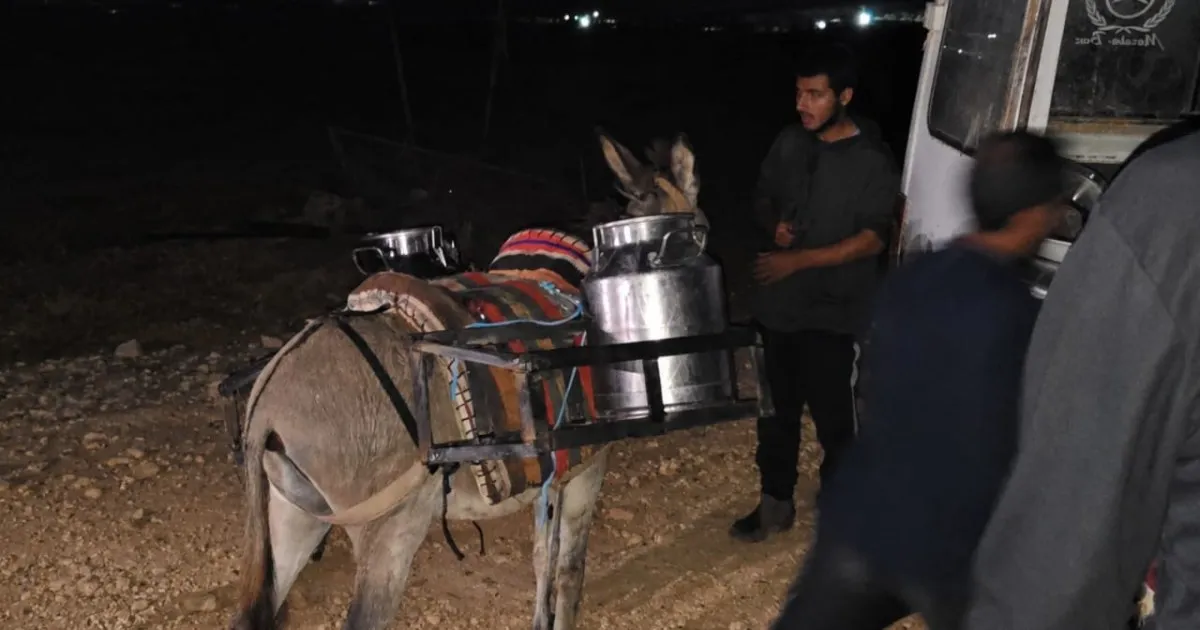
Residents of Ras al-Ahmar say Israeli restrictions have cut access to water, animal feed, healthcare, as military barrier reshapes Jordan Valley.Residents of Ras al-Ahmar, a rural Bedouin community, were forced to carry goods at night on donkeys, away from the eyes of Israeli soldiers and settlers [Moath Ghannam/Al Jazeera]Published On 2 Oct 2026Saeed Ayed* watches over his livestock herd. The animals are starving and parched due to a two-week-long Israeli siege on the Ras al-Ahmar Bedouin community in the occupied West Bank’s Jordan Valley.Access to the community has been blocked since mid-September, as Israeli forces continue building a barrier through Palestinian land in the area, including a road for military patrols, trenches and embankments.Recommended Stories list of 3 itemslist 1 of 3How can Jordan respond to Israel’s escalation across the West Bank?list 2 of 3Israeli drone kills Palestinian in Gaza, settlers kill another in West Banklist 3 of 3Flydubai attack gives Netanyahu new security message ahead of Israel voteend of listSince the road closures began, movement for Palestinians has been severely restricted. They are forced to move around at night, transporting water, fodder and milk via donkeys under the cover of darkness to avoid detection by Israeli soldiers and settlers.Ayed told Al Jazeera that no water had entered the community over the past three days after Israeli forces sealed the access points residents had been using to bring in supplies.“The situation is dire. We are completely besieged, and the livestock cannot survive without water and food for this long,” Ayed said. “We own 15,000 head of livestock, and we fear they will perish because of the siege.”Ras al-Ahmar is a 300-person village home to around 50 families who have lived off livestock and herding since the 1970s. Ayed said that Israeli settler attacks – part of a wider pogrom against Palestinians across the West Bank – had intensified since February, accusing settlers of trying to force residents out to seize their land.“We have faced livestock theft, attacks on our dwellings, beatings of residents and vandalism of our homes. This was happening almost daily, yet we refused to leave. Now, they are completely besieging us to force us out,” he added.The greatest challenge facing residents is restricted access to medical care as a result of the siege, a particular concern for the elderly.Disease is also rampant among livestock, particularly newborn animals. And with veterinary teams unable to reach the area and treat the animals, deaths have been reported.The military barrier – which Israel calls Crimson Thread and says it is needed for security – runs for roughly 20km (12 miles) through the northern Jordan Valley, with a width of up to 50 metres (165 feet).Construction expanded early this year, including the digging of trenches and the bulldozing of agricultural land that damaged wells, water networks and greenhouses. The Israeli military seized nearly 115 hectares, 85 percent of which is privately owned Palestinian land, according to Kerem Navot, which monitors Israeli land policies in the West Bank.Abdullah Bisharat, head of the village council of Ras al-Ahmar and Atuf, a nearby rural area also facing the military blockade, told Al Jazeera that the Israeli blockade has stopped 51 schoolchildren from attending classes for two weeks because vehicles can no longer reach them.Israeli forces confiscated a tractor belonging to the village council on Sunday, detaining its driver as he was delivering animal fodder and water to Ras al-Ahmar, Bisharat said.“We reached out to human rights organisations, but unfortunately no one was able to break the siege. Hundreds of people there are suffering, the majority of whom are women and children,” Bisharat added.A trench dug by Israel around the rural Bedouin community of Ras al-Ahmar has restricted their movement [File: Moath Ghannam/Al Jazeera]Broader contextThe targeting of Bedouin and herding communities in the Jordan Valley is part of a mounting pressure campaign on residents to abandon their properties by restricting access to land and pastures. The tactics include settler violence, the demolition of structures and the closure of roads and access points.The United Nations Office for the Coordination of Humanitarian Affairs (OCHA) has described Bedouin and herding communities as among the groups most vulnerable to displacement in the West Bank. Dozens of Palestinian communities across the West Bank have been entirely or partially displaced since 2023, when Israel began its genocide in Gaza and ramped up its attacks on the West Bank after the October 7 Hamas attack.OCHA has reported that at least 130 Palestinian communities have experienced full or partial displacement since January 2023, with 48 communities completely displaced, including 12 from January to August.According to OCHA, more than 2,500 Palestinians were displaced in 2026 due to settler attacks and related access restrictions, out of a total of more than 6,400 displaced since 2023.As the Israeli elections – scheduled for October 27 – approach, Palestinian analysts and rights advocates argue that the measures being implemented on the ground are entrenching a new reality that may persist regardless of the next government.Hassan Mleihat, chairman of the al-Baydar Organization for Defense of Bedouin Rights, told Al Jazeera that settlers appear to be rapidly intensifying measures aimed at displacing Bedouin communities in the lead-up to the elections.Mleihat said that Israel’s objective was to expel as many Palestinians as possible and seize control of their land.“The road being constructed near Ras al-Ahmar aims to dominate the area’s land under security pretexts and to isolate Palestinian communities into tiny geographical pockets, effectively confining their presence there,” he said.A new realityObservers believe the significance of these Israeli measures against Palestinian communities extends beyond their immediate impact on the population, creating demographic, geographic and security-related changes that may prove irreversible even if the Israeli political landscape shifts after the elections.Adel Shadid, an expert on Israeli affairs, told Al Jazeera that Israel currently exercises an unprecedented degree of control over Palestinian territory in the West Bank. Palestinians, he said, live in small, fragmented and scattered enclaves with Israeli control over security, military and economic matters, as well as the minutiae of daily life.He said the change was not only limited to geography but also entails normalising the presence of illegal Israeli settlements in the West Bank so that they are viewed as an integral part of the region’s fabric, rather than a temporary presence or a reality subject to change.“This shift is accompanied by the entrenchment of the perception that the West Bank is no longer viewed as a Palestinian area – or even a disputed one – but rather as a territory where Jews have the right to live in safety and security,” he said.Shadid argued that this perspective also shapes how Israeli and Palestinian communities in the West Bank are perceived by the Israeli state. Israeli settlers are presented as a population requiring protection, while Palestinians are increasingly framed primarily as a security threat.“This logic extends to how the land and the very elements of life are treated. A tree, for instance, might be viewed as a potential resource for acts targeting the Jewish community; consequently, cutting it down is seen, within this framework, as a security measure that warrants no intervention,” he said.Shadid said this was also changing perceptions of the role of the Israeli army and police in the West Bank. He argued that the security forces’ role was increasingly seen as protecting settlers against a so-called “Palestinian threat”, rather than restraining settler aggression against Palestinians.
SRCAl Jazeera
LANGEN
LEANCenter
WORDS1 227
ENT12
FRI · 2026-10-02 · 18:18 GMTBRIEF NSR-2026-1002-115910
NSR-2026-1002-115910News Report·EN·Human Rights
Israeli barrier cuts off water to West Bank Palestinians before elections
Residents of the Bedouin community of Ras al-Ahmar in the occupied West Bank's Jordan Valley are facing severe restrictions on essential supplies, including water and animal feed, due to the construction of an Israeli military barrier. Since mid-September, access to the community has been blocked, forcing residents to transport goods at night via donkeys to avoid Israeli soldiers and settlers.
Fayha ShalashAl JazeeraFiled 2026-10-02 · 18:18 GMTLean · CenterRead · 5 min
Al JazeeraFIG 01
Reading time
5min
Word count
1 227words
Sources cited
2cited
Entities identified
12entities
Quality score
100%
§ 01
Briefing Summary
AI-generatedNEWSAR · AI
Residents of the Bedouin community of Ras al-Ahmar in the occupied West Bank's Jordan Valley are facing severe restrictions on essential supplies, including water and animal feed, due to the construction of an Israeli military barrier. Since mid-September, access to the community has been blocked, forcing residents to transport goods at night via donkeys to avoid Israeli soldiers and settlers. The siege has led to livestock starvation and deaths, and has also restricted access to healthcare for the elderly and veterinary services for animals. The barrier, described by Israel as a security measure, has resulted in the seizure of Palestinian land and damage to infrastructure. The restrictions have also prevented 51 schoolchildren from attending classes for two weeks. This situation is part of a broader campaign targeting Bedouin communities in the Jordan Valley to pressure them to abandon their properties.
Confidence 0.90Sources 2Claims 5Entities 12
§ 02
Article analysis
Model · rule-basedFraming
Human Rights
Conflict
Tone
Mixed Tone
AI-assessed
CalmNeutralAlarmist
Factuality
0.60 / 1.00
Mixed
LowHigh
Sources cited
2
Limited
FewMany
§ 03
Key claims
5 extracted01
The Israeli military barrier, called Crimson Thread, runs for roughly 20km through the northern Jordan Valley and is up to 50 metres wide.
factualIsraeli military
Confidence
0.95
02
Access to the Ras al-Ahmar community has been blocked since mid-September due to Israeli forces building a barrier.
factualAl Jazeera
Confidence
0.95
03
No water had entered the community for three days prior to the report due to Israeli forces sealing access points.
factualSaeed Ayed
Confidence
0.90
04
Israeli restrictions have cut access to water and animal feed for residents of Ras al-Ahmar.
factualResidents of Ras al-Ahmar
Confidence
0.90
05
Israeli settler attacks, including livestock theft and vandalism, have intensified since February.
factualSaeed Ayed
Confidence
0.80
§ 04
Full report
5 min read · 1 227 words§ 05
Entities
12 identifiedKey playerOppositionContextPositiveNeutralNegative
Organizations3
Locations5
Events1
§ 06
Keywords & salience
10 termsisraeli barrier
1.00
west bank
1.00
water access
0.90
livestock
0.80
siege
0.80
palestinians
0.70
jordan valley
0.60
settlers
0.50
healthcare access
0.40
elections
0.40
§ 07
Topic connections
Interactive graph Network visualization showing 6 related topics
View Full Graph Person Organization Location Event|Click node to navigate|Edge numbers = shared articles