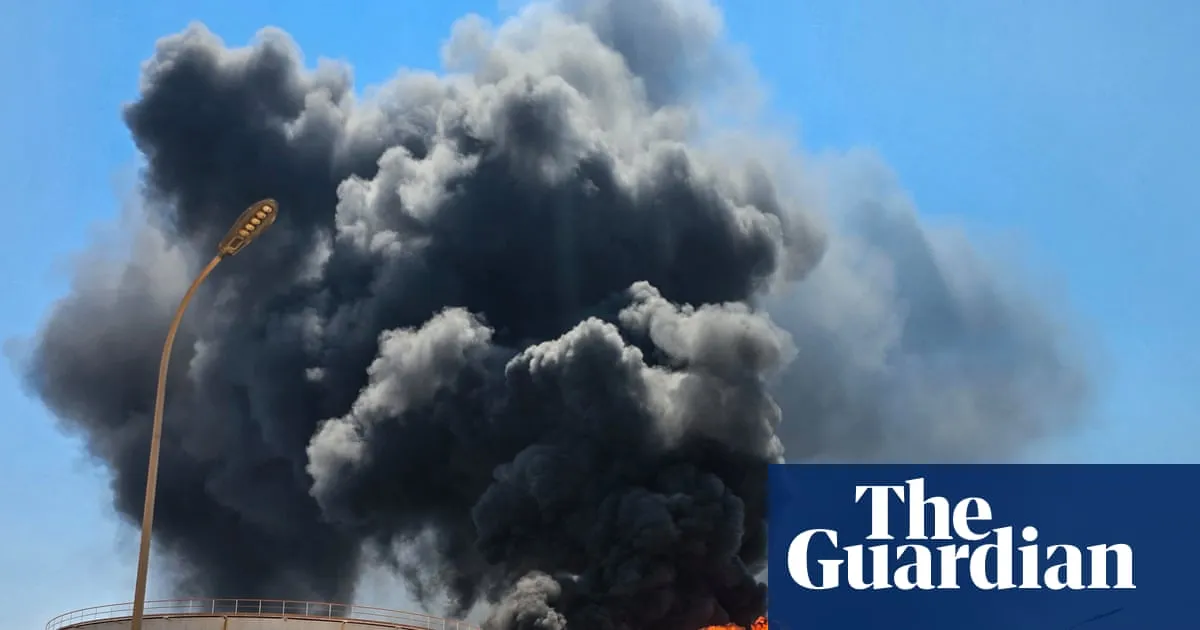
Allegations that the son of the Libyan warlord Khalifa Haftar oversaw a “terror cell” that launched Drone attacks on fuel storage facilities and power stations in western Libya have upended plans for the Tripoli-based Government of National Unity (GNU) to continue cooperating with Haftar on a plan to unify the country.Saddam Haftar, the deputy commander of the so-called Libyan National Army (LNA), has increasingly been seen by the US as an important figure in its plans to unify Libyan security, judicial and political institutions.But a round of Drone attacks in August worsened electricity blackouts in the west of the country, putting intense popular pressure on the GNU led by the prime minister, Abdul Hamid Dbeibah.Libya has been split between the east, dominated by Haftar, and the west, governed by the GNU, since the fall of Col Muammar Gaddafi in 2011, leaving the oil-rich country at the mercy of corruption, militia, migrant traffickers and myriad external actors.Khalifa Haftar. Photograph: Esam Omran Al-Fetori/ReutersDonald Trump’s Africa adviser, Massad Boulos, has hatched a plan to unify the two Libyan governments in which Haftar from the east would take on the role of president and a member of the Dbeibah family from the west would become prime minister.Boulos has insisted he is not trying a quick fix that entrenches family elites in Libya. “It’s not about families or names,” Boulos said when asked about the reported Haftar-Dbeibah deal, before adding: “At the end of the day, those are individuals that have to be in one position or the other.”But the drone strikes, it is claimed, were prompted by Haftar’s anger at Dbeibah apparently stalling on the Boulos merger plan and by Tripoli allegedly encouraging tribes in southern Libya to attack and kill his forces.Over more than five days in August, drones attacked the Zawiya oil station and fuel storage facilities in western Libya. The drone strikes hit the gasoline-storage tank at the Zawiya oil complex, west of Tripoli, causing a large fire and the tank’s collapse. The tank held approximately 4.5m litres of fuel when it was struck, according to Libya’s National Oil Corporation.Libyan oil refinery engulfed in flames after drone attack – videoOn 5 September, three Libyans and one Spanish citizen were arrested in southern Tripoli by the GNU for their alleged role in a plot that was intended to include an attack on Tripoli airport. It was thought the whole group involved five Spaniards and four Libyans. The three arrested Libyans were allegedly affiliated with the Tareq ben Ziyad brigade, an LNA formation. Information that has emerged from interviews about the plot, and Saddam Haftar’s alleged role, not just in Libya, has been described as a goldmine, capable of weakening Khalifa Haftar.Sources in the GNU said the alleged plotters were working for Saddam Haftar. “No formal decision has been made, but in light of what has been discovered it is impossible to work with Saddam,” the sources said.The claims not only damage Saddam Haftar’s role in the Boulos plan but also the parallel UN sponsored 4+4 talks involving the main four political institutions in Libya that led to an August agreement to stage elections within two years. The deal endorsed by the UN security council overcomes previous obstacles to elections, and had been backed by the main actors capable of delivering the change.Walid Ellafi, minister for state for political affairs in the UN-backed Libyan GNU and an enthusiast for elections, said: “Our support for the 4+4 process is rooted in its role as a UN sponsored framework offering a new approach to achieving practical results that pave the way for elections and institutions whose political legitimacy derives from the will of the people – not as a political settlement that overlooks violations or sets aside the rights of those affected.”He opposes an elite east-west political deal that brushes aside longstanding grievances such as the displacement of 9,000 families in Benghazi during the 2014 war.The allegations about the sabotage operation may intensify a power struggle between the three sons of Khalifa Haftar in the east.Saddam Haftar is seen as his father’s most likely heir, possesses the most resources, enjoys the backing of the United Arab Emirates and has so far dominated the political tracks. But his brothers, Khaled and Belqasim – more allied with Egypt than the United Arab Emirates – have recently started to challenge his dominance.
SRCThe Guardian - World News
LANGEN
LEANCenter-Left
WORDS724
ENT12
SAT · 2026-10-03 · 09:00 GMTBRIEF NSR-2026-1003-116012
NSR-2026-1003-116012News Report·EN·Political Strategy
Libyan unity talks upended as warlord’s son linked to drone attacks on fuel facilities
Plans to unify Libya have been disrupted by allegations that Saddam Haftar, son of warlord Khalifa Haftar and deputy commander of the Libyan National Army (LNA), oversaw a "terror cell" responsible for drone attacks on fuel facilities and power stations in western Libya. These attacks in August worsened electricity blackouts and intensified pressure on the Tripoli-based Government of National Unity (GNU).
Patrick WintourThe Guardian - World NewsFiled 2026-10-03 · 09:00 GMTLean · Center-LeftRead · 3 min
The Guardian - World NewsFIG 01
Reading time
3min
Word count
724words
Sources cited
3cited
Entities identified
12entities
Quality score
100%
§ 01
Briefing Summary
AI-generatedNEWSAR · AI
Plans to unify Libya have been disrupted by allegations that Saddam Haftar, son of warlord Khalifa Haftar and deputy commander of the Libyan National Army (LNA), oversaw a "terror cell" responsible for drone attacks on fuel facilities and power stations in western Libya. These attacks in August worsened electricity blackouts and intensified pressure on the Tripoli-based Government of National Unity (GNU). The allegations have made cooperation with Saddam Haftar impossible for the GNU, impacting US-backed merger plans and UN-sponsored talks aimed at holding elections. The drone strikes are believed to have been a response to perceived delays in a merger plan and alleged encouragement of tribal attacks on LNA forces. The GNU has arrested individuals allegedly affiliated with an LNA formation and working for Saddam Haftar in connection with a plot that included an attack on Tripoli airport.
Confidence 0.90Sources 3Claims 5Entities 12
§ 02
Article analysis
Model · rule-basedFraming
Political Strategy
Conflict
Tone
Mixed Tone
AI-assessed
CalmNeutralAlarmist
Factuality
0.70 / 1.00
Factual
LowHigh
Sources cited
3
Well sourced
FewMany
§ 03
Key claims
5 extracted01
Drone attacks in August worsened electricity blackouts in western Libya, putting pressure on the GNU.
factualarticle
Confidence
0.90
02
Three Libyans and one Spanish citizen were arrested for a plot that included an attack on Tripoli airport, allegedly affiliated with an LNA formation.
factualGNU
Confidence
0.80
03
A plan hatched by Donald Trump's Africa adviser, Massad Boulos, proposed Khalifa Haftar as president and a Dbeibah family member as prime minister.
factualMassad Boulos
Confidence
0.80
04
Allegations that Saddam Haftar oversaw a 'terror cell' that launched drone attacks on fuel facilities have upended plans for the GNU to cooperate with Khalifa Haftar on unifying Libya.
factualallegations
Confidence
0.70
05
The drone strikes were allegedly prompted by Haftar's anger at Dbeibah stalling on the merger plan and Tripoli encouraging tribes to attack his forces.
factualclaimed
Confidence
0.60
§ 04
Full report
3 min read · 724 words§ 05
Entities
12 identifiedKey playerOppositionContextPositiveNeutralNegative
People4
Organizations3
Locations4
§ 06
Keywords & salience
10 termsdrone attacks
1.00
libyan unity talks
1.00
fuel facilities
0.90
khalifa haftar
0.80
government of national unity
0.80
libyan national army
0.70
political institutions
0.60
security
0.50
corruption
0.40
migrant traffickers
0.40
§ 07
Topic connections
Interactive graph Network visualization showing 42 related topics
View Full Graph Person Organization Location Event|Click node to navigate|Edge numbers = shared articles