close Video Flavio Bolsonaro leads São Paulo caravan ahead of Brazil's presidential election Flavio Bolsonaro joined supporters in Santa Barbara D'Oeste to lead a motorcade. Polls in Brazil show a tight presidential race with incumbent Luiz Inacio Lula da Silva. (Video: Reuters.) NEWYou can now listen to Fox News articles! Hören Sie sich diesen Artikel an 5 Min SÃO PAULO: As Brazil goes to the polls Sunday, analysts are watching closely to see whether the continent’s most populous nation will be the latest domino to fall into the conservative column, following Colombia, Peru, Chile, and others in voting out the left-wing President Lula-da-silva" class="entity-link entity-person" data-entity-id="1908" data-entity-type="person">Luiz Inácio Lula da Silva. Known by his nickname Lula, the 80-year-old, who served time in jail for corruption in a massive payback bribery scandal, barely leads Brazilian senator Flavio Bolsonaro, the son of former president Jair. Going into Sunday’s first round, neither candidate is expected to win outright. The latest Datafolha poll puts Lula at 42% and Bolsonaro at 38%, with a two-point margin of error. If the election goes to a runoff, it has Lula up by 3%. But the polls have been wrong before. ANTI-CARTEL CANDIDATE 'THE TIGER' CHANNELS TRUMP AND BUKELE IN Colombia ELECTION SHOCKER Flavio Bolsonaro, Brazilian presidential candidate, top center, during a campaign rally in Sao Joao de Meriti, Rio de Janeiro state, Brazil, on Saturday, Sept. 26, 2026. President Luiz Inacio Lula da Silva and Bolsonaro are deadlocked less than two weeks before Brazil's election, a new poll showed, following fresh revelations about the challenger's ties to a jailed banker at the center of a massive fraud scheme. (Dado Galdieri/Bloomberg via Getty Images) "The problem with Datafolha, which is the largest polling institute in the country, is that it tends to underestimate the force and voting intention in candidates running against Lula or the Workers Party (PT). This has been consistent for at least over a decade, and it underestimated Jair Bolsonaro’s number on the runoff of 2018 by 7%," Roberto Reis, an electoral strategist working with several candidates across multiple electoral tiers and analyzing aggregator data, told Fox News Digital. "According to the latest aggregator data such as MRT News or Polling Data, we currently have Lula leading Bolsonaro 42% to 39% on the first runoff of the elections with Bolsonaro leading Lula 45% to 44% on the runoff," he added. One Brazil analyst said that the election is about more than just another ideological contest between left and right in Latin America — It is the single major remaining stumbling block in the Western Hemisphere that still hasn’t shifted to conservativism and while there are other left-wing governments in the hemisphere, including Cuba, Jamaica, Mexico, Nicaragua and Uruguay, Brazil is by far the largest and most important economy in this group with its status as the 11th largest world economy according to the IMF and the 10th largest world economy according to the World Bank. ‘WAVE OF FREEDOM’ SWEEPS LATIN AMERICA AS TRUMP ALLY TAKES FIGHT TO MARXIST TERROR GROUP Brazil's President and presidential candidate Luiz Inacio Lula da Silva (C) waves next to Vice-President Geraldo Alckmin (L) and to his candidate for Sao Paulo's governor, Fernando Haddad during a campaign rally on the eve of the general election, in Sao Paulo, Brazil on October 3, 2026. Brazilians go to the polls on October 4, 2026, in a tight race led by leftist President Luiz Inacio Lula da Silva and right-wing senator Flavio Bolsonaro, son of former president Jair Bolsonaro, who is serving house arrest. (Luis Robayo/AFP Via Getty Images) Bolsonaro has spent much of the campaign cultivating a relationship with President Donald Trump and presenting himself as a potential U.S. partner in the Western Hemisphere. He met Trump at the White House in May, where the two discussed organized crime, tariffs and Brazil's rare earth and critical mineral reserves — both critical prime-source materials Brazil has plenty of and which could significantly lower U.S. and European dependency on Russia and China. Bolsonaro also said he had asked Washington to designate Brazil's two largest criminal organizations, the First Capital Command (PCC, in its Portuguese acronym) and Red Command (Comando Vermelho, in Portuguese), as terrorist groups. Both designations were accepted by the Department of State on May 28 and became effective in June under section 219 of the Immigration and Naturalization Code. TRUMP ADMIN'S LIST OF US-DESIGNATED 'FOREIGN TERRORIST' GROUPS IN LATIN AMERICA EXPANDS TO 21 The designation by the U.S. government incensed Lula and his allies and was viewed as direct meddling in domestic affairs and a rubber stamp from the Trump administration that the left-wing, populist president has not been doing enough to combat organized crime in his country, directly favoring Bolsonaro’s contest in the elections. Flávio Bolsonaro has also proposed a free-trade agreement between Brazil and the United States, potentially expanding it into a broader free-trade arrangement among countries in the Americas. And his campaign has emphasized cooperation with Washington on critical minerals, an increasingly strategic issue as the Trump administration tries to reduce U.S. dependence on China, as per a current report by Brazil’s leading newspaper, Folha de S. Paulo. That would represent a significant change in emphasis from Lula's foreign policy. Senator Flávio Bolsonaro has entered the 2026 Brazilian presidential race after father's prison endorsement. (Evaristo Sa / AFP via Getty Images) China is Brazil's largest trading partner, and Brazilian agricultural exports to China totaled more than $55 billion in 2025, according to Reuters. Lula has defended maintaining strong relations with Beijing while pursuing what he describes as an independent foreign policy that oftentimes borders on aggressiveness towards both the United States and its closest allies, such as Israel. Lula's relationship with Trump has been considerably more complicated. Washington imposed new 25% tariffs on a wide range of Brazilian goods in July, affecting about $7 billion of Brazilian exports, while Lula's government has challenged the measures and sought negotiations with Washington with very limited success so far. Washington has also imposed a ban on most new permanent visa requests coming from Brazil, and that could lead to green cards. TANVI RATNA: LATIN AMERICA'S RIGHT TURN IS REDRAWING THE UNITED STATES' BACKYARD Brazilian President Luiz Inacio Lula da Silva announced his country was open for business at the inauguration of a factory for a Chinese automaker. (Allison Robbert/Bloomberg via Getty Images; Tingshu Wang - Pool/Getty Images) A Bolsonaro presidency would come with stated plans for closer U.S. economic and security cooperation, greater alignment with Israel, a more confrontational posture toward China's influence in Brazil and reduced friction both within the hemisphere and in global affairs. Whether those policies can all be implemented depends on negotiations with Congress, Brazil's powerful bureaucracy, and the country's economic interests — especially the agribusiness and mining powerhouses in the country. A Lula victory would mean continuity in a foreign policy trajectory that seeks strong commercial ties with China while maintaining strategic autonomy from Washington, alongside his government's current position on Israel and Gaza. Both attitudes are in direct defiance of Trump’s policies and could end up damaging U.S.-Brazilian relations even further. With the presidential race effectively heading toward a second round, the stakes for a new version of the Americas for U.S. interests could very much hinge on its outcome. Solly Boussidan is an international journalist covering Latin America for Fox News Digital. He has previously covered international affairs, war, finance and travel for several U.S. and international outlets. He is currently based in Brazil.
SRCFox News - World
LANGEN
LEANCenter-Right
WORDS1 244
ENT12
SUN · 2026-10-04 · 10:00 GMTBRIEF NSR-2026-1004-116219
NSR-2026-1004-116219News Report·EN·Political Strategy
Latin America’s conservative shift faces its biggest test yet in Brazil election
Brazil is holding a presidential election where incumbent Luiz Inácio Lula da Silva faces a close challenge from Flavio Bolsonaro, son of former president Jair Bolsonaro. This election is seen as a crucial test for a conservative shift occurring across Latin America, with Brazil being the region's largest economy.
Fox News - WorldFiled 2026-10-04 · 10:00 GMTLean · Center-RightRead · 5 min
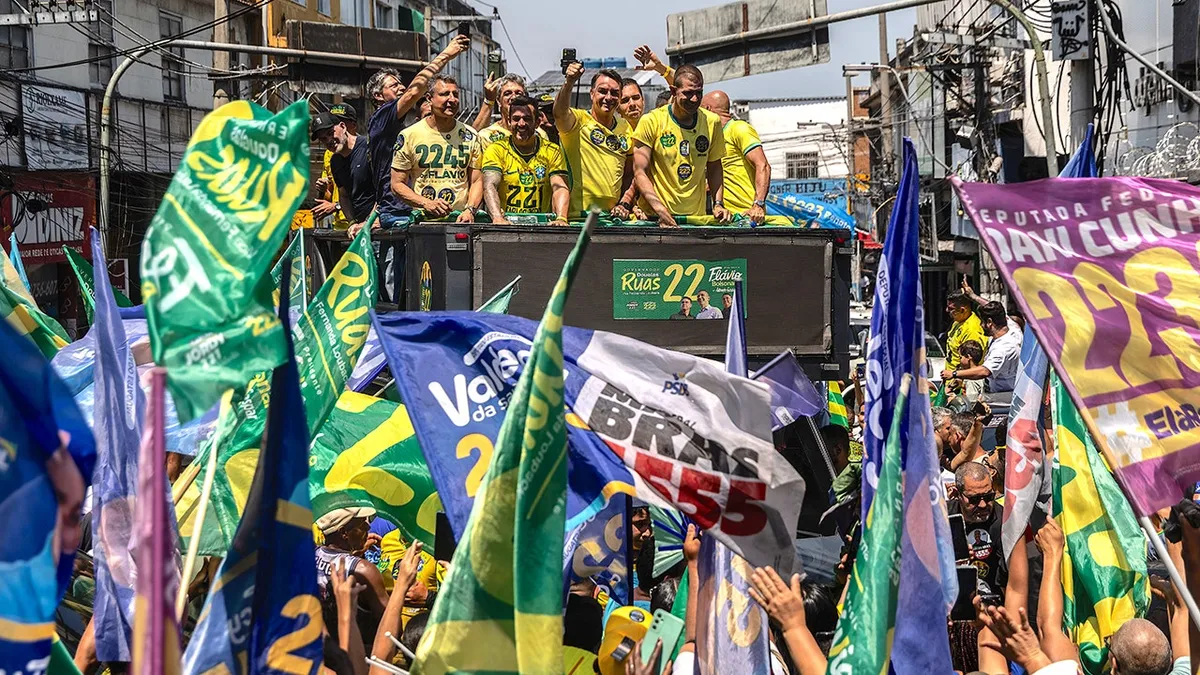
Fox News - WorldFIG 01
Reading time
5min
Word count
1 244words
Sources cited
2cited
Entities identified
12entities
Quality score
100%
§ 01
Briefing Summary
AI-generatedNEWSAR · AI
Brazil is holding a presidential election where incumbent Luiz Inácio Lula da Silva faces a close challenge from Flavio Bolsonaro, son of former president Jair Bolsonaro. This election is seen as a crucial test for a conservative shift occurring across Latin America, with Brazil being the region's largest economy. Polls indicate a tight race, with neither candidate expected to win outright in the first round, suggesting a potential runoff. Bolsonaro has cultivated ties with Donald Trump, discussing issues like organized crime and critical minerals, and has advocated for closer U.S.-Brazil cooperation. Lula's potential victory would signify continuity in foreign policy, maintaining strong ties with China and strategic autonomy from the U.S. The outcome could significantly impact U.S. interests in the Western Hemisphere.
Confidence 0.90Sources 2Claims 5Entities 12
§ 02
Article analysis
Model · rule-basedFraming
Political Strategy
Economic Impact
Tone
Mixed Tone
AI-assessed
CalmNeutralAlarmist
Factuality
0.60 / 1.00
Mixed
LowHigh
Sources cited
2
Limited
FewMany
§ 03
Key claims
5 extracted01
Polls show a tight race between incumbent Luiz Inácio Lula da Silva (Lula) and Brazilian senator Flavio Bolsonaro, with neither expected to win outright in the first round.
factual
Confidence
0.90
02
Brazil's presidential election is seen as a test for a conservative shift in Latin America, following similar outcomes in Colombia, Peru, and Chile.
factual
Confidence
0.90
03
Electoral strategist Roberto Reis claims Datafolha tends to underestimate candidates running against Lula or the Workers Party (PT), citing the 2018 election where it underestimated Jair Bolsonaro's runoff numbers by 7%.
quoteRoberto Reis
Confidence
0.80
04
The latest Datafolha poll shows Lula at 42% and Bolsonaro at 38%, with a two-point margin of error.
statisticDatafolha
Confidence
0.80
05
Aggregator data suggests Lula leading Bolsonaro 42% to 39% in the first round and Bolsonaro leading Lula 45% to 44% in a runoff.
statisticRoberto Reis (citing MRT News or Polling Data)
Confidence
0.70
§ 04
Full report
5 min read · 1 244 words§ 05
Entities
12 identifiedKey playerOppositionContextPositiveNeutralNegative
People4
Locations4
§ 06
Keywords & salience
9 termsbrazil election
1.00
conservative shift
0.90
luiz inácio lula da silva
0.80
flavio bolsonaro
0.80
latin america
0.70
polling data
0.60
runoff election
0.50
corruption
0.40
workers party
0.40
§ 07
Topic connections
Interactive graph Network visualization showing 37 related topics
View Full Graph Person Organization Location Event|Click node to navigate|Edge numbers = shared articles