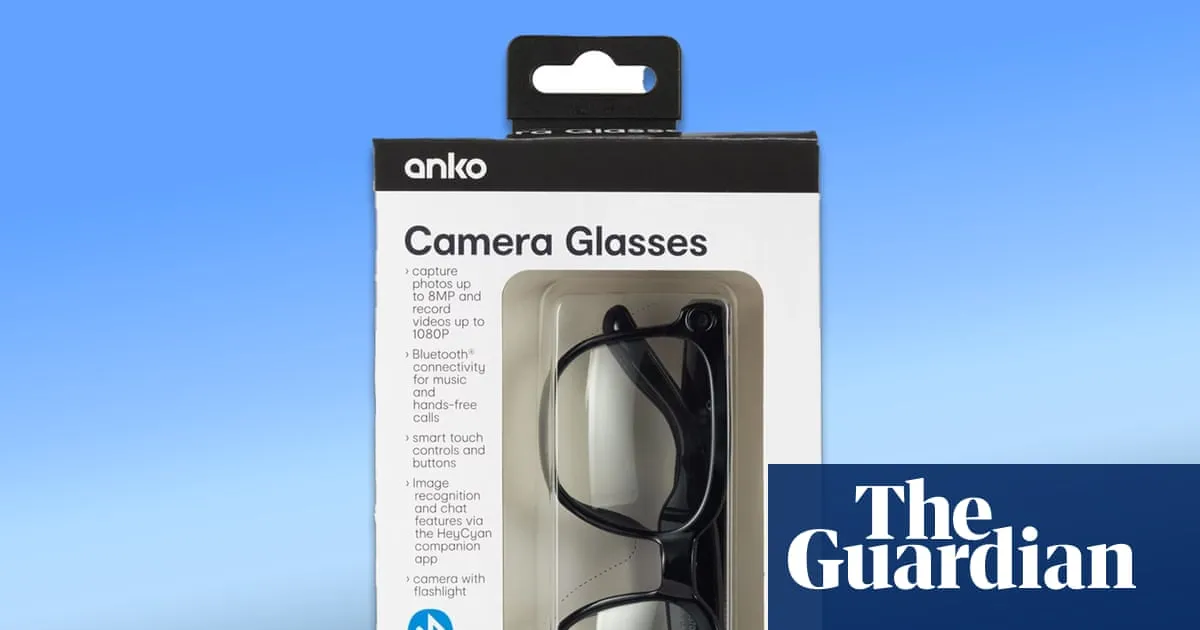
Australia’s privacy regulator launched an investigation into the China-based company behind the HeyCyan app in Kmart’s Anko-branded discount version of Meta’s smartglasses. Photograph: Kmart View image in fullscreen Australia’s privacy regulator launched an investigation into the China-based company behind the HeyCyan app in Kmart’s Anko-branded discount version of Meta’s smartglasses. Photograph: Kmart Privacy watchdog launches probe into China-based company behind Kmart ‘pervert glasses’ app Commissioner said Shenzhen Qingcheng, the app maker behind the HeyCyan app in the smartglasses, failed to respond to her inquiries Get our breaking news email, free app or daily news podcast The Australian privacy regulator has opened an investigation into the China-based software company behind the HeyCyan app in Kmart’s $89 smartglasses, following public outrage over the covert use of the devices. In August, Guardian Australia reported Kmart had sold out of the Anko-branded discount version of Meta’s smartglasses that can capture images and record high-definition video, which led to widespread concern and calls to ban or restrict their use. A GetUp petition has had more than 55,000 signatures calling to restrict the use of what has been labelled as “pervert glasses”, and councils around the country have looked to ban the glasses in public spaces such as swimming pools. The federal government is also considering a restriction on use in government workplaces. The Australian privacy commissioner, Carly Kind, was asked by the attorney general to assess the privacy implications of the glasses at the time. Kind wrote to Kmart and BDI Technology, retailers for the glasses, as well as Shenzhen Qingcheng, the app maker behind the HeyCyan app in the glasses. She also wrote to Meta – for its Ray-Bans glasses – and Google which is planning its own smartglasses. In a blog post on Wednesday, Kind announced an investigation has been opened into Shenzhen Qingcheng after it failed to respond to inquiries, “as well as concerns arising from third party analysis of the technology itself as well as the entity’s ” None of the other companies will be investigated as part of this process, Kind said. The privacy commissioner also highlighted the difficulty in applying privacy law to individuals who may use the devices given the privacy act only applies to companies and Commonwealth agencies – not individuals. “Retailers that sell smart glasses – for example on an e-commerce website – or companies that manufacture them, may not have any Privacy Act obligations if they do not collect any personal information with respect to those devices,” Kind said. “Instead, the entity providing the software at use in the device is likely to be the entity that collects and holds the information for the purpose of privacy law.” Kind said that potential changes to the privacy act proposed by the government would strengthen how privacy law would apply to surveillance wearables such as smartglasses. “The most substantial change will be the replacement of the ‘reasonably necessary for an entity’s functions and activities’ test with a ‘fair and reasonable’ test,” she said. “The new test will require an entity to look at a range of factors, including the extent to which an individual had genuine choice in the collection of their personal information, as well as the best interests of the child where children are involved.” Kind said she hoped the community would “find comfort” in the proposed reforms as it would raise the bar over what personal information smartglasses can collect. “These reforms are likely to become increasingly necessary as we face subsequent generations of surveillance wearables and connected devices, from personal assistant gadgets to ambient recording badges.” Researchers at the University of Sydney in August analysed 350 publicly-available Instagram videos shot on smartglasses from around the world during 2023 to 2026, showing what they said was “a shift to discreet, point-of-view recording that is difficult for bystanders to detect”. In a subset of these videos, about 60% of interactions could be classified as potential harassment, with subjects visibly uneasy or attempting to disengage. Canterbury-Bankstown and Sydney City are among the councils in Sydney to have banned the glasses from some venues, as well as Brisbane in Queensland, and Yarra city council in Melbourne. Explore more on these topics Wearable technology Privacy AI (artificial intelligence) Gadgets Meta news Share Reuse this content
SRCThe Guardian - World News
LANGEN
LEANCenter-Left
WORDS707
ENT10
TUE · 2026-10-06 · 23:02 GMTBRIEF NSR-2026-1007-116886
NSR-2026-1007-116886News Report·EN·Legal & Judicial
Privacy watchdog launches probe into China-based company behind Kmart ‘pervert glasses’ app
Australia's privacy regulator has launched an investigation into Shenzhen Qingcheng, the China-based company behind the HeyCyan app used in Kmart's $89 smartglasses. This action follows public outrage over concerns about the covert use of the devices, which can capture images and record video.
Josh Taylor Technology reporterThe Guardian - World NewsFiled 2026-10-06 · 23:02 GMTLean · Center-LeftRead · 3 min
The Guardian - World NewsFIG 01
Reading time
3min
Word count
707words
Sources cited
3cited
Entities identified
10entities
Quality score
100%
§ 01
Briefing Summary
AI-generatedNEWSAR · AI
Australia's privacy regulator has launched an investigation into Shenzhen Qingcheng, the China-based company behind the HeyCyan app used in Kmart's $89 smartglasses. This action follows public outrage over concerns about the covert use of the devices, which can capture images and record video. The privacy commissioner initiated the probe after Shenzhen Qingcheng failed to respond to her inquiries. The investigation aims to assess the privacy implications of the technology, especially given that the app provider is likely the entity collecting personal information. The government is also considering reforms to privacy law to better address surveillance wearables. Several councils have already banned the glasses in public spaces.
Confidence 0.90Sources 3Claims 5Entities 10
§ 02
Article analysis
Model · rule-basedFraming
Legal & Judicial
Technology
Tone
Mixed Tone
AI-assessed
CalmNeutralAlarmist
Factuality
0.80 / 1.00
Factual
LowHigh
Sources cited
3
Well sourced
FewMany
§ 03
Key claims
5 extracted01
The privacy act in Australia primarily applies to companies and Commonwealth agencies, not individuals, making enforcement difficult for surveillance wearables.
factualCarly Kind (Australian privacy commissioner)
Confidence
1.00
02
A GetUp petition calling to restrict the use of the glasses has garnered over 55,000 signatures.
statisticGetUp
Confidence
1.00
03
Kmart sold out of the Anko-branded smartglasses, which can capture images and record video, leading to public concern.
factualGuardian Australia
Confidence
1.00
04
The investigation was opened after Shenzhen Qingcheng failed to respond to inquiries from the privacy commissioner.
factualCarly Kind (Australian privacy commissioner)
Confidence
1.00
05
Australia's privacy regulator has launched an investigation into Shenzhen Qingcheng, the China-based company behind the HeyCyan app in Kmart's smartglasses.
factualAustralian privacy regulator
Confidence
1.00
§ 04
Full report
3 min read · 707 words§ 05
Entities
10 identifiedKey playerOppositionContextPositiveNeutralNegative
Organizations6
§ 06
Keywords & salience
10 termssmartglasses
1.00
privacy
1.00
investigation
0.90
heycyan app
0.80
china-based company
0.80
privacy watchdog
0.70
kmart
0.70
covert use
0.60
privacy law
0.50
public outrage
0.40
§ 07
Topic connections
Interactive graph No topic relationship data available yet. This graph will appear once topic relationships have been computed.