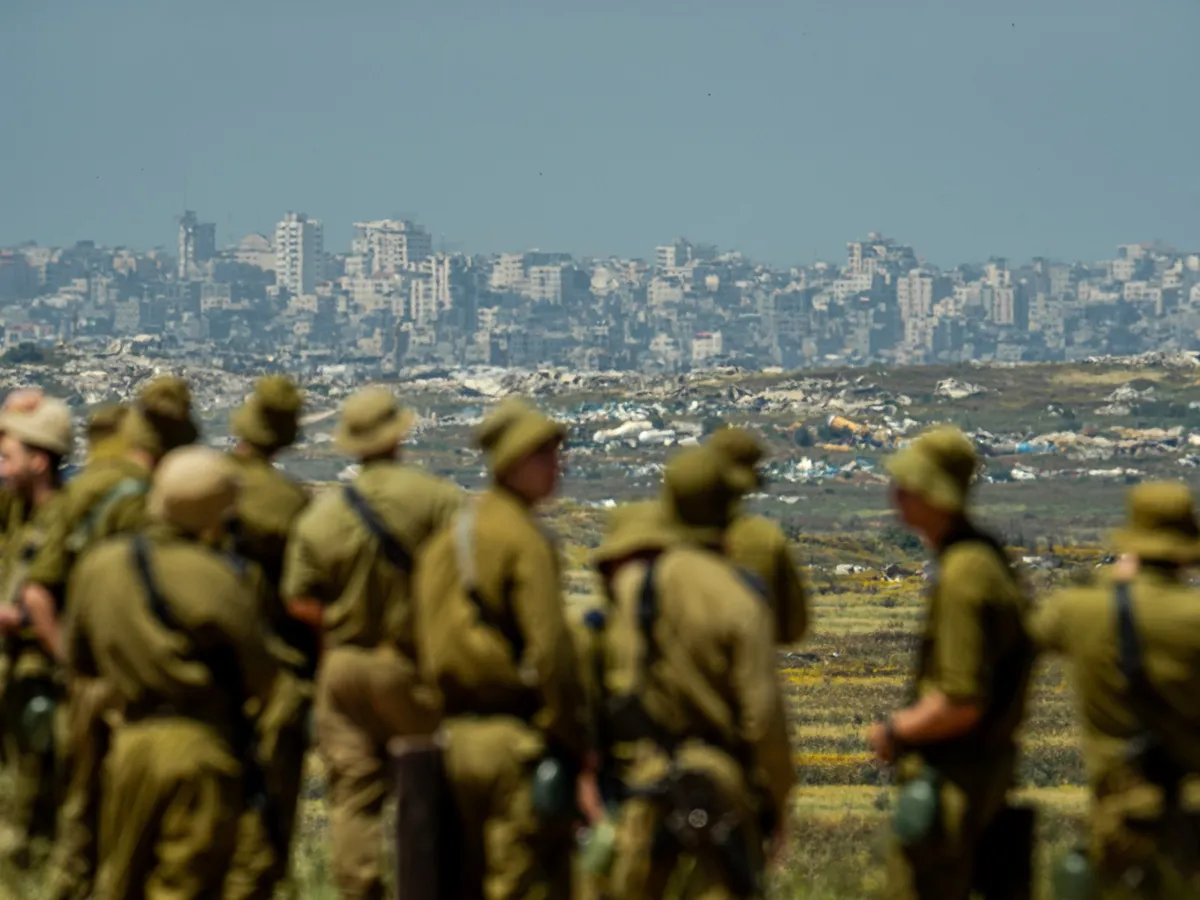
Israel’s military might has failed to achieve the political goals in Gaza it was supposed to.Published On 7 Oct 2026Israeli soldiers looking at the destroyed city of Jabalia, in Gaza Strip, near Kibbutz Nir Am on April 22, 2026 in Kibbutz Nir Am, Israel [Erik Marmor/Getty Images]Three years have passed since Hamas’s attack shook Israel and triggered the ongoing genocidal war. The image of the Israeli army as an invincible force was shattered. In response, Israel used all its military power – except the nuclear bomb – and mobilised all its Western allies to unleash an unprecedent campaign of death and destruction that has devastated Gaza.The Israeli army did not just target military positions and fighters of the Islamic resistance, it set out to punish the civilian population through massacres and mass destruction. By now, it has killed more than 74,000 and injured more than 180,000, starved the entire population, destroyed the healthcare system, devastated the education system, and wiped out most of Gaza’s life-sustaining infrastructure, including water treatment and desalination plants and electricity grid.If the purpose of military power is to achieve political objectives, then the measure of success cannot be the number of people killed or the scale of destruction wrought. It has to be whether the conflict has ended on the desired terms.But three years into this carnage, Israel appears unable to translate its military superiority into a political reality that reflects its stated goals.From the start, the Israeli government made clear it aimed to free the captives, eliminate the Palestinian resistance, impose security control over the Gaza Strip, and establish an alternative administration. It also tacitly demonstrated it wished to prepare the ground for the eventual expulsion of the Palestinians.So what has it achieved so far?First, all captives have been freed. But of the 250 taken to Gaza, the Israeli army managed to free just eight and recovered the bodies of another 12. It shot dead at least three and killed an unknown number of others during bombing operations.The vast majority of captives – both dead and alive – were released after intense diplomacy and negotiations with Hamas. It is quite telling that the Israeli army’s point man for the captives issue recently said that the captives could have been released a year earlier and some of those who died could have been saved. Overwhelming military power clearly failed in the captives file.Second, Israel has also been unable to end the presence of the Palestinian resistance in the Gaza Strip despite extensive military operations and the assassination of a large number of its leaders. Hamas continues to be in control of parts of the Strip despite facing continuing Israeli bombing campaigns and attacks by pro-Israel Palestinian militias. Israel has now been forced to negotiate Hamas’s disarmament rather than achieve it by force.Third, the Israeli army has occupied 60 percent of the Gaza Strip, but it has stopped short of a massive operation to take over the rest of the territory. That is because it understands that the political, humanitarian, and military costs of such a decision would be too high.Fourth, Israel and its foremost ally, the United States, put a lot of effort into the creation of the Board of Peace and a plan for the reconstruction and alternative administration of the Gaza Strip that excludes the UN. However, that effort has largely failed. The administrative committee for Gaza has not entered the territory to take over governing and the humanitarian provisions of the agreement are yet to be implemented.Finally, the preparation for the expulsion of the Palestinians from Gaza has not made significant progress. Israel has tried to push Palestinians to leave their land through repeated displacement, starvation, the destruction of homes and infrastructure, and various schemes for “voluntary departure”. destruction has made the Strip unlivable, but the majority of the Palestinian population has made clear it wants to stay. There have even been returnees from Egypt.At this point, it is clear that Israel faces a “day after” problem in Gaza. Its military is able to raze the Strip, but not build a new political reality that satisfies Israeli aims and desires.The hope that reducing Gaza into an apocalyptic landscape would push the entire population into such despair that they would give up on their cause and their rights has been quashed.The continued presence of Palestinians, the continued resistance, and the growing political and international prominence of the Palestinian cause have demonstrated that the Israeli approach of brutal aggression has failed.Military power can impose a temporary reality, but it cannot produce political legitimacy on its own. Worse still, it can actually destroy legitimacy. And that is exactly what has happened to the Israeli government and the Israeli project as a whole.When, last month, Israeli Prime Minister Benjamin Netanyahu took to the podium to deliver his speech before the UN General Assembly, representatives of the majority of UN members walked out of the hall.Netanyahu himself faces an arrest warrant issued by the International Criminal Court on charges of war crimes and crimes against humanity.And it’s not just his international standing that the Israeli genocidal war has destroyed.Israel is increasingly spurned by the global majority. A Pew Research survey across 36 countries found that 67 percent of adults see the country unfavourably. The populations of key Israeli allies perceive Israel increasingly negatively: the US – 60 percent; Germany – 73 percent; United Kingdom – 69 percent; France – 68 percent.In Washington, the debate about US support for Israel has intensified to the point that a growing number of lawmakers are supporting bills that propose curbing military aid or imposing sanctions. In European capitals, similar discussions have resulted in the recent imposition of restrictions on trade with illegal Israeli settlements.Today, Israeli leaders will address their nation, boasting of military successes, celebrating military prowess and promising more revenge.But the truth is, the Israeli army, one of the strongest in the world, wielding state-of-the-art fighter jets, sophisticated drones, and AI-navigated 900-tonne bombs, launched a genocidal war against a weak non-state actor armed with small arms … and lost.People can be killed, homes can be pulverised, and territory can be controlled, but a national cause that has resonated with the world for decades cannot be wiped out through military force.The views expressed in this article are the author’s own and do not necessarily reflect Al Jazeera’s editorial stance.
SRCAl Jazeera
LANGEN
LEANCenter
WORDS1 057
ENT10
WED · 2026-10-07 · 15:25 GMTBRIEF NSR-2026-1007-117089
NSR-2026-1007-117089Analysis·EN·Political Strategy
The mass killing does not mean Israel’s winning
Three years after Hamas's attack, Israel's military campaign in Gaza has failed to achieve its stated political objectives. Despite extensive destruction and the killing of over 74,000 Palestinians, Israel has not secured the release of most captives, eliminated Palestinian resistance, or established a new administration.
Refaat IbrahimAl JazeeraFiled 2026-10-07 · 15:25 GMTLean · CenterRead · 5 min
Al JazeeraFIG 01
Reading time
5min
Word count
1 057words
Sources cited
0cited
Entities identified
10entities
Quality score
100%
§ 01
Briefing Summary
AI-generatedNEWSAR · AI
Three years after Hamas's attack, Israel's military campaign in Gaza has failed to achieve its stated political objectives. Despite extensive destruction and the killing of over 74,000 Palestinians, Israel has not secured the release of most captives, eliminated Palestinian resistance, or established a new administration. The article states that the majority of captives were freed through negotiations, and Hamas continues to control parts of the Strip. Israel has occupied 60 percent of Gaza but avoids a full takeover due to high costs. Efforts to create an alternative administration have largely failed, and plans for Palestinian expulsion have not progressed significantly, with most Palestinians remaining in Gaza. The article concludes that Israel's military actions have not created a desired political reality.
Confidence 0.90Claims 5Entities 10
§ 02
Article analysis
Model · rule-basedFraming
Political Strategy
Conflict
Tone
Mixed Tone
AI-assessed
CalmNeutralAlarmist
Factuality
0.40 / 1.00
Mixed
LowHigh
Sources cited
0
No named sources
FewMany
§ 03
Key claims
5 extracted01
Israel has occupied 60 percent of the Gaza Strip.
factual
Confidence
0.80
02
Israel has been unable to end the presence of the Palestinian resistance in Gaza.
factual
Confidence
0.80
03
Israel's military might has failed to achieve its political goals in Gaza.
factual
Confidence
0.80
04
The Israeli army's point man for the captives issue said captives could have been released a year earlier.
quoteIsraeli army's point man for the captives issue
Confidence
0.70
05
Israel has killed more than 74,000 and injured more than 180,000 in Gaza.
statistic
Confidence
0.70
§ 04
Full report
5 min read · 1 057 words§ 05
Entities
10 identifiedKey playerOppositionContextPositiveNeutralNegative
Locations5
Events1
§ 06
Keywords & salience
10 termsisrael
1.00
gaza
1.00
military goals
0.90
hamas attack
0.80
civilian population
0.70
destruction
0.70
captives
0.60
political objectives
0.50
military power
0.50
palestinian resistance
0.40
§ 07
Topic connections
Interactive graph Network visualization showing 51 related topics
View Full Graph Person Organization Location Event|Click node to navigate|Edge numbers = shared articles