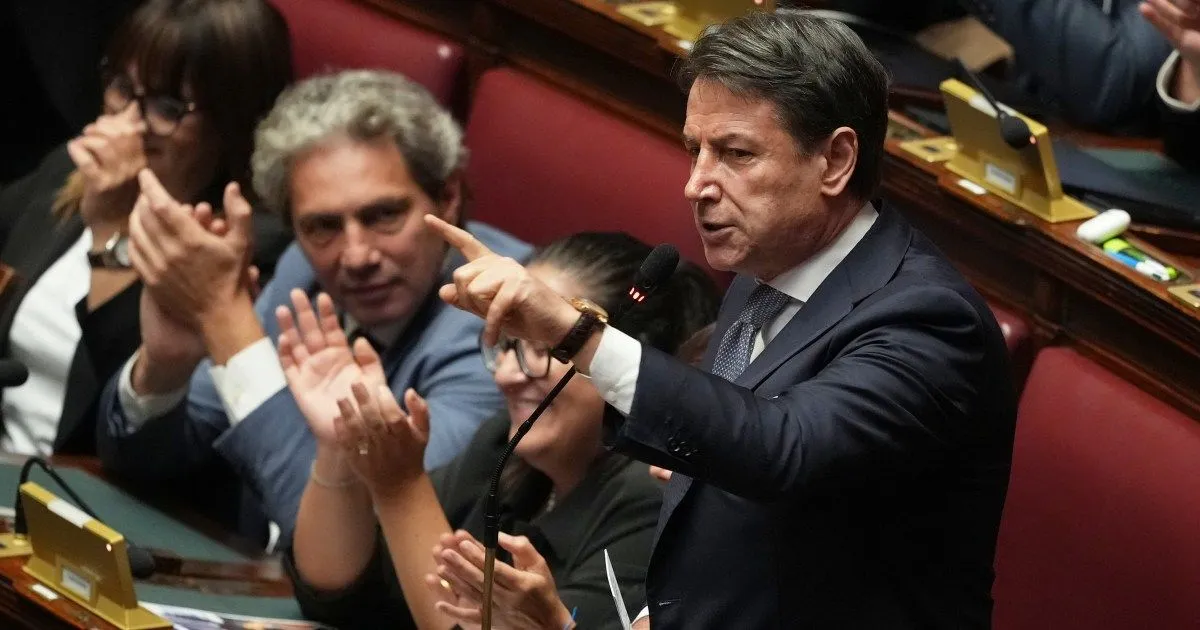
EXPLAINERCritics say the proposed law is undemocratic, potentially granting a winning coalition disproportionate power in parliament. Italian Five Star Movement leader Giuseppe Conte gestures as he delivers a speech during a Chamber of Deputies meeting before a final vote on an electoral law bill in Rome, Italy, October 8 [Andrew Medichini/AP Photo]Published On 8 Oct 2026Italy’s parliament is voting on Thursday on a new electoral law that would make it easier for election winners to form a majority government.The law, proposed by Prime Minister Giorgia Meloni, would award extra seats to any party or coalition that obtains more than 42 percent of seats in both parliamentary chambers, ensuring it holds a majority.Recommended Stories list of 3 itemslist 1 of 3Italy’s Meloni slams protesters following clashes in Bolognalist 2 of 3Abderrahim Fakir’s death has reignited Italy’s police accountability debatelist 3 of 3‘She doesn’t give up that easily’: France’s Le Pen eyes the Elyseeend of listMeloni has framed the legislation as a route to greater stability in Italy’s political system, which has often been run by fragile coalition governments. Her critics, however, say the move is actually aimed at boosting her own chances in elections next year.Here’s what we know about the electoral law and what it means for Italian politics:What is Italy’s current electoral system?Italy currently has a mixed electoral system for its 600-seat parliament, with about 36 percent of members of parliament elected directly in constituencies where the candidate with the most votes wins, and the rest decided through proportional representation.The system, called “Rosatellum”, has been in place since 2017. It encourages coalition-building but can produce fractured results that make a governing majority hard to forge.What would the new law change?The new legislation would replace the mixed electoral system with a fully proportional one, as well as awarding extra seats to the party or coalition that wins the most seats if it secures at least 42 percent in both chambers.The bonus would be as many as 70 seats in the 400-member Chamber of Deputies, the lower house, and up to 35 seats in the Senate, which has 200 elected members.That means if a party or coalition meets the 42 percent share threshold in both chambers, it would have stronger power to govern. If no party or coalition meets the threshold, representation would be decided proportionally.The new law would also force coalitions to announce their candidates for prime minister before the elections. Rado Fonda, head of research at Italian pollster SWG, told the Reuters news agency this provision could “prove problematic for the centre-left, potentially forcing an early leadership contest and exposing divisions that could weaken the bloc”.Meloni, who currently leads the country’s longest-serving government since World War II, has said the reform will help stabilise the country rather than serve any one political group. “Whoever wins the elections will have the numbers to govern,” she said.What stage is the legislation at?The proposed law has already been approved by the Senate and must now undergo a final secret-ballot vote in the Chamber of Deputies.Giovanni Orsina, a political scientist at Rome’s Luiss Guido Carli University, predicted that the law is “extremely likely” to pass.If it fails, Meloni has said she will resign.Italian Prime Minister Giorgia Meloni speaks during the MED9 Summit, in Split, Croatia, October 7 [Antonio Bronic/Reuters]Why is the legislation controversial?Opponents say the law is undemocratic because it could potentially grant a winning coalition a disproportionate level of power in parliament.They also say that the legislation is intended to favour Meloni, whose Brothers of Italy party (Fdl) is bracing for a tough election battle next year.Riccardo Magi, head of the liberal More Europe party, who is on a hunger strike to protest the proposed reform, has called it an “anti-democratic law” that risks giving a minority bloc a huge majority in parliament.Senator Matteo Renzi, who leads the Italia Viva party, has accused Italy’s governing coalition of pushing the electoral reform due to a fear of losing power.Other critics have pointed out that the law would do little to stabilise the political system if no party or coalition reaches the 42 percent threshold in both chambers – a relatively high bar.“This could produce a hung parliament, making post-electoral negotiations necessary to form a government,” Vincenzo Emanuele, a political science professor at Luiss Guido Carli University in Rome and a member of the Italian Center for Electoral Studies (CISE), told Al Jazeera. “Even relatively small changes in coalition composition could make the difference between a clear parliamentary majority and a situation of political deadlock.”When are Italy’s next elections, and what do the polls show?Italy’s next general election must be held by December 22, 2027, although the government can call elections earlier if it wishes.Currently, Meloni’s Fdl is polling ahead of all other parties, with 27 percent support, according to Politico’s polling aggregator. Her coalition partners, Lega and Forza Italia, have a combined 12 percent support, according to Politico, bringing the coalition share to 39 percent.Fdl’s polling has been dented by support for a new far-right group, Futuro Nazionale (National Future), Reuters reported. It currently has 7.8 percent support, according to Italian polling institute SWG.In opposition, the Democratic Party (PD) has 21 percent support, the Five Star Movement (M5S) has 12 percent and the Alliance of Greens and Left (AVS) has 6 percent, according to Politico. The Italy Viva (IV) and More Europe parties have 2 percent support each.Emanuele said the current landscape means the proposed electoral law would not necessarily favour Meloni and could even benefit the opposition.He said recent simulations by the CISE have shown that a centre-left coalition including the PD and M5S could potentially reach 44 percent of the vote, securing a “comfortable parliamentary majority”, though that could change if Meloni allies with National Future.“The reform does not inherently favour the incumbent government: Its effects will depend crucially on how the competing coalitions are formed,” said Emanuele.
SRCAl Jazeera
LANGEN
LEANCenter
WORDS977
ENT10
THU · 2026-10-08 · 12:10 GMTBRIEF NSR-2026-1008-117352
NSR-2026-1008-117352Analysis·EN·Political Strategy
Italian law to give election winners bonus seats: Why that’s controversial
Italy's parliament is considering a new electoral law that would award bonus seats to any party or coalition securing over 42 percent of seats in both parliamentary chambers, ensuring them a majority. Prime Minister Giorgia Meloni frames the reform as a path to greater political stability, replacing the current mixed system with a fully proportional one.
Stephen QuillenAl JazeeraFiled 2026-10-08 · 12:10 GMTLean · CenterRead · 4 min
Al JazeeraFIG 01
Reading time
4min
Word count
977words
Sources cited
2cited
Entities identified
10entities
Quality score
100%
§ 01
Briefing Summary
AI-generatedNEWSAR · AI
Italy's parliament is considering a new electoral law that would award bonus seats to any party or coalition securing over 42 percent of seats in both parliamentary chambers, ensuring them a majority. Prime Minister Giorgia Meloni frames the reform as a path to greater political stability, replacing the current mixed system with a fully proportional one. Critics, however, argue the law is undemocratic, potentially granting disproportionate power to a winning coalition and favoring Meloni's party ahead of upcoming elections. The legislation has passed the Senate and awaits a final vote in the Chamber of Deputies. If it fails, Meloni has stated she will resign.
Confidence 0.90Sources 2Claims 5Entities 10
§ 02
Article analysis
Model · rule-basedFraming
Political Strategy
Legal & Judicial
Tone
Measured
AI-assessed
CalmNeutralAlarmist
Factuality
0.70 / 1.00
Factual
LowHigh
Sources cited
2
Limited
FewMany
§ 03
Key claims
5 extracted01
The new law would replace the current mixed electoral system with a fully proportional one.
factual
Confidence
1.00
02
Proposed Italian law awards extra seats to election winners securing over 42% of seats in both parliamentary chambers.
factual
Confidence
1.00
03
Prime Minister Meloni frames the legislation as a route to greater stability in Italy's political system.
quoteGiorgia Meloni
Confidence
0.90
04
Critics argue the law is undemocratic and grants disproportionate power to a winning coalition.
quoteCritics
Confidence
0.90
05
The provision forcing coalitions to announce prime ministerial candidates before elections could weaken the center-left.
quoteRado Fonda
Confidence
0.80
§ 04
Full report
4 min read · 977 words§ 05
Entities
10 identifiedKey playerOppositionContextPositiveNeutralNegative
People3
Organizations2
Topics1
§ 06
Keywords & salience
9 termselectoral law
1.00
bonus seats
0.90
majority government
0.80
political stability
0.70
proportional representation
0.60
italian politics
0.50
giorgia meloni
0.50
undemocratic
0.40
coalition governments
0.40
§ 07
Topic connections
Interactive graph Network visualization showing 51 related topics
View Full Graph Person Organization Location Event|Click node to navigate|Edge numbers = shared articles