Russia is fighting for settlements it once firmly held in Donetsk, and has retreated from many others, as Operation Vivaldi unfolds.Rescuers work at a site of a building of a sewing factory damaged by a Russian air strike in Kharkiv, Ukraine, October 5, 2026 [Sofiia Gatilova/Reuters]Published On 9 Oct 2026Russian forces continue to retreat in Ukraine’s eastern Donetsk region.The Kremlin-aligned channel Rybar, on Telegram, said on October 7 that Moscow’s forces were losing villages south of Lyman, a town they have tried to capture as a springboard to mount a full-scale offensive on the “fortress belt” cities of Sloviansk and Kramatorsk.Recommended Stories list of 4 itemslist 1 of 4Is Europe preparing for a wider war with Russia?list 2 of 4At least 24 killed as Russia launches massive attack on Ukrainelist 3 of 4‘New tactic’: Russia expands deadly attacks on Ukraine’s transport systemlist 4 of 4Putin pledges Russia’s support to end US-led war on Iranend of listA Ukrainian counteroffensive named “Operation Vivaldi” this year has reclaimed 175 square kilometres (67 square miles) of previously occupied land around Lyman.British Foreign Secretary Ed Miliband, Ukraine’s President Volodymyr Zelenskyy and Foreign Minister Andrii Sybiha visit a makeshift memorial at the site of an apartment building where 22 residents were killed the day before by a Russian missile strike in the town of Pryluky in the Chernihiv region, Ukraine, October 8, 2026 [Valentyn Ogirenko/Reuters]“The enemy is using successes in the Lyman direction to develop attacks [east of Sloviansk], where Russian troops are forced to defend previously occupied positions and expend resources on restoring control, instead of launching their own offensive,” wrote Rybar.“It is becoming increasingly clear that the possibility of storming the urban area [of Sloviansk] is receding into the more distant future.”A key battle seems to be building for the village of Kryva Luka east of Sloviansk, which sits on high ground on the Russian-held right bank of the Siversky-Donets River, and which could serve as a base to launch counterattacks further east.Ukrainian President Volodymyr Zelenskyy told the Reuters news agency that Operation Vivaldi was successful but incomplete.To get as far as Kryva Luka, Russian sources acknowledged that Ukraine has recaptured settlements west of it. They blamed the Russian communications strategy of claiming settlements that have not been captured, giving away the plan of attack.“Premature statements” aided Ukraine, said Rybar. “Some villages were declared liberated even before Russian units arrived, which allowed the enemy to accumulate forces there and launch counterattacks.”A dog looks on while women hold posters as they participate in a rally demanding the establishment of a humanitarian corridor to evacuate Ukrainian civilians from the town of Oleshky in Kherson region, Kyiv, Ukraine, October 6, 2026 [Alina Smutko/Reuters]Ukraine built up reserves in the Lyman area before unfolding its counteroffensive. That preparation seems to be yielding results.Ukraine’s Ministry of Defence said its campaign to disrupt the flow of Russian ammunition and fuel to the front struck a record number of air defence assets and targets more than 50km (30 miles) away in September.Russian President Vladimir Putin claimed Russia had captured 1,300sq km (500sq miles) of Ukraine in September, echoing claims by his generals.People carry a casualty as emergency services work to rescue residents from the debris at the site of an apartment building which was hit by a Russian missile in the town of Pryluky in the Chernihiv region, Ukraine, October 7, 2026 [Valentyn Ogirenko/Reuters]The Institute for the Study of War, which monitors territorial advances using geolocated, open-source data, said Russia actually lost 80sq km (30sq miles) during that month.The Russian casualty rate rose to a record for 2026 of 46,230 in September, according to Ukraine’s military.Of these, 33,087 – more than 70 percent – were confirmed kills, said Ukraine.The commander of Ukraine’s Unmanned Systems Forces, Robert Brovdi, said enemy casualties were up by 40 percent in the first five days of October, compared with the same period in September.The Ukrainian military on October 7 counted 1,545,950 Russian dead and wounded for the entire full-scale invasion since 2022.A Russian jet-powered drone hits one of Kyiv’s bridges in Kyiv, Ukraine, October 2, 2026 [Valentyn Ogirenko/Reuters]Putin’s responsePutin’s response has been to intensify bombing, causing civilian suffering.Twenty-two people, five of them children, were killed in the city of Pryluky, in the northern Chernihiv region, when a Russian cruise missile demolished a five-storey apartment building on October 7, Putin’s birthday.“Today, for Putin’s birthday, the Russian army ‘gifted’ the destruction of a residential building in Pryluky,” said Zelenskyy.Ukraine’s Air Force said Russia unleashed 130 drones and 48 cruise missiles across 12 regions that day, as well as ballistics. At least two more people died in Kyiv and two in Oleksandria.At least 30 people died in Kramatorsk on October 8, when a Russian bomb struck two city buses. Video of the emergency response showed bodies strewn across an avenue and in a park.Ihor Malchevsky, 69, a deputy department head at Ukraine’s National Academy of Sciences, uses a ladder as flames rise from an administrative building hit by a Russian jet-powered drone attack, in Kyiv, Ukraine, September 28, 2026 [Valentyn Ogirenko/Reuters]Recent analysis of the Geran-4 and Geran-5 jet-powered drones Russia increasingly uses for many of its attacks makes it unlikely that these attacks on nonmilitary targets are accidental.Ukraine’s military intelligence said the attacks use satellite and sophisticated inertial navigation systems, as well as a camera that reads landmark features and checks them against an on-board database – all three systems working in concert to ensure accurate navigation.Ukraine has responded to the jet-powered drones by speeding up delivery of F-16 fighters from its allies, which are proving an effective first line of defence.“Currently, F-16s are destroying between 50 percent and 60 percent of the drone attacks,” said Zelenskyy.Ukraine is also testing five new types of interceptor drones, the most successful of which is 30 percent effective, and experimenting with small-scale missiles, Zelenskyy said.A dozen AI-driven heavy machine-gun turrets have been placed around Kyiv as a last line of defence, with dozens more planned around the country.These are a “facility-level” defence, said Serhiy Beskrestnov, a senior Defence Ministry adviser. “It can protect a warehouse, factory, bridge, or power substation.”Russia has begun hitting bridges across the Dnipro River, striking Kyiv’s southern and northern bridges seven times in the first four days of October. It has previously struck the building where Ukraine’s cabinet met, as well as energy facilities feeding the city, in an effort to cause a blackout.Russia’s jet-powered drones travel at more than 500km (310 miles) per hour and are more difficult to intercept than its propeller-driven Shahed drones.Despite this, during the October 7 strike, Ukraine’s Air Force said it intercepted 80 percent of the jet-powered drones, 95 percent of the propeller-driven drones and 80 percent of cruise missiles.On October 7, German Chancellor Friedrich Merz visited Kyiv to announce a 1.3-billion-euro ($1.46bn) military aid package, and to sign agreements worth 8.5 billion euros ($9.5bn) to jointly develop drone defences and other weapons with Ukraine.Merz’s visit was an important political gesture following recent elections in two German states where the pro-Russian AfD trounced his governing CDU party.Ukraine continued long-range strikes inside Russia.
SRCAl Jazeera
LANGEN
LEANCenter
WORDS1 179
ENT12
FRI · 2026-10-09 · 13:09 GMTBRIEF NSR-2026-1009-117653
NSR-2026-1009-117653News Report·EN·Conflict
Ukraine pushes Russia back in Donetsk as military, civilian casualties soar
Ukrainian forces, through "Operation Vivaldi," have pushed Russian troops back in the eastern Donetsk region, reclaiming territory around Lyman. Russian forces are now defending previously held positions and retreating from villages they once controlled, hindering their offensive plans towards Sloviansk and Kramatorsk.
John T PsaropoulosAl JazeeraFiled 2026-10-09 · 13:09 GMTLean · CenterRead · 5 min
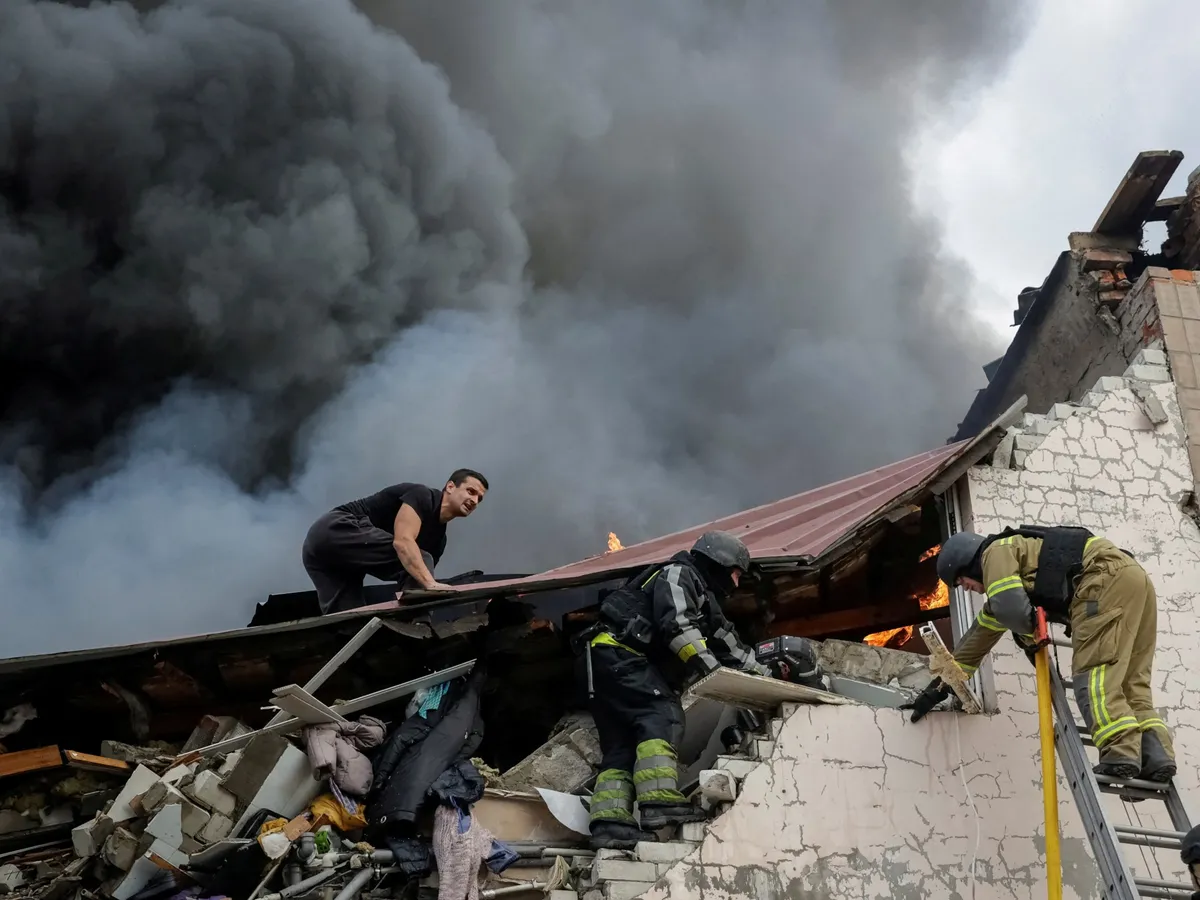
Al JazeeraFIG 01
Reading time
5min
Word count
1 179words
Sources cited
3cited
Entities identified
12entities
Quality score
100%
§ 01
Briefing Summary
AI-generatedNEWSAR · AI
Ukrainian forces, through "Operation Vivaldi," have pushed Russian troops back in the eastern Donetsk region, reclaiming territory around Lyman. Russian forces are now defending previously held positions and retreating from villages they once controlled, hindering their offensive plans towards Sloviansk and Kramatorsk. This Ukrainian success is partly attributed to Russia's premature claims of captured settlements, which allowed Ukraine to concentrate its forces. Meanwhile, Russian bombing campaigns have intensified, leading to significant civilian casualties, including a recent strike on an apartment building in Pryluky that killed 22 people. Russian military casualties in September reached a record high for 2026, with Ukraine reporting over 1.5 million Russian dead and wounded since the full-scale invasion began.
Confidence 0.90Sources 3Claims 5Entities 12
§ 02
Article analysis
Model · rule-basedFraming
Conflict
Political Strategy
Tone
Measured
AI-assessed
CalmNeutralAlarmist
Factuality
0.70 / 1.00
Factual
LowHigh
Sources cited
3
Well sourced
FewMany
§ 03
Key claims
5 extracted01
Ukraine's "Operation Vivaldi" has reclaimed 175 square kilometers of occupied land around Lyman.
statisticArticle
Confidence
0.95
02
Russian forces are retreating in Ukraine’s eastern Donetsk region, losing villages south of Lyman.
factualRybar (Telegram channel)
Confidence
0.90
03
Premature statements by Russia about liberated villages aided Ukraine's counterattacks.
quoteRybar (Telegram channel)
Confidence
0.85
04
Russian forces are forced to defend previously occupied positions and expend resources, hindering their offensive capabilities.
quoteRybar (Telegram channel)
Confidence
0.85
05
Ukraine has recaptured settlements west of Kryva Luka.
factualRussian sources
Confidence
0.80
§ 04
Full report
5 min read · 1 179 words§ 05
Entities
12 identifiedKey playerOppositionContextPositiveNeutralNegative
People3
Organizations1
Locations7
§ 06
Keywords & salience
10 termsukraine counteroffensive
1.00
donetsk
1.00
russian retreat
0.90
operation vivaldi
0.80
military casualties
0.70
civilian casualties
0.70
lyman
0.60
sloviansk
0.50
kramatorsk
0.40
air strike
0.40
§ 07
Topic connections
Interactive graph Network visualization showing 23 related topics
View Full Graph Person Organization Location Event|Click node to navigate|Edge numbers = shared articles