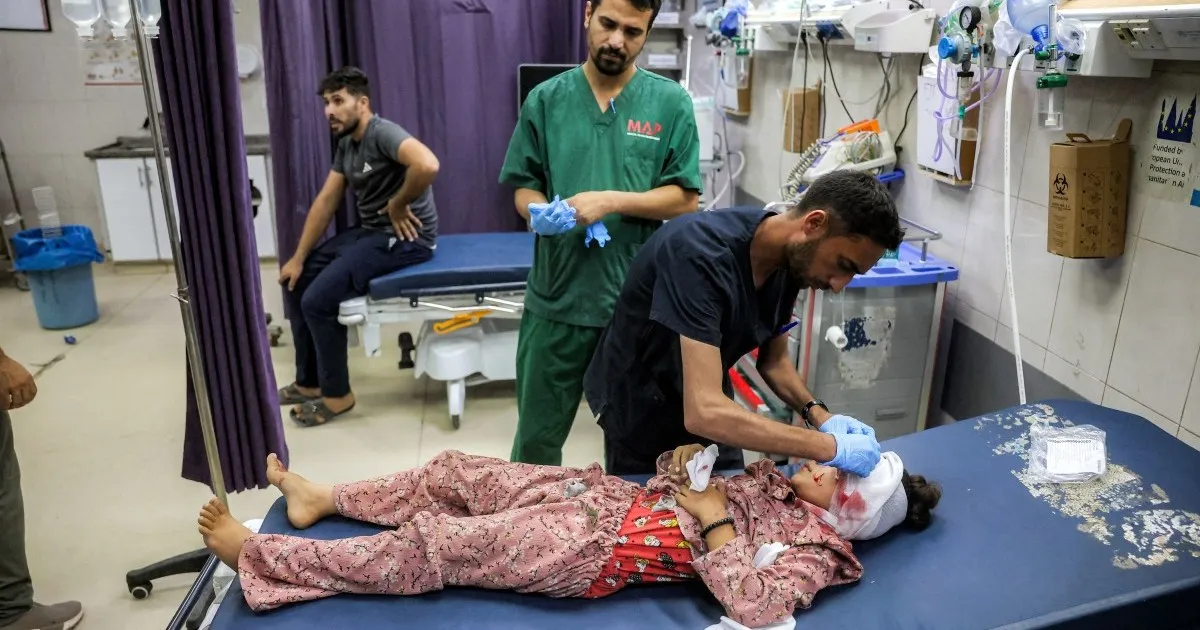
Continuing attacks, restrictions on medical aid and delayed evacuations are still killing Palestinians.Published On 10 Oct 2026An injured childreceives treatment at a hospital ward in Khan Yunis in the southern Gaza Strip on July 7, 2026, following an Israeli attack in the Mawasi area [File: Bashar Taleb/AFP]When the “ceasefire” was announced on October 10 last year, we knew how much needed repairing. For the first time in a long while, we thought we might have the breathing space to do it.We thought medicines and equipment could arrive more regularly. Hospitals and clinics could begin to be restored. Patients could leave Gaza for treatment. Emergency medical teams could come from overseas to support Gaza’s exhausted health workers. We could finally look beyond the next crisis and plan how to care for people over the coming months and years.None of that happened.Three years into the genocide, there is barely a moment to catch our breath. We’re being asked to do far more than Gaza’s devastated health system can sustain, while regular deliveries of medical supplies and equipment are still restricted and medical evacuations stalled.People are still arriving at our clinics with traumatic injuries because Israel’s bombardment continues. More than 1,470 people have been killed since the “ceasefire” started. Even reaching a health centre can now put patients at risk. As the security situation has deteriorated, services supported by Palestinians" class="entity-link entity-organization" data-entity-id="138811" data-entity-type="organization">Medical Aid for Palestinians (MAP) have had to be suspended in parts of Gaza. Last month, a 65-year-old patient was killed by Israeli military quadcopter fire while seeking treatment at a MAP-supported health centre in Jabalia.While treating new arrivals with new injuries, we are trying to look after patients whose treatment may take months or years.Those who have lost limbs need rehabilitation, prosthetics and more surgery, but Israeli authorities heavily restrict the needed supplies. Children who survived acute malnutrition now live with anaemia and stunting, which need treatment, while people with diabetes and high blood pressure struggle to get their medicines. Cancer patients can’t get the radiotherapy they need, and people with kidney failure can’t count on regular dialysis.Last month, a colleague of mine at MAP in Gaza lost her aunt, Iktimal. In February, Iktimal sensed something was wrong and had a biopsy, but the lab, like so many across Gaza, didn’t have the supplies to test the sample on time. It was more than a month before she learned she had cervical cancer, a disease that is usually curable when found early.She had surgery in April, but her recovery was slow and painful, and she went on to develop kidney complications that needed specialist treatment unavailable in Gaza. Her family applied for a medical evacuation, but the process was slow, unclear, and bureaucratic. By the time Israeli authorities approved it, her condition was critical. She travelled to Egypt hoping she would finally get the care she needed, but two weeks later, she died.Iktimal’s case is not unique. According to the World Health Organization, more than 15,000 people in Gaza are still waiting for medical evacuation; if delayed too long, many of these patients could be lost to a preventable death.We had another tragic case a month ago: A newborn with a serious heart condition died at Assahaba Medical Complex, a hospital MAP supports. The baby needed emergency surgery that isn’t available in Gaza. The doctors knew what was needed but had no way to provide it.Sometimes we struggle to provide treatment because even basic medical supplies are running short. Hospitals are also short on IV fluids, anaesthetics and surgical supplies. Even oxygen is in short supply.Staff in many hospitals have to carry cylinders to a central station for refilling. Across Gaza, more than 500 patients rely on oxygen, some of them around the clock: People with cancer, pulmonary fibrosis and heart conditions, and babies and children in intensive care.In August, the Palestinian Ministry of Health warned that 22 of Gaza’s 34 oxygen stations had stopped working, and only four of 30 machines used to fill oxygen cylinders were still running.The stations that still function could fail soon. Israeli authorities continue to block the spare parts needed to repair them, classifying them as “dual-use” items. For similar reasons, Gaza has no working MRI machine, and only one or two CT scanners serve about two million people.Doctors are sometimes left to make decisions without the scans, tests or medicines they would normally rely on.A cancer that could have been caught early becomes harder to treat. An injury that could have healed with rehabilitation becomes a permanent disability. A child who needed proper food and treatment can be left with chronic malnutrition, stunting and developmental difficulties that may last a lifetime.We were told the “ceasefire” would give people in Gaza time to heal and rebuild. It hasn’t. The restrictions that stood between Iktimal and her diagnosis, her treatment and her evacuation are still in place, and her story is one of thousands across Gaza in the past year.Every delay has a cost. Every week a medicine is held back, a scan can’t be done, a patient is refused exit, someone’s condition passes the point where it can be treated.Iktimal ran out of time. Right now, thousands of people in Gaza are running out of time, too.The views expressed in this article are the author’s own and do not necessarily reflect Al Jazeera’s editorial stance.
SRCAl Jazeera
LANGEN
LEANCenter
WORDS888
ENT10
SAT · 2026-10-10 · 09:30 GMTBRIEF NSR-2026-1010-117838
NSR-2026-1010-117838Opinion·EN·Human Rights
A year after the ‘ceasefire’, Gaza’s healthcare is still collapsing
A year after a declared ceasefire on October 10, 2025, Gaza's healthcare system remains in collapse due to ongoing attacks and restrictions on medical aid. Despite the ceasefire, Palestinian health workers continue to treat new injuries from continuing Israeli bombardment, with over 1,470 deaths reported since its announcement.
Sally SalehAl JazeeraFiled 2026-10-10 · 09:30 GMTLean · CenterRead · 4 min
Al JazeeraFIG 01
Reading time
4min
Word count
888words
Sources cited
1cited
Entities identified
10entities
Quality score
100%
§ 01
Briefing Summary
AI-generatedNEWSAR · AI
A year after a declared ceasefire on October 10, 2025, Gaza's healthcare system remains in collapse due to ongoing attacks and restrictions on medical aid. Despite the ceasefire, Palestinian health workers continue to treat new injuries from continuing Israeli bombardment, with over 1,470 deaths reported since its announcement. Essential medical supplies, equipment, and spare parts for critical infrastructure like oxygen stations are restricted, hindering treatment for chronic conditions, cancer, and kidney failure. Medical evacuations are significantly delayed, leading to preventable deaths, as exemplified by a woman who died from cervical cancer after her evacuation was approved too late. The lack of basic medical resources and advanced diagnostic equipment, such as MRI and functioning CT scanners, forces doctors to make difficult decisions with limited information, impacting long-term patient outcomes.
Confidence 0.90Sources 1Claims 5Entities 10
§ 02
Article analysis
Model · rule-basedFraming
Human Rights
Public Health
Tone
Mixed Tone
AI-assessed
CalmNeutralAlarmist
Factuality
0.30 / 1.00
Opinion-Heavy
LowHigh
Sources cited
1
Limited
FewMany
§ 03
Key claims
5 extracted01
A patient named Iktimal died from cervical cancer after delays in diagnosis and treatment due to lack of supplies and unavailable specialist care in Gaza.
factual
Confidence
0.80
02
Israeli authorities heavily restrict supplies needed for rehabilitation, prosthetics, and further surgery for those who lost limbs.
factual
Confidence
0.80
03
A 65-year-old patient was killed by Israeli military quadcopter fire while seeking treatment at a MAP-supported health centre.
factual
Confidence
0.80
04
Continuing attacks, restrictions on medical aid, and delayed evacuations are killing Palestinians in Gaza.
factual
Confidence
0.80
05
More than 1,470 people have been killed in Gaza since the 'ceasefire' started on October 10 last year.
statistic
Confidence
0.70
§ 04
Full report
4 min read · 888 words§ 05
Entities
10 identifiedKey playerOppositionContextPositiveNeutralNegative
Organizations3
§ 06
Keywords & salience
10 termsgaza healthcare collapse
1.00
medical aid restrictions
0.90
delayed evacuations
0.80
palestinian casualties
0.70
traumatic injuries
0.60
health system strain
0.60
medical supplies
0.50
rehabilitation needs
0.40
chronic disease management
0.40
medical aid for palestinians (map)
0.40
§ 07
Topic connections
Interactive graph Network visualization showing 51 related topics
View Full Graph Person Organization Location Event|Click node to navigate|Edge numbers = shared articles