The northern lights illuminated the skies across the UK on Friday and Saturday evening.Sky-gazers as far south as Devon, Hampshire and Kent were treated to the dazzling natural phenomenon, also known as the Aurora Borealis.The Met Office said sightings could continue during clear skies until Tuesday.Spectacular aurora captured from space by Russian cosmonaut – videoSuch occurrences are mostly visible near the Arctic Circle and northern Scotland.The Aurora Borealis is a natural light display in Earth’s sky, driven by Solar Activity and Geomagnetic Storms interacting with the upper atmosphere.Sightings will remain possible until Tuesday across Scotland and similar geomagnetic longitudes during clear skies, the Met Office said.Aurora displays occur when charged particles collide with gases in the Earth’s atmosphere around the magnetic poles. As they collide, light is emitted at various wavelengths, creating colourful displays in the sky.According to the Met Office, the sun emits charged particles known as Solar Wind, which travel at bout 1m mph.The forecaster said: “When these particles interact with Earth’s magnetic field – especially when the Solar Wind’s polarity is opposite to Earth’s – they are funnelled toward the magnetic poles.“As these energetic particles collide with gases in the upper atmosphere, they release energy in the form of light. Oxygen produces green and, at higher altitudes, rare red auroras, while nitrogen creates blue and purple hues.”Last year, experts said 2026 will be a peak year for aurora-spotting, as the sun has been in a heightened state of activity as part of its 11-year natural cycle.
SRCThe Guardian - World News
LANGEN
LeanCenter-Left
WORDS249
ENT12
SAT · 2026-10-10 · 22:30 GMTBRIEF NSR-2026-1010-117960
NSR-2026-1010-117960News Report·EN·Human Interest
Skies across the UK illuminated by the northern lights
The northern lights, also known as the aurora borealis, were visible across the UK on Friday and Saturday evenings. Sky-gazers as far south as Devon, Hampshire, and Kent witnessed the phenomenon, which is typically seen closer to the Arctic Circle.
Nadeem BadshahThe Guardian - World NewsFiled 2026-10-10 · 22:30 GMTLean · Center-LeftRead · 1 min
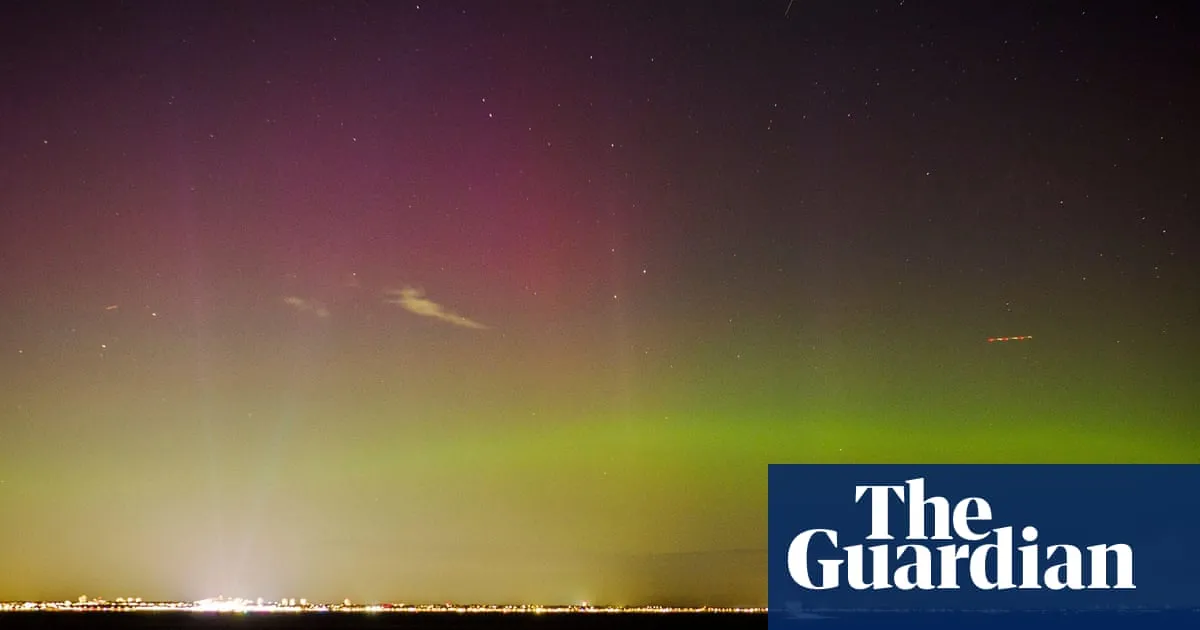
The Guardian - World NewsFIG 01
Reading time
1min
Word count
249words
Sources cited
2cited
Entities identified
12entities
NEWSAR · AI
The northern lights, also known as the aurora borealis, were visible across the UK on Friday and Saturday evenings. Sky-gazers as far south as Devon, Hampshire, and Kent witnessed the phenomenon, which is typically seen closer to the Arctic Circle. The Met Office stated that sightings could continue with clear skies until Tuesday, particularly across Scotland and similar geomagnetic longitudes. The aurora borealis is caused by charged particles from solar activity and geomagnetic storms interacting with Earth's upper atmosphere. This interaction, where particles collide with gases like oxygen and nitrogen, emits light in various colors. Experts anticipate 2026 to be a peak year for aurora spotting due to heightened solar activity.
Confidence 0.90Sources 2Claims 5Entities 12
Framing
Human Interest
Environmental
Tone
Measured
AI-assessed
CalmNeutralAlarmist
Factuality
0.90 / 1.00
Factual
LowHigh
Sources cited
2
Limited
FewMany
01
Oxygen produces green and red auroras, while nitrogen creates blue and purple hues.
factualMet Office
Confidence
1.00
02
The aurora borealis is a natural light display in Earth’s sky, driven by solar activity and geomagnetic storms interacting with the upper atmosphere.
factual
Confidence
1.00
03
The northern lights illuminated the skies across the UK on Friday and Saturday evening.
factual
Confidence
1.00
04
Sightings could continue during clear skies until Tuesday, according to the Met Office.
predictionMet Office
Confidence
0.90
05
Experts said 2026 will be a peak year for aurora-spotting due to the sun's heightened activity in its 11-year cycle.
predictionexperts
Confidence
0.80
§ 04
Full report
1 min read · 249 wordsKey playerOppositionContextPositiveNeutralNegative
Locations6
aurora borealis
1.00
northern lights
1.00
solar activity
0.90
geomagnetic storms
0.80
earth's atmosphere
0.70
solar wind
0.70
magnetic poles
0.60
uk
0.50
met office
0.50
sun cycle
0.40
§ 07
Connections
Who appears together in the newsIn this articleWider coverageLine weight = articles in common
Laying out network…
Strongest ties articles in common
- 298
- 170
- 75
- 34
- 22
- 20
Recurring context not named in this article
- LUnited Stateslinks 8
- LUnited Kingdomlinks 7
- PAndy Burnhamlinks 7
- LLondonlinks 7
- LWaleslinks 7
- PKeir Starmerlinks 7
- OHome Officelinks 7
- LFrancelinks 7