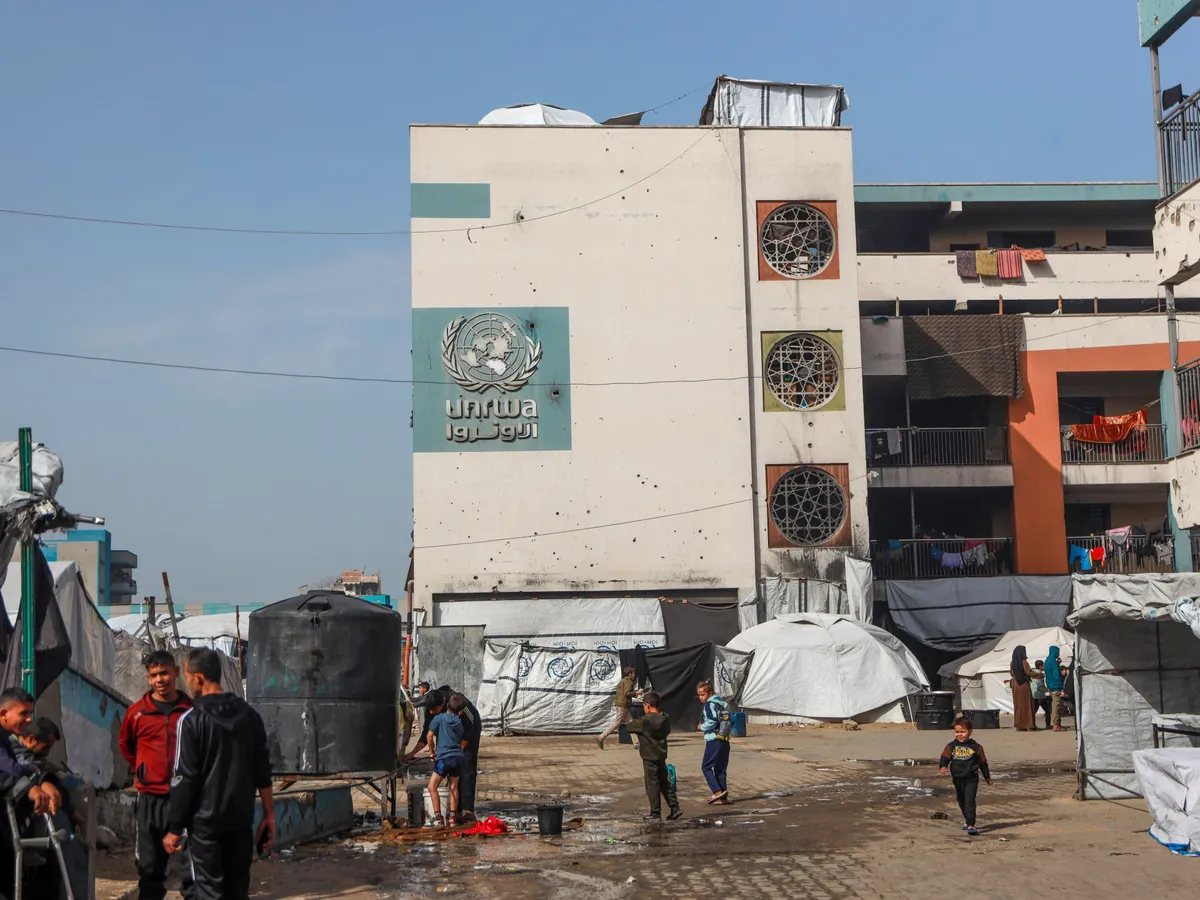
UN’s Palestinian refugee agency cast into forced austerity: 600 staff members laid off, Gaza salaries cut by 20%, working hours reduced; aid access blocked amid worsening humanitarian crisis.One of UNRWA schools in central Gaza City, which has been turned into a shelter for displaced families since the start of Israel's genocidal war [Abdelhakim Abu Riash/Al Jazeera]Published On 30 Jan 2026Gaza City — After 18 years as a teacher with an UNRWA-run school, Maryam Shaaban (name changed for safety reasons) fainted upon learning she was among 600 employees dismissed from their posts, the latest in a barrage of devastating blows borne out of Israel’s genocidal war on the besieged enclave.Earlier in January, the United Nations agency for Palestinian refugees (UNRWA) announced a series of harsh austerity measures, including a 20 percent salary cut for local staff in Gaza, reduced working hours, and the termination of contracts for employees based outside Gaza who had been previously placed on “exceptional leave”.Recommended Stories list of 3 itemslist 1 of 3‘Yellow line’, the de facto Israeli buffer zone shaping life in Gazalist 2 of 3Investigation reveals Israeli campaign to flatten Gaza town of Beit Hanoonlist 3 of 3‘Barbaric new era’: Palestinians, UN slam Israeli demolition of UNRWA HQend of listAccording to a letter sent to affected staff by UNRWA Commissioner-General Philippe Lazzarini, the agency said it was forced to take steps due to a severe financial shortfall in its 2026 budget of some $220m.The deficit threatens the agency’s ability to meet core operational obligations, including staff salaries and the continuation of essential humanitarian programmes.Shaaban, 52, who is currently displaced in Egypt with her injured husband, began working with the UN agency in 2007 as a teacher at one of the agency’s schools in Jabalia, northern Gaza.Like most residents of Gaza, she suffered a heavy price during Israel’s genocidal war.She was displaced with her family from Jabalia to Nuseirat, in central Gaza, where they took refuge in her brother’s home. In December 2023, they were hit by a direct Israeli air attack that killed 15 people and injured dozens.Among the victims were Maryam’s 22-year-old daughter, her brother, and his entire family.Israeli targeting of UNRWASustained Israeli campaigns to decimate and denigrate the agency have escalated to unprecedented levels.Israel has repeatedly accused the agency of being lenient or complicit with Palestinian armed groups, without providing verifiable evidence. These are allegations UNRWA has vehemently denied, stressing that it takes disciplinary action against any employee proven to be involved in wrongdoing.In 2025, the Israeli Knesset passed legislation effectively banning the agency’s operations in areas it considers part of “Israeli sovereignty”, including occupied East Jerusalem, claiming the agency poses a security threat.The agency rejected the law as illegal and said it places it in direct confrontation with Israeli authorities.As of this month, the UN agency has recorded deaths in Israeli attacks of more than 380 of its staff members in Gaza since October 2023.Earlier this month, Israel sent in bulldozers, partially destroying UNRWA’s headquarters in East Jerusalem. Israeli lawmakers and members of the far-right government were also present, according to Lazzarini, who said the attack came “in the wake of other steps taken by Israeli authorities to erase the Palestine Refugee identity”.As a UN agency, it enjoys international legal status. UN Secretary-General Antonio Guterres warned Prime Minister Benjamin Netanyahu earlier in January that he could take Israel to the International Court of Justice (ICJ) if it does not repeal laws targeting UNRWA and return its seized assets and property.‘By what law does this happen?’Maryam herself sustained minor injuries in the Israeli attack, while five of her children also suffered injuries. Her husband was critically wounded in the neck.In April 2024, she left Gaza as a medical companion to her spouse, who was referred for treatment at an Egyptian hospital. She was forced to leave behind the rest of her children in Gaza, including those who were wounded.“It feels like leaving for treatment and escaping death has become a crime we are being punished for,” Maryam told Al Jazeera by phone, her voice breaking with tears.“Wasn’t it enough that I spent all this time grieving for my injured children, being away from them and constantly worried about them while accompanying my husband in treatment? They added to our wounds by dismissing us from our jobs. By what law does this happen?”For Maryam and many others who were displaced outside Gaza during the war, the blow was especially severe, as it followed a February 2025 decision to place them on “exceptional leave” despite the fact that many of them continued teaching remotely.“All my children are injured and have metal plates in their limbs. They suffered immensely after my salary stopped,” said the mother of eight.In the past two weeks, the crisis has extended to employees who remain in the Strip, after the agency decided to cut their salaries by 20 percent, a move that has further deepened their humanitarian suffering amid Gaza’s catastrophic conditions.The financial shortfall comes amid a decline in international donations, which had long formed the backbone of UNRWA’s budget, particularly after several donor states froze their contributions following Israeli allegations against some of its employees.UNRWA provides essential services to millions of Palestinian refugees, who make up about 70 percent of the Gaza population, including education, healthcare, and social assistance, playing a central role in maintaining a minimum level of stability amid repeated Israeli wars and restrictions on crossings.Dr Mustafa al-Ghoul, a dentist with UNRWA for 29 years, who heads the agency’s staff union, is currently leading protests against its recent decisions [Abdelhakim Abu Riash/Al Jazeera]Why Gaza first?There has been widespread anger and protests among UNRWA staff in Gaza, both inside and outside the Strip, who argue that the measures disproportionately target Gaza compared with the agency’s other five areas of operation: the occupied West Bank, Jerusalem, Jordan, Lebanon, and Syria.Mustafa al-Ghoul, head of the UNRWA staff union in Gaza and a dentist who has worked with the agency for 29 years, questioned why Gaza — the most devastated and afflicted area — was chosen as the first sacrifice.“All the measures started in Gaza, as if Gaza is not already overwhelmed by death, destruction, and hunger,” he told Al Jazeera, standing in front of their partially destroyed headquarters in Gaza City.Of some of the 600 dismissed Palestinian employees who were outside Gaza, the cutting off of their salaries and savings without prior notice, al-Ghoul said, “Some are sick. Some have cancer. Some were on official leave. Some lost their entire families. Some left to treat a grandchild, and then they are punished with dismissal and deprivation of their rights.”“Gaza needs someone to heal its wounds. Gaza is dying. You see tents, death, and destruction everywhere. Gaza needs compassion, not dismissals and the drying up of its lifelines,” al-Ghoul appealed to UNRWA’s leadership.Jihan al-Harazin with her husband and their three children in their tent west of Gaza City, where they were displaced after their home was destroyed [Abdelhakim Abu Riash/Al Jazeera]‘UNRWA was the backbone of our survival’Union warnings about the consequences of UNRWA cuts are already visible in the scarred daily lives of displaced Palestinians in Gaza, particularly in education, healthcare and food security.This decline is reflected in the testimony of Jihan al-Harazin, 28, a mother of three, displaced in Gaza City, whose family relied almost entirely on the agency’s services.
SRCAl Jazeera
LANGEN
LEANCenter
WORDS1 219
ENT8
FRI · 2026-01-30 · 06:19 GMTBRIEF NSR-2026-0130-11833
NSR-2026-0130-11833News Report·EN·Human Rights
UNRWA staff cuts deepen in Gaza as Israel restricts critical aid access
In January 2026, UNRWA, the UN agency for Palestinian refugees, implemented severe austerity measures in Gaza due to a $220 million budget shortfall. These measures include the dismissal of 600 staff members, a 20% salary cut for local Gazan staff, and reduced working hours.
Maram HumaidAl JazeeraFiled 2026-01-30 · 06:19 GMTLean · CenterRead · 5 min
Al JazeeraFIG 01
Reading time
5min
Word count
1 219words
Sources cited
2cited
Entities identified
8entities
Quality score
100%
§ 01
Briefing Summary
AI-generatedNEWSAR · AI
In January 2026, UNRWA, the UN agency for Palestinian refugees, implemented severe austerity measures in Gaza due to a $220 million budget shortfall. These measures include the dismissal of 600 staff members, a 20% salary cut for local Gazan staff, and reduced working hours. The agency attributes the financial crisis to restricted aid access and funding shortfalls amid the ongoing conflict. The cuts threaten UNRWA's ability to maintain essential humanitarian programs and pay staff salaries. The situation is exacerbated by what is described as Israel's ongoing campaign against the agency, including accusations of complicity with armed groups. The cuts have impacted many, including teachers like Maryam Shaaban, displaced by the conflict.
Confidence 0.90Sources 2Claims 5Entities 8
§ 02
Article analysis
Model · rule-basedFraming
Human Rights
Economic Impact
Tone
Mixed Tone
AI-assessed
CalmNeutralAlarmist
Factuality
0.70 / 1.00
Factual
LowHigh
Sources cited
2
Limited
FewMany
§ 03
Key claims
5 extracted01
In 2025, the Israeli Knesset passed legislation banning UNRWA operations in areas it considers part of “Israeli sovereignty”.
factualnull
Confidence
1.00
02
UNRWA vehemently denies Israeli accusations and stresses it takes disciplinary action against wrongdoing.
quoteUNRWA
Confidence
1.00
03
The UN agency said it was forced to take steps due to a severe financial shortfall in its 2026 budget of some $220m.
factualUNRWA
Confidence
0.90
04
Israel has repeatedly accused UNRWA of being lenient or complicit with Palestinian armed groups.
factualnull
Confidence
0.90
05
UNRWA laid off 600 staff members and cut Gaza salaries by 20% due to a $220m budget shortfall.
factualUNRWA Commissioner-General Philippe Lazzarini
Confidence
0.90
§ 04
Full report
5 min read · 1 219 words§ 05
Entities
8 identifiedKey playerOppositionContextPositiveNeutralNegative
Organizations2
§ 06
Keywords & salience
10 termsunrwa
1.00
gaza
0.90
staff cuts
0.90
aid access
0.80
humanitarian crisis
0.70
austerity measures
0.60
financial shortfall
0.60
israeli war
0.50
palestinian refugees
0.50
salary cuts
0.40
§ 07
Topic connections
Interactive graph Network visualization showing 18 related topics
View Full Graph Person Organization Location Event|Click node to navigate|Edge numbers = shared articles