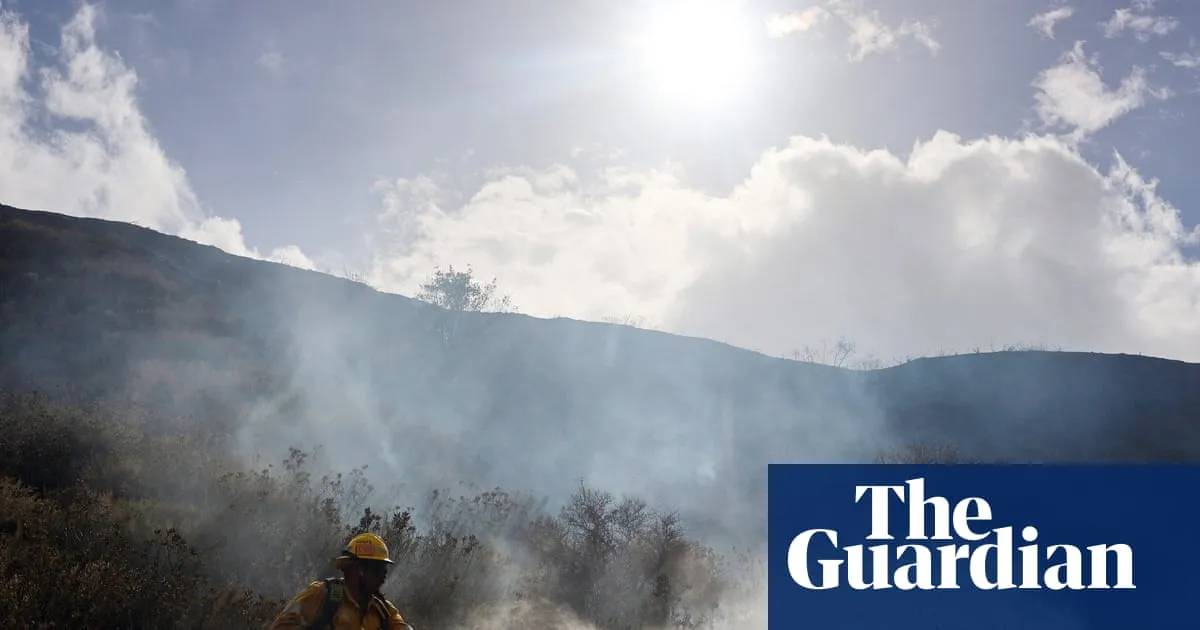
Communities across California are bracing for more dangerous weather this week, with strong winds and high temperatures that could set the stage for rapid wildfire growth over the next several days.“A moderate to strong Santa Ana wind will bring widespread strong winds and critical fire weather conditions to much of south-west California through Saturday,” the National Weather Service said in a forecast issued on Thursday.Strong, dry winds could reach 20-40mph (32 to 64 km/h), with gusts from 50-70mph in the San Gabriel mountains in Los Angeles county and the Santa Susana mountains, which are mostly in Ventura county, officials said. Critical fire weather conditions are also forecast for portions of the Santa Lucia mountains in San Luis Obispo county.The elevated risks come amid a tumultuous start to autumn that has already brought severe heatwaves, high surf and flooding – and this may just be the beginning, according to experts.Destructive conditions fueled by a potentially historic El Niño brewing in the Pacific will continue to mount through the end of this year and into next. The impacts, which have already raised sea levels, increased temperatures and supercharged storms in the Pacific, layer on top of natural hazards and those fueled by the human-caused Climate Crisis.The so-called Santa Ana winds in this week’s forecast are expected during this time of year, along with higher fire dangers that typically linger in the state through November. But on the heels of the recent storm surge that battered the California coast, the weather whiplash has left residents reeling.With the threat of fire, heat and sea level rise colliding, as the state readies for more incoming effects from El Niño, Kevin McGowan, the director of LA’s office of emergency management, urged residents to be ready. “People should continue to prepare not just for one hazard,” he said during a recent briefing, “but all hazards”.In Los Angeles, where strong Santa Ana winds fueled the devastating 2025 firestorm that killed more than 30 people, the warnings were sharply felt. Neighborhoods are still being rebuilt after multiple blazes consumed more than 16,000 structures, and the huge burn scars left behind have increased the dangers for debris flows and landslides, should the elevated chances of severe storms materialize over this winter.Officials are preparing to meet the fire risks head on to protect communities now and in months that follow. New fires will mean more risks in the season ahead.“If there is any significant fire activity this week, it would be somewhat poorly timed in the context of El Niño,” said climate scientist Daniel Swain in an online briefing on Wednesday. “We know the likelihood of a wet winter in southern California is now very high. [Fire] would further raise the stakes.”Thousands of people in California were without electricity on Thursday as utilities tried to reduce the risk of hot, windy weather that could blow over power lines and spark wildfires.In northern California, nearly 62,000 customers in 26 counties had no electricity, according to Pacific Gas and Electric Company. The company began proactively turning off power on Wednesday night. Weather conditions that increase the fire risk were expected to last through Saturday.Los Angeles Fire chief, Jaime Moore, said staffing has been augmented and equipment pre-deployed so crews will be ready.“We are asking residents to do their part too,” he added. “Clear the streets, have a plan and stay informed.”With the risks rising across California, the state’s office of emergency services has also increased its coordination and readied resources to support local officials should disaster strike, according to spokesperson Chris Dargan.The National Weather Service issued fire weather warnings for parts of central and northern California, starting on Thursday and lasting through Friday morning, saying any fires would spread rapidly.“It’s a pretty widespread event of elevated fire weather, so the whole SoCal region should really be on alert,” said Rose Schoenfeld, a meteorologist with the National Weather Service.The Associated Press contributed in reporting
SRCThe Guardian - World News
LANGEN
LEANCenter-Left
WORDS650
ENT12
THU · 2026-10-15 · 20:56 GMTBRIEF NSR-2026-1015-119306
NSR-2026-1015-119306News Report·EN·Environmental
California faces more extreme weather as hot, windy days raise wildfire risk
California is facing heightened wildfire risks this week due to strong Santa Ana winds and high temperatures across much of southwest California through Saturday. These conditions, with winds potentially reaching 40 mph and gusts up to 70 mph in mountainous areas, are considered critical for rapid fire growth.
Gabrielle Canon in OaklandThe Guardian - World NewsFiled 2026-10-15 · 20:56 GMTLean · Center-LeftRead · 3 min
The Guardian - World NewsFIG 01
Reading time
3min
Word count
650words
Sources cited
3cited
Entities identified
12entities
Quality score
100%
§ 01
Briefing Summary
AI-generatedNEWSAR · AI
California is facing heightened wildfire risks this week due to strong Santa Ana winds and high temperatures across much of southwest California through Saturday. These conditions, with winds potentially reaching 40 mph and gusts up to 70 mph in mountainous areas, are considered critical for rapid fire growth. This elevated risk follows a turbulent autumn that has already seen heatwaves, storm surges, and flooding, with experts predicting continued extreme weather due to a brewing El Niño. Utilities have proactively shut off power to thousands in Northern California to prevent ignitions, while emergency services are increasing coordination and resources. Officials are urging residents to prepare for multiple hazards, including potential debris flows and landslides from recent burn scars if severe storms materialize this winter.
Confidence 0.90Sources 3Claims 5Entities 12
§ 02
Article analysis
Model · rule-basedFraming
Environmental
Public Health
Tone
Mixed Tone
AI-assessed
CalmNeutralAlarmist
Factuality
0.70 / 1.00
Factual
LowHigh
Sources cited
3
Well sourced
FewMany
§ 03
Key claims
5 extracted01
A moderate to strong Santa Ana wind will bring widespread strong winds and critical fire weather conditions to much of south-west California through Saturday.
quoteNational Weather Service
Confidence
1.00
02
If there is any significant fire activity this week, it would be somewhat poorly timed in the context of El Niño, as the likelihood of a wet winter in southern California is now very high.
quoteDaniel Swain
Confidence
0.90
03
Thousands of people in California were without electricity on Thursday as utilities tried to reduce the risk of wildfires.
factual
Confidence
0.90
04
Strong winds and high temperatures are expected to increase wildfire risk in California this week.
factual
Confidence
0.90
05
Destructive conditions fueled by a potentially historic El Niño brewing in the Pacific will continue to mount through the end of this year and into next.
predictionexperts
Confidence
0.70
§ 04
Full report
3 min read · 650 words§ 05
Entities
12 identifiedKey playerOppositionContextPositiveNeutralNegative
Organizations1
Locations7
Events1
§ 06
Keywords & salience
10 termswildfire risk
1.00
extreme weather
1.00
santa ana winds
0.90
climate crisis
0.80
el niño
0.70
strong winds
0.60
high temperatures
0.60
sea level rise
0.50
emergency management
0.40
debris flows
0.40
§ 07
Topic connections
Interactive graph Network visualization showing 51 related topics
View Full Graph Person Organization Location Event|Click node to navigate|Edge numbers = shared articles