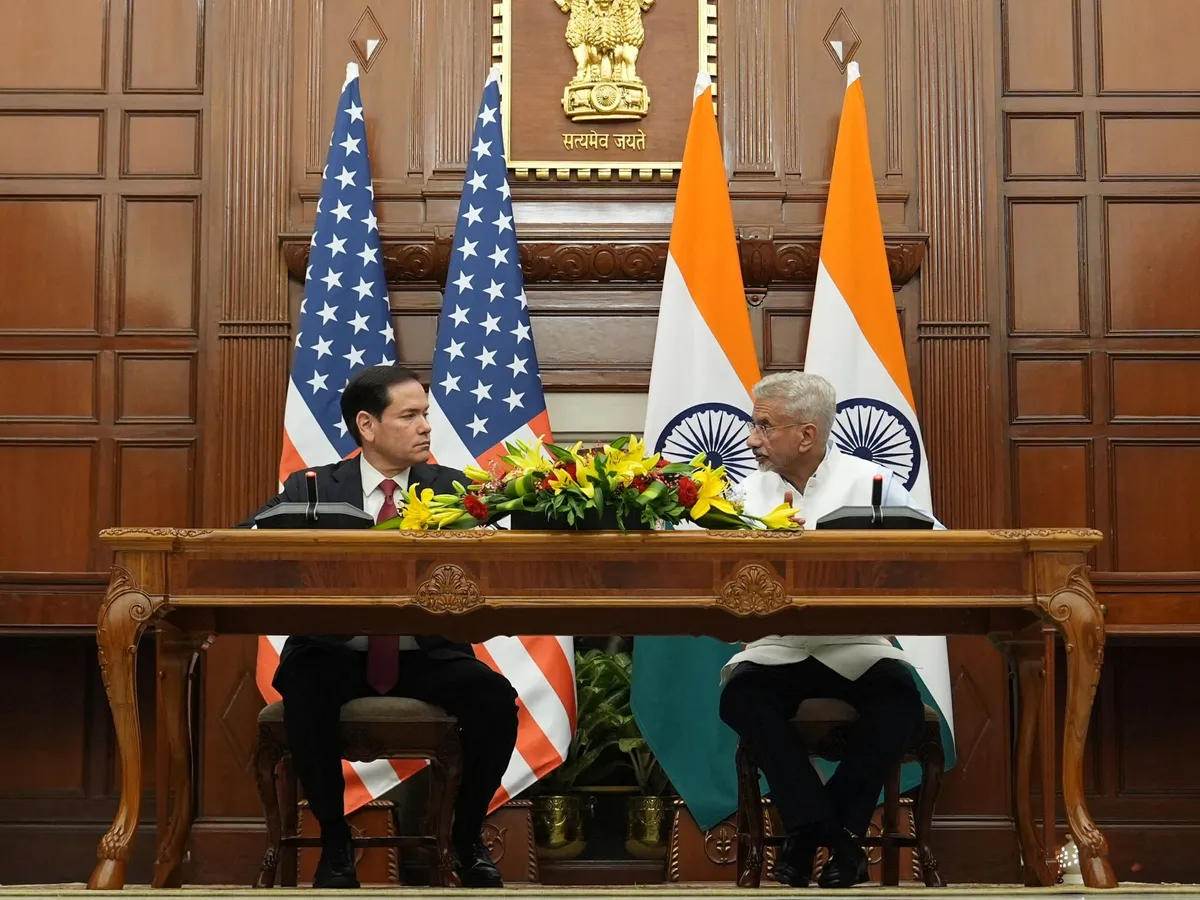
EXPLAINERThe US secretary of state is skipping New Delhi on his second trip to India in six months, and opposition leaders say the arrangements are humiliating.US Secretary of State Marco Rubio, left, and Indian External Affairs Minister Subrahmanyam Jaishankar prepare to sign an agreement in New Delhi, India, on May 26, 2026 [Julia Demaree Nikhinson/Pool via Reuters]Published On 18 Oct 2026United States Secretary of State Marco Rubio is to visit India in the coming week, but he will not set foot in the capital, New Delhi.Instead, on Monday, Rubio will hold talks with Indian External Affairs Minister Subrahmanyam Jaishankar in Mumbai, India’s financial hub, and then visit an oil refinery in Jamnagar in the western state of Gujarat, according to a statement from the US Department of State.Recommended Stories list of 4 itemslist 1 of 4US lifts sanctions on Venezuela’s top legislatorlist 2 of 4US-Iran stalemate: What are Trump’s next military options?list 3 of 4Rubio presses Lebanon on confiscation of weapons from Hezbollahlist 4 of 4Rubio’s Uzbekistan trip underlines Central Asia’s hunt for diverse partnersend of listHis itinerary sparked a political storm after the US ambassador to India said Washington expected Jaishankar to travel to meet Rubio, prompting opposition leaders to accuse the government of allowing India’s top diplomat to be “summoned” on home soil.The spat comes as relations between the two countries are strained over trade, tariffs and India’s purchases of Russian oil.So why is Rubio avoiding New Delhi, and why has it caused such upset? Here’s what you need to know:What is Rubio doing in India?He plans to discuss trade, energy and investment.Rubio is arriving on Sunday from Samarkand, Uzbekistan, where he has been meeting with five Central Asian states at the C5+1 summit.In India, he is due to meet senior officials to discuss the US-India strategic partnership and energy cooperation and hold talks with business leaders, the State Department said.Indian Ministry of External Affairs spokesperson Randhir Jaiswal appeared to confirm the agenda, stating on Friday that the Mumbai talks would cover energy, trade and investment, defence, and critical and emerging technologies.In Jamnagar, Rubio is to visit the world’s largest single-site refinery, operated by billionaire Mukesh Ambani’s Reliance Industries, and attend a reception hosted by the Ambani family, according to The Hindu newspaper.Rubio and his wife, Jeanette Rubio, appear with Ambassador to India Sergio Gor, also the US special envoy for South and Central Asia, at the Taj Mahal in Agra, India, on May 25, 2026 [Julia Demaree Nikhinson/Pool via Reuters]Why isn’t Rubio going to New Delhi?No official reason has been given.Rubio was in the Indian capital in May for a meeting of foreign ministers of countries in the Quad, a group consisting of the US, India, Japan and Australia.The State Department has framed his upcoming trip around energy and investment, and the second stop on Rubio’s India visit, Jamnagar, is one of the world’s most important energy hubs.The visit also comes as fuel prices bite in the US before next month’s midterm elections.Reliance, an energy, retail and telecommunications conglomerate, also sits at the centre of Washington’s wider oil diplomacy.Business Standard, an Indian financial daily, said the Jamnagar stop was significant because Reliance is the biggest buyer of Venezuelan crude oil besides the US at a time when Washington has been urging India to buy more.Since US forces seized Venezuelan President Nicolas Maduro in January and took essential control of the country’s oil industry, the US government has marketed Venezuelan oil to buyers abroad.Reliance is also investing in a new refinery in Texas, the first to be built in the US in 50 years, which Trump hailed as a $300bn deal when he announced it in March, Business Standard reported.Villagers sit outside the Jamnagar refinery, run by the Indian business conglomerate Reliance Industries, in Jamnagar, India [File: Manish Swarup/AP]What did the US ambassador say, and why has it caused upset?Speaking at the Bloomberg New Economy Forum in New Delhi on Thursday, US Ambassador to India Sergio Gor said Rubio would meet Indian government officials in Mumbai, and Washington “expected” Jaishankar and others from New Delhi to travel there to see him.Earlier in the week, however, Jaiswal had not confirmed the trip or explained why Rubio was skipping New Delhi, telling reporters the Indian government would announce it “at the appropriate time”, The Hindu newspaper reported.Jairam Ramesh, a general secretary of the opposition Indian National Congress party, wrote on X that the ambassador’s statement was “quite extraordinary”.Rahul Gandhi, leader of the opposition in parliament’s lower house, also took to X to comment, writing on Friday that Rubio had “summoned his employee to Mumbai”.Congress MP Pawan Khera went further.“A foreign government summoning India’s External Affairs Minister on Indian soil is a new low, even by the Modi Government’s standards,” he wrote on X, referring to Prime Minister Narendra Modi.Why are US-India relations strained?Mainly because of Trump’s tariffs and Russian oil.In August last year after a round of trade talks broke down, the US hit most Indian goods with a 50 percent tariff. Under a framework the two sides agreed in February, that rate fell to 18 percent, however.Since then, negotiations have stalled.This month, Indian Finance Minister Nirmala Sitharaman said the talks had “plateaued”, according to The Hindu.On Thursday, Trade Minister Piyush Goyal said the “first tranche” of a deal was in its final stages but India would not sign until its exporters had an edge over rivals such as Bangladesh, Vietnam and Indonesia, according to the Reuters news agency.Other points of friction have emerged.Last week, US Labor Secretary Keith Sonderling announced that his department was suspending eight companies – including the Indian IT giants Infosys, Tata Consultancy Services, Wipro and HCL – from a labour certification scheme that is a key step for employers seeking green cards for their foreign staff.Sameer Lalwani, a senior fellow in the South Asia Program at the Carnegie Endowment for International Peace, wrote this week that Indian public opinion of the US has hit a record low, citing US engagement with Pakistan and the US-Israel war on Iran, which he said had pushed India back towards Russian oil.Despite that, he argued, defence and technology cooperation has quietly deepened, and bilateral trade grew by almost 12 percent in 2025 to nearly $240bn.In his view, “perceptions of the political relationship have deteriorated faster than its strategic foundations.”A sanctions law had threatened to make matters worse.Last month, Trump signed the Lindsey O Graham Sanctioning Russia and Iran Act, which could impose tariffs of up to 100 percent on goods from the five largest importers of Russian oil or gas.India, one of the world’s biggest buyers of Russian oil, had warned Washington that new tariffs could hurt bilateral ties. Trump signed an executive order seeking to waive the sanctions on Friday as he tries to ease high oil prices before the November 3 US elections.
SRCAl Jazeera
LANGEN
LEANCenter
WORDS1 136
ENT12
SUN · 2026-10-18 · 05:16 GMTBRIEF NSR-2026-1018-119821
NSR-2026-1018-119821News Report·EN·Diplomatic
Why Marco Rubio’s visit to Mumbai has ruffled feathers in India
US Secretary of State Marco Rubio is scheduled to visit India next week, but will bypass the capital, New Delhi. Instead, he will hold talks with Indian External Affairs Minister Subrahmanyam Jaishankar in Mumbai and visit an oil refinery in Jamnagar.
Nils AdlerAl JazeeraFiled 2026-10-18 · 05:16 GMTLean · CenterRead · 5 min
Al JazeeraFIG 01
Reading time
5min
Word count
1 136words
Sources cited
4cited
Entities identified
12entities
Quality score
100%
§ 01
Briefing Summary
AI-generatedNEWSAR · AI
US Secretary of State Marco Rubio is scheduled to visit India next week, but will bypass the capital, New Delhi. Instead, he will hold talks with Indian External Affairs Minister Subrahmanyam Jaishankar in Mumbai and visit an oil refinery in Jamnagar. This itinerary has caused political controversy, with opposition leaders accusing the government of allowing India's top diplomat to be "summoned" on home soil after the US ambassador stated Washington expected Jaishankar to travel to meet Rubio. The visit aims to discuss trade, energy, and investment, with a focus on energy cooperation and business leaders. No official reason has been given for Rubio skipping New Delhi, though the Jamnagar stop is significant for its connection to Reliance Industries' oil dealings.
Confidence 0.90Sources 4Claims 5Entities 12
§ 02
Article analysis
Model · rule-basedFraming
Diplomatic
Political Strategy
Tone
Mixed Tone
AI-assessed
CalmNeutralAlarmist
Factuality
0.70 / 1.00
Factual
LowHigh
Sources cited
4
Well sourced
FewMany
§ 03
Key claims
5 extracted01
Rubio plans to discuss trade, energy, and investment during his visit.
factualUS Department of State
Confidence
1.00
02
Opposition leaders accuse the government of allowing India's top diplomat to be 'summoned' on home soil.
quoteopposition leaders
Confidence
1.00
03
Rubio will hold talks with Indian External Affairs Minister Subrahmanyam Jaishankar in Mumbai.
factual
Confidence
1.00
04
US Secretary of State Marco Rubio will visit India but will not go to the capital, New Delhi.
factual
Confidence
1.00
05
Relations between the US and India are strained over trade, tariffs, and India's purchases of Russian oil.
factual
Confidence
0.90
§ 04
Full report
5 min read · 1 136 words§ 05
Entities
12 identifiedKey playerOppositionContextPositiveNeutralNegative
Organizations3
§ 06
Keywords & salience
8 termsmarco rubio visit
1.00
india us relations
0.90
diplomatic snub
0.80
mumbai talks
0.70
trade and energy
0.60
political storm
0.50
subrahmanyam jaishankar
0.40
strategic partnership
0.40
§ 07
Topic connections
Interactive graph Network visualization showing 51 related topics
View Full Graph Person Organization Location Event|Click node to navigate|Edge numbers = shared articles