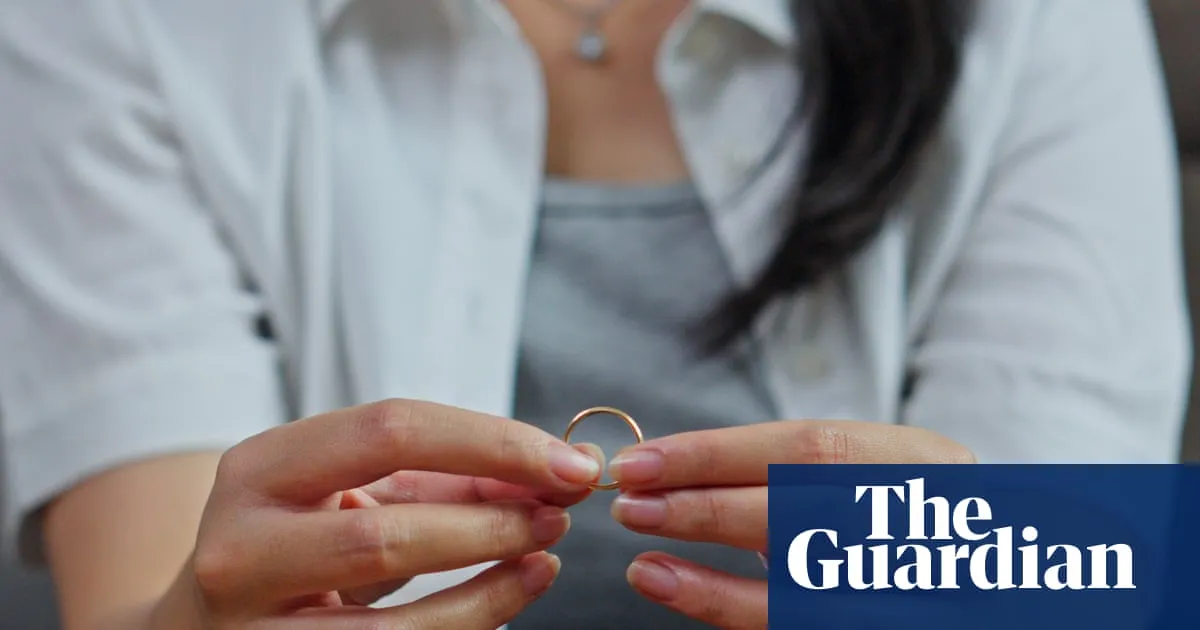
Most couples are aware of the dreaded “seven-year itch”, when the honeymoon period wears off and real life starts to bite.Now official data has shown that couples in England and Wales are more likely to split after 20 years. According to Office for National Statistics figures, more than a quarter of all divorces between opposite-sex couples happened after 20 years or longer of marriage.The former Strictly presenter Tess Daly recently separated from her husband, the presenter Vernon Kay, after 22 years of marriage. The Downton Abbey actor Hugh Bonneville split from his wife, Lulu Williams, in 2023 after 25 years, and in 2019, Colin Firth announced his separation from wife, Livia Giuggioli, after 22. Last year, the Hollywood actor Nicole Kidman and singer Keith Urban separated after almost 20 years of marriage.Divorce lawyers have previously said some couples are putting off splitting up because of the cost of living crisis. Recent figures have shown the average length of a marriage ending in divorce in England and Wales reached a record high last year.ONS figures have long shown that the seven-year itch appears to exist; since records began in 1963, the largest proportion of divorces each year has almost always been among those who have spent between five to nine years as a couple.Just over a quarter (26%) of the 102,879 divorces involving opposite-sex couples in England and Wales last year had been married for 20 years or more, while 23% were between five and nine years. This is the second time the five- to nine-year category has been pushed to second place. In the mid-1980s it happened when a new law cut the minimum term of a marriage from three years to one.Divorce lawyers think the rise of the divorce after 20 years is due to couples staying together for the sake of the children. Lisa Pepper, a divorce lawyer at Osbornes Law, told the Sunday Times: “The largest percentage of cases I see are after a long marriage. Staying together for the sake of the children is true.”The trend is also happening in the US: a Pew research group study found the incidents of those divorcing after 20 years had doubled since the 1990s. Researchers cautioned: “Divorce at this stage of life can also have some downsides. Grey divorcees tend to be less financially secure than married and widowed adults, particularly among women. And living alone at older ages can be detrimental to one’s financial comfort and, for men, their satisfaction with their social lives.”Analysis from the US law firm Weinberger found: “Marrying for life is no longer seen as the pinnacle of successful adulthood – especially in more progressive areas of the country. Those who have adequate financial resources to flourish solo may feel more freedom to uncouple.“With less societal pressure to stay together no matter what, ‘grey divorcees’ have more ‘permission’ to unshackle themselves from unhappy marriages and make the best of their golden years.”Earlier ONS figures for England and Wales found the average marriage ending in divorce in 2025 lasted for 13 years. This is the longest since records began in 1963 and up from a record low of 8.9 years in 1985.Rebecca Aston‑Jones, a senior associate at Clarke Willmott, a law firm that specialises in divorce, said the rising cost of living was keeping unhappy couples together.“One of the main factors discouraging people from pursuing a divorce is the significant financial pressure that comes with establishing and maintaining two separate households,” she said.
SRCThe Guardian - World News
LANGEN
LEANCenter-Left
WORDS578
ENT12
SUN · 2026-10-18 · 13:29 GMTBRIEF NSR-2026-1018-119889
NSR-2026-1018-119889News Report·EN·Human Interest
Forget the seven-year itch: opposite-sex marriages more likely to end after two decades
New data from the Office for National Statistics in England and Wales reveals that opposite-sex marriages are now more likely to end after two decades than the commonly cited "seven-year itch." In 2025, 26% of heterosexual divorces occurred after 20 or more years of marriage, surpassing the 23% of divorces that happened between five and nine years. Divorce lawyers suggest couples may stay together for children's sake, while the rising cost of living also discourages splitting due to the financial burden of maintaining two households.
Helena HortonThe Guardian - World NewsFiled 2026-10-18 · 13:29 GMTLean · Center-LeftRead · 3 min
The Guardian - World NewsFIG 01
Reading time
3min
Word count
578words
Sources cited
4cited
Entities identified
12entities
Quality score
100%
§ 01
Briefing Summary
AI-generatedNEWSAR · AI
New data from the Office for National Statistics in England and Wales reveals that opposite-sex marriages are now more likely to end after two decades than the commonly cited "seven-year itch." In 2025, 26% of heterosexual divorces occurred after 20 or more years of marriage, surpassing the 23% of divorces that happened between five and nine years. Divorce lawyers suggest couples may stay together for children's sake, while the rising cost of living also discourages splitting due to the financial burden of maintaining two households. This trend mirrors findings in the US, where divorces after 20 years have doubled since the 1990s, with researchers noting potential financial and social downsides for "grey divorcees."
Confidence 0.90Sources 4Claims 5Entities 12
§ 02
Article analysis
Model · rule-basedFraming
Human Interest
Legal & Judicial
Tone
Mixed Tone
AI-assessed
CalmNeutralAlarmist
Factuality
0.70 / 1.00
Factual
LowHigh
Sources cited
4
Well sourced
FewMany
§ 03
Key claims
5 extracted01
The proportion of divorces after 20 years or more has surpassed those occurring between five and nine years of marriage.
statisticOffice for National Statistics
Confidence
1.00
02
In England and Wales, over a quarter of divorces involving opposite-sex couples in the last year occurred after 20 years or more of marriage.
statisticOffice for National Statistics
Confidence
1.00
03
In the US, the incidence of divorce after 20 years has doubled since the 1990s.
statisticPew research group
Confidence
0.90
04
Divorce lawyers suggest couples stay together for the sake of children, contributing to later-life divorces.
quoteLisa Pepper (divorce lawyer)
Confidence
0.90
05
Divorce at later stages of life can lead to reduced financial security, particularly for women.
quotePew research group
Confidence
0.80
§ 04
Full report
3 min read · 578 words§ 05
Entities
12 identifiedKey playerOppositionContextPositiveNeutralNegative
People8
Organizations1
§ 06
Keywords & salience
10 termsdivorce trends
1.00
long marriages
0.90
opposite-sex couples
0.80
seven-year itch
0.70
marriage duration
0.70
divorce after 20 years
0.60
staying together for children
0.50
grey divorce
0.40
cost of living crisis
0.40
office for national statistics
0.40
§ 07
Topic connections
Interactive graph Network visualization showing 51 related topics
View Full Graph Person Organization Location Event|Click node to navigate|Edge numbers = shared articles