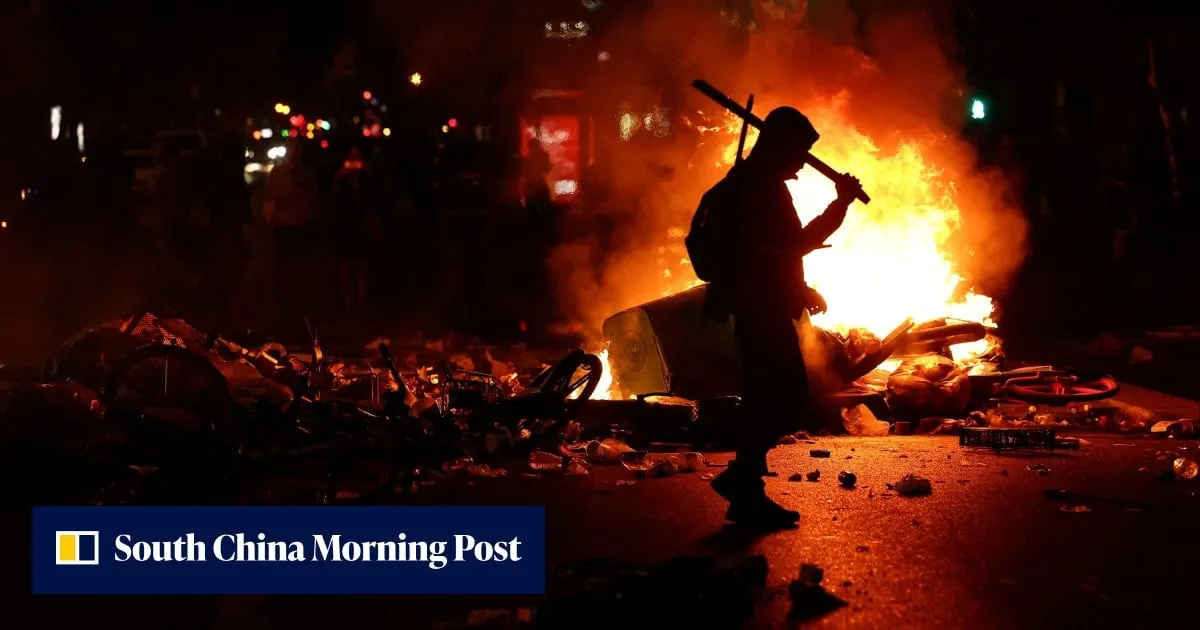
The French prime minister called for localised curfews on Monday, as protesters blocked the entrance to the Louvre in Paris and authorities scrambled to stem public discontent that over the weekend saw mass cost-of-living protests spill over into some of the worst street violence in recent years.Prime Minister Sebastien Lecornu huddled with ministers in a crisis meeting after the interior minister said the police “had lost control” during the weekend’s unrest.With the Yellow Vests movement, which organised the weekend’s rallies, calling for a new round of protests next Saturday, Lecornu called for regional authorities to impose “partial” and “localised” curfews to protect businesses after hundreds of shops were damaged and looted.“I’m absolutely determined to restore public order”, he vowed, adding that the government was ready to impose a state of emergency “if needed”.Other European countries, where anger over rising prices has also led to protests, were keeping a nervous eye on the developments, with smaller clashes breaking out in Milan and Belgium over the weekend and protests simmering in Spain and Portugal.A protester is detained in Paris on Sunday. Photo: ReutersSome half a million people turned out across France on Saturday to denounce the surging cost of living, a culmination of four weeks of protests that began with high school students demanding better conditions at their schools.What started as peaceful protests morphed into violence in some places, as masked groups on the sidelines of the protests attacked law enforcement, broke into town halls and other public buildings, setting many of them ablaze, looted shops, and set fire to cars, bicycles and scooters on the streets.Interior Minister Laurent Nunez offered to resign on Monday after more than 2,500 people were arrested and nearly 1,000 members of the security forces injured. Protesters were also hurt, with a protester’s hand blown off by a police crowd-control grenade.“On Saturday, in some major cities, you couldn’t look shopkeepers in the eye after hundreds of shops had been looted and tell them we hadn’t lost control,” Nunez said.French President Emmanuel Macron refused Nunez’s resignation, even as he acknowledged security and intelligence failures in the government response, despite the deployment of some 60,000 law enforcement personnel across the country on Saturday.A yellow vest is draped on Paris’ Statue de la Republique on Sunday. Photo: EPANationwide, more than 2,330 people were taken into police custody over the weekend, 70 per cent of whom were adults – and many of whom were already known to authorities, Justice Minister Gerald Darmanin said on Monday.More than 2,000 shops were expected to have been affected by the weekend’s violence across France, with damage running into “hundreds of millions of euros”, according to chamber of commerce president Alain Di Crescenzo.In an address to the nation on Sunday, Macron slammed the “unbridled” violence and said local authorities would be able to ban some rallies, but stopped short of imposing more drastic measures.City authorities in Marseille said on Monday they had banned public gatherings from noon to 8pm local time.The European Union slammed the weekend violence as “unacceptable” but warned that the right to peaceful protest “must be protected” in France.Germany condemned the violence and updated its travel advice for France, saying “further demonstrations and, in some cases, further outbreaks of violence in the coming days cannot be ruled out”.The United Kingdom said the right to protest “can never excuse violence”.Protesters block an entrance to the Louvre on Monday. Photo: EPAThe public discontent showed no signs of subsiding on Monday, with protesters blocking the entrance to Paris’s iconic Louvre Museum, the most visited in the world.Further ReadingRising prices have fuelled anger in France, where diesel prices have jumped nearly 40 per cent and petrol by 25 per cent since March and where food prices have risen by 25 per cent since 2021.The unrest has flared just months before a key presidential election where centrist Macron cannot stand again and Marine Le Pen, the far-right presidential candidate for the National Rally party, is riding high in the polls.Ministers and Le Pen have accused ultra-left groups of stoking the violence to boost the chances of the far-left firebrand Jean-Luc Melenchon in the presidential polls.On Monday Lecornu blamed the “ultra-left movement” for seeking to “orchestrate deep unrest across the country”.“There is a whole network that could be mobilised to even call into question the timetable for the presidential election and the holding of the presidential election itself,” Lecornu told reporters.Riot police use a water cannon as protesters gather in Brussels on Saturday. Photo: AFPSimilar protests have broken out in other countries.During the weekend, clashes broke out on the sidelines of a cost-of-living protest in Milan, with Mayor Giuseppe Sala warning: “I’m very worried because it’s a new phenomenon, which also originates from an international scenario and therefore feeds itself.”In Belgium, police fired tear gas and water cannon to disperse protesters in Brussels and Liege.In Spain, hundreds of tents have occupied Madrid’s central Puerta del Sol square since September, when the eviction of an 87-year-old woman from her lifelong flat sparked nationwide protests in a country with soaring housing costs.Protesters have also set up tents in Portugal’s main cities of Lisbon and Porto over the rising costs of housing.
SRCSouth China Morning Post
LANGEN
LEANCenter-Right
WORDS860
ENT12
MON · 2026-10-19 · 12:57 GMTBRIEF NSR-2026-1019-120147
NSR-2026-1019-120147News Report·EN·Conflict
France’s PM calls for curfews as nation grapples with unrest
France's Prime Minister Sebastien Lecornu has called for localized curfews to combat widespread unrest stemming from cost-of-living protests. The demonstrations, which began peacefully, escalated over the weekend into significant street violence, with protesters blocking the Louvre and hundreds of shops looted and damaged.
Agence France-PresseSouth China Morning PostFiled 2026-10-19 · 12:57 GMTLean · Center-RightRead · 4 min
South China Morning PostFIG 01
Reading time
4min
Word count
860words
Sources cited
4cited
Entities identified
12entities
Quality score
100%
§ 01
Briefing Summary
AI-generatedNEWSAR · AI
France's Prime Minister Sebastien Lecornu has called for localized curfews to combat widespread unrest stemming from cost-of-living protests. The demonstrations, which began peacefully, escalated over the weekend into significant street violence, with protesters blocking the Louvre and hundreds of shops looted and damaged. The interior minister admitted police had "lost control" during the unrest, which saw over 2,330 arrests and nearly 1,000 security force injuries. Prime Minister Lecornu vowed to restore public order and is prepared to declare a state of emergency if necessary, blaming an "ultra-left movement" for orchestrating the deep unrest. The violence occurs as France faces rising prices and approaches a presidential election.
Confidence 0.90Sources 4Claims 5Entities 12
§ 02
Article analysis
Model · rule-basedFraming
Conflict
Economic Impact
Tone
Mixed Tone
AI-assessed
CalmNeutralAlarmist
Factuality
0.70 / 1.00
Factual
LowHigh
Sources cited
4
Well sourced
FewMany
§ 03
Key claims
5 extracted01
French Prime Minister called for localized curfews to protect businesses amidst unrest.
quoteFrench Prime Minister Sebastien Lecornu
Confidence
1.00
02
The Yellow Vests movement is calling for a new round of protests next Saturday.
factualYellow Vests movement
Confidence
0.90
03
A protester's hand was lost due to a police crowd-control grenade.
factualnull
Confidence
0.90
04
Over 2,500 people were arrested and nearly 1,000 security forces members injured during weekend unrest.
statisticInterior Minister Laurent Nunez
Confidence
0.90
05
More than 2,000 shops were affected by violence, with damage costs in the hundreds of millions of euros.
statisticChamber of commerce president Alain Di Crescenzo
Confidence
0.80
§ 04
Full report
4 min read · 860 words§ 05
Entities
12 identifiedKey playerOppositionContextPositiveNeutralNegative
People3
§ 06
Keywords & salience
10 termscost of living protests
1.00
public unrest
1.00
curfews
0.90
public order
0.80
yellow vests
0.70
street violence
0.70
looting
0.60
state of emergency
0.50
security failures
0.50
european protests
0.40
§ 07
Topic connections
Interactive graph Network visualization showing 51 related topics
View Full Graph Person Organization Location Event|Click node to navigate|Edge numbers = shared articles