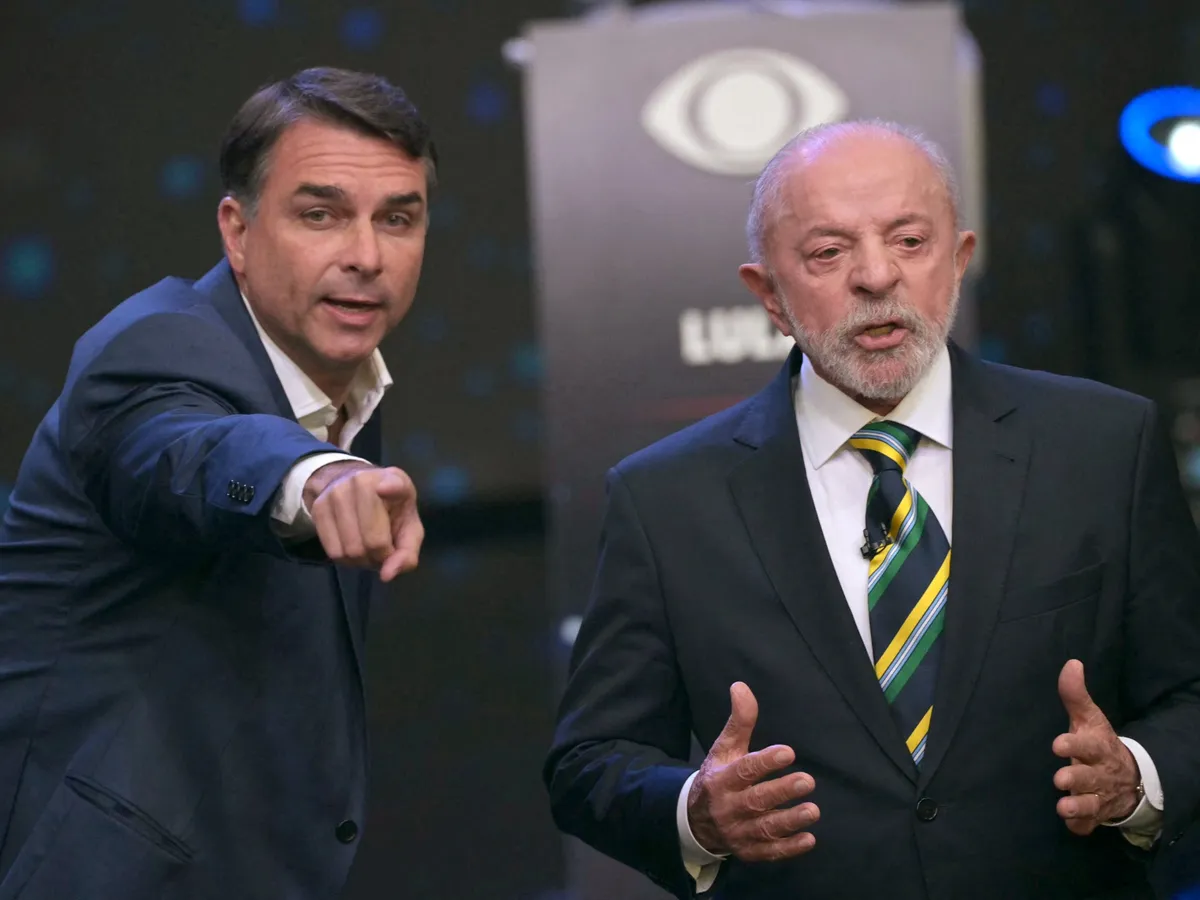
A judge also doubled the daily fine for noncompliance with a previous court order governing political content on Meta’s platform.Brazilian President Luiz Inacio Lula da Silva and Senator Flavio Bolsonaro debate ahead of the Presidential election run-off in Sao Paulo, Brazil, on October 18, 2026 [Nelson Almeida/AFP]Published On 19 Oct 2026Brazil’s top electoral court has doubled a daily fine for the United States-based social media company Meta, saying it failed to comply with an order about how political content is shown on its platforms.On Monday, the Superior Electoral Court (TSE) gave Meta 24 hours to show that it is not favouring one presidential candidate over the other in its content feeds.Recommended Stories list of 3 itemslist 1 of 3Meta lawsuits: Is social media facing a global legal reckoning?list 2 of 3Lula and Bolsonaro spar in Brazil’s fiery first presidential run-off debatelist 3 of 3Meta employees say Lula’s accounts restricted in Brazil election: Reportend of listThe decision comes less than a week before Brazilians vote in a presidential run-off that pits left-wing incumbent Luiz Inacio Lula da Silva against right-wing senator Flavio Bolsonaro.“The continued noncompliance, just a few days before the run-off election, demonstrates that the fine imposed was insufficient,” a TSE judge said in Monday’s order.The penalty for noncompliance was also increased in the order, from 500,000 Brazilian reals ($100,000) to one million reals ($200,000).The court order is in response to a complaint from Lula’s campaign that Meta prevented his profile from being fully promoted on Instagram and from being visible in searches.His campaign has also argued that posts by Lula’s supporters are being disproportionately taken down by moderators, who are instead allowing content promoting his rival or questioning the integrity of elections.Civil society groups and digital rights monitors have supported those allegations, saying Facebook, Instagram and WhatsApp — three platforms run by Meta — have suppressed content from the left-leaning leader while boosting posts promoting Bolsonaro.Meta has denied favouring either candidate on its platforms, although it admits some of Lula’s campaign ads were taken offline temporarily due to technical errors.Lula and Bolsonaro are set to face off in a final round of voting on Sunday. Bolsonaro, the son of an imprisoned former president, performed better than many analysts expected in the first round of voting on October 4.He garnered 47 percent of the vote, compared with Lula’s 45 percent. Neither, however, crossed the 50-percent threshold needed to avoid a run-off. Pre-election polling puts the two virtually neck-and-neck going into Sunday’s vote.Social media bias has been a point of contention on both sides of Brazil’s political sphere.Earlier this month, Lula’s campaign launched a website to document complaints from supporters about their activities being unfairly restricted on Meta and other social media platforms.Several digital rights groups, such as the nonprofit CTRL+Z, have published findings that suggest Meta may have helped Bolsonaro have an outsized presence on its platforms, which many in Brazil use as their main source of news.“Brazilian citizens have the right to know why their accounts were banned, why their posts disappeared, why their accounts lost reach, and why they are being prevented from commenting, reposting, and saving content,” CTRL+Z wrote on its website.“Meta cannot be the invisible judge of the Brazilian electoral debate.”On Friday, the Brazilian newspaper Folha de S Paulo reported it had reviewed internal messages between Meta employees acknowledging they were aware of the inconsistent treatment of Lula and Bolsonaro’s social media presence.Political campaigns in Brazil have dramatically increased their spending on social media platforms like Facebook and Instagram, outpacing traditional avenues like television or street advertising in recent elections, said Daniela da Silva, the executive director of CTRL+Z.According to data collected by the Supreme Electoral Court, Facebook received more than 200 million reals ($40m) in revenue in the 2024 municipal elections, ranking at the top of advertising suppliers for that cycle.Despite that revenue, da Silva said that Meta and other companies were not taking their responsibility towards election fairness seriously.“These are very powerful, wealthy companies, and they do have the capacity to do much more than they are doing,” she told Al Jazeera.More than 100 civil society groups, including Greenpeace International, Global Witness and Oxfam Brazil, have joined CTRL+Z to sign a letter calling on Brazilian authorities to enforce rules meant to rein in Meta.They have also pushed the company itself to do a better job removing deepfakes and disinformation, and to provide clear rules on how it moderates content.“We want transparency regarding moderation criteria, a human review channel, and timely responses to protect the election,” the group said on its website.
SRCAl Jazeera
LANGEN
OutletState media · Qatar
WORDS757
ENT10
MON · 2026-10-19 · 17:24 GMTBRIEF NSR-2026-1019-120203
NSR-2026-1019-120203News Report·EN·Legal & Judicial
Brazilian court orders Meta to prove Lula and Bolsonaro get equal treatment
Brazil's Superior Electoral Court (TSE) has doubled the daily fine for Meta to one million reals ($200,000) for failing to comply with an order regarding political content on its platforms. The court gave Meta 24 hours to prove it is not favoring either presidential candidate, Luiz Inacio Lula da Silva or Flavio Bolsonaro, in its content feeds, just days before the election run-off.
Umar FarooqAl JazeeraFiled 2026-10-19 · 17:24 GMTOutlet · State media · QatarRead · 4 min
Al JazeeraFIG 01
Reading time
4min
Word count
757words
Sources cited
3cited
Entities identified
10entities
Quality score
100%
NEWSAR · AI
Brazil's Superior Electoral Court (TSE) has doubled the daily fine for Meta to one million reals ($200,000) for failing to comply with an order regarding political content on its platforms. The court gave Meta 24 hours to prove it is not favoring either presidential candidate, Luiz Inacio Lula da Silva or Flavio Bolsonaro, in its content feeds, just days before the election run-off. This decision stems from a complaint by Lula's campaign alleging Meta suppressed his content while allowing posts promoting Bolsonaro. Meta denies favoritism, though it acknowledged temporary technical issues with some of Lula's ads. Civil society groups have supported the allegations, citing internal messages suggesting awareness of inconsistent treatment.
Confidence 0.90Sources 3Claims 5Entities 10
Framing
Legal & Judicial
Political Strategy
Tone
Measured
AI-assessed
CalmNeutralAlarmist
Factuality
0.80 / 1.00
Factual
LowHigh
Sources cited
3
Well sourced
FewMany
01
Lula's campaign complained Meta prevented his profile promotion and visibility in searches, and took down supporter posts.
factualLula's campaign
Confidence
1.00
02
Meta was given 24 hours to prove it is not favoring one presidential candidate over another in content feeds.
factualSuperior Electoral Court (TSE)
Confidence
1.00
03
Brazilian court doubled daily fine for Meta for failing to comply with an order on political content display.
factualSuperior Electoral Court (TSE)
Confidence
1.00
04
Meta denies favoring candidates but admits temporary removal of some Lula ads due to technical errors.
factualMeta
Confidence
0.90
05
Civil society groups and digital rights monitors allege Meta suppressed content from Lula while boosting Bolsonaro posts.
factualCivil society groups and digital rights monitors
Confidence
0.90
§ 04
Full report
4 min read · 757 wordsKey playerOppositionContextPositiveNeutralNegative
People2
Organizations6
Locations1
brazilian election
1.00
meta
1.00
political content
0.90
lula
0.80
bolsonaro
0.80
court order
0.70
content feeds
0.60
superior electoral court
0.50
daily fine
0.40
§ 07
Topic connections
Interactive graph Network visualization showing 51 related topics
View Full Graph Person Organization Location Event|Click node to navigate|Edge numbers = shared articles