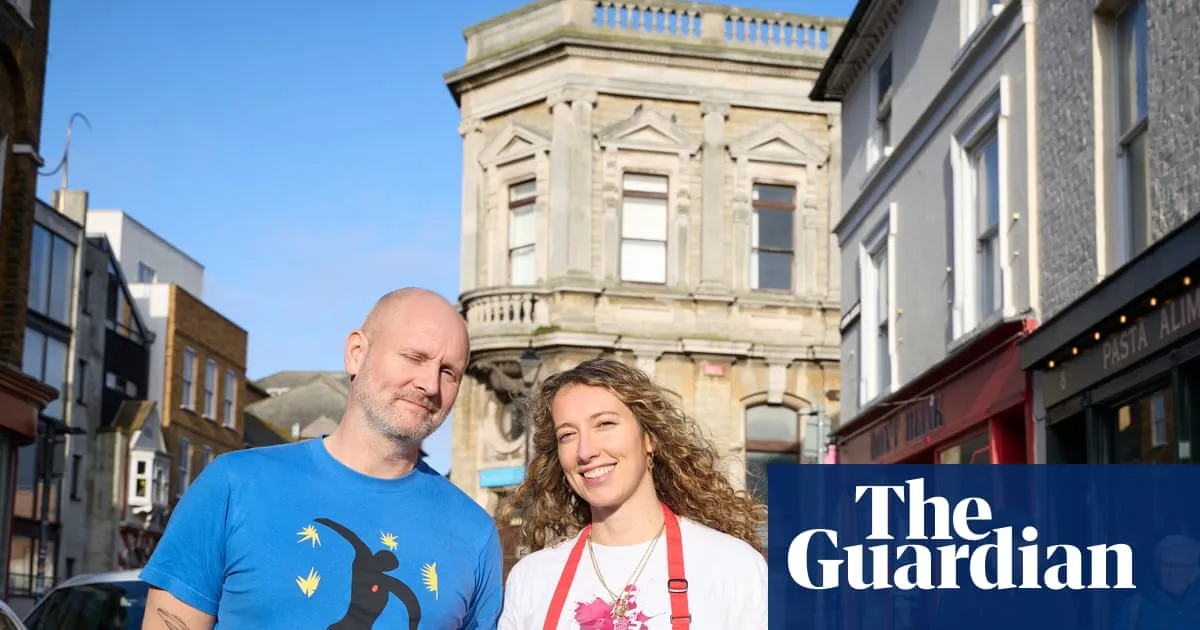
Not many chefs working in small, family-run restaurants expect global megastars to turn up for dinner and to design them a menu from scratch.But that’s what happened to Simona Di Dio last weekend, when she cooked dishes inspired by her Italian grandmother’s recipes for Madonna, who sat on the single wooden dining table in Di Dio’s cosy, candlelit Italian restaurant in Margate’s old town.“It was really informal and really lovely, and relaxed. It was really special and she was really nice,” said Di Dio.She said it was “mind-blowing” to realise she had cooked her richly flavoured bean and kale stew and unusual Neapolitan beef shin pasta for one of the world’s most famous musicians, though she acknowledged: “Margate is always full of opportunities.”Di Dio moved with her partner, Harry Ryder, to Margate a decade ago, priced out of London and Canterbury, and Di Dio said she spotted there was “already a buzz” in the town back then, but the pair have been astonished to witness its changing fortunes.Simona Di Dio and Harry Ryder found it ‘mind-blowing’ to be cooking for Madonna. Photograph: David Levene/The GuardianAs well as raving about her visit to Di Dio’s Cantina Caruso restaurant during a visit organised by the Turner prize-winning artist Tracey Emin, Madonna enthused about Margate on Instagram, describing the town as “heaven” and “energised by creativity”.While Di Dio and Ryder recognised Madonna’s depiction of Margate as filled with artists, musicians and performers – vocations shared by many of their staff members – they felt that it was important not to idealise the town, which has a sharp social and economic divide.Noting that the town has some of the most deprived postcodes in the UK, Ryder said: “It’s not all rosy. She didn’t see it all, she saw the art scene. Obviously there is a lot more to it.”But he added that although the influx of wealthier people and “DFLs” (Down From Londons) has been much maligned, lots of newer arrivals do want to contribute to the area.Among the projects aiming to bridge the divide between Margate’s “two towns” is the Perfect Place to Grow project, a cafe situated on the site of Tracey Emin’s TKE Studios which trains local 18 to 24-year-olds who are struggling to access sustainable employment.David Wilson, a chef and support worker who runs the kitchen, said: “Young people who try to engage with the Jobcentre and employment services locally are given very uninspiring options and we try to do the opposite of that.”Margate’s strong brand has given trainees the opportunity to work with celebrity chefs such as José Pizarro and Nathan Outlaw, he said.David Wilson runs the kitchen for the Perfect Place to Grow project. Photograph: David Levene/The GuardianMany local people have mixed feelings about Margate’s growing appeal to the rich and famous. Dan Thompson, an artist who has lived in the town for 20 years, moved in to what used to be one of the town’s “roughest streets”, but has been unable to keep up with prices rising as high-end galleries have moved in, and is now homeless and living with friends.He said this experience was shared by others in his cohort of DIY experimental artists who moved in in the early 2000s – with many having since relocated to Dover in search of cheaper rents.Artist Dan Thompson is a longtime Margate resident. Photograph: David Levene/The GuardianBut he acknowledged that there have been “massive spillover benefits” from the town’s recent gentrification for some – for example, local tradesmen have profited from the increased demand for their services.He is curating an exhibition that opens next week called Lost Margate, which looks at the way different waves of arrivals have rewritten Margate’s story.Connor Sansby is a poet who incorporates Margate’s seascape into his work. Photograph: David Levene/The Guardian“For 300 years, it has only existed to take money from Londoners, so has always reinvented itself,” he said. “People absolutely love this place, and every generation that comes in falls in love with it for a slightly different reason.”Connor Sansby, a poet who has lived in Margate his whole life, is contributing a work to the exhibition, which uses the seaside town’s waves as a metaphor for gentrification, in which new arrivals erase that which existed before.“Margate has become a place of two halves. It’s two places occupying the same space,” he said, noting that the new art world has “splintered” from local creatives.“They’re not interacting with the Margate native population, so they don’t understand some of the issues,” he said, citing the battle over a Greggs takeaway opening as a symbol for the disconnection between people who need affordable food options and those who do not.Despite this, Sansby agreed with Madonna’s assessment: “It does occasionally feel like an absolute dream. There’s a culture and a community of people who’ve been here the whole time, and we are all fantastic.”Margate’s shabby high street is often seen as exemplifying the town that is being left behind amid the boutiques, restaurants and art galleries opening up in its old town.Leo Kilburn-Long, who works in the McDonald’s on the street, said he appreciated how Margate’s changing fortunes have led to “new stuff popping up recently” to reverse the high street’s decline.Leo Kilburn-Long is one of many people in Margate worried about the cost of living. Photograph: David Levene/The GuardianBut he viewed gentrification as a double-edged sword: “Cost of living down here is ridiculous, you have to spend an arm and a leg to even afford a little room in somebody’s gaff,” he said. “Margate is a great place to go visit, but to stay down here is so expensive.”Amy Holbourne, who works on the high street, hoped that Madonna’s enthusiastic post may “help bring a lot of business to the town”.But she said believed that rising housing prices had resulted in growing homelessness and drug addiction.Amy Holbourne feels Margate is improving. Photograph: David Levene/The GuardianHer niece, who has three children, has been on a social housing waiting list for three years and has been living with her grandfather. “There’s just no housing round here,” she said. “The council need to really sort it out.”Asked if she too would describe Margate as “heaven”, she said: “I live here, I wouldn’t describe it as that … but it’s improving.”
SRCThe Guardian - World News
LANGEN
LEANCenter-Left
WORDS1 042
ENT7
FRI · 2026-01-30 · 18:19 GMTBRIEF NSR-2026-0130-12025
NSR-2026-0130-12025News Report·EN·Economic Impact
‘A place of two halves’: how Margate’s art-led renewal has left it ‘splintered’
Margate, England, has experienced an art-led renewal, attracting figures like Madonna, who praised the town's creativity after visiting Tracey Emin and dining at Cantina Caruso. The restaurant's owners, Simona Di Dio and Harry Ryder, moved to Margate a decade ago.
Rachel HallThe Guardian - World NewsFiled 2026-01-30 · 18:19 GMTLean · Center-LeftRead · 5 min
The Guardian - World NewsFIG 01
Reading time
5min
Word count
1 042words
Sources cited
6cited
Entities identified
7entities
Quality score
100%
§ 01
Briefing Summary
AI-generatedNEWSAR · AI
Margate, England, has experienced an art-led renewal, attracting figures like Madonna, who praised the town's creativity after visiting Tracey Emin and dining at Cantina Caruso. The restaurant's owners, Simona Di Dio and Harry Ryder, moved to Margate a decade ago. While acknowledging the positive changes and influx of artists, they emphasize the town's stark social and economic disparities, noting areas with significant deprivation. Projects like Perfect Place to Grow, a cafe at Emin's TKE Studios, aim to address this divide by training local young adults facing employment challenges. The article highlights the contrast between Margate's thriving art scene and the socio-economic realities faced by some of its residents.
Confidence 0.90Sources 6Claims 5Entities 7
§ 02
Article analysis
Model · rule-basedFraming
Economic Impact
Social Justice
Tone
Measured
AI-assessed
CalmNeutralAlarmist
Factuality
0.70 / 1.00
Factual
LowHigh
Sources cited
6
Well sourced
FewMany
§ 03
Key claims
5 extracted01
Simona Di Dio cooked for Madonna in her restaurant in Margate's old town.
factualThe article itself
Confidence
1.00
02
Perfect Place to Grow project trains local 18-24 year olds struggling to access sustainable employment.
factualThe article itself
Confidence
1.00
03
Margate has some of the most deprived postcodes in the UK.
factualHarry Ryder
Confidence
1.00
04
Madonna visited Cantina Caruso restaurant in Margate and praised the town on Instagram.
factualThe article itself
Confidence
1.00
05
Margate's strong brand has given trainees the opportunity to work with celebrity chefs.
factualDavid Wilson
Confidence
0.90
§ 04
Full report
5 min read · 1 042 words§ 05
Entities
7 identifiedKey playerOppositionContextPositiveNeutralNegative
People3
§ 06
Keywords & salience
9 termsmargate
1.00
art-led renewal
0.80
social divide
0.70
economic divide
0.70
madonna
0.60
tracey emin
0.60
inequality
0.50
regeneration
0.50
employment
0.40
§ 07
Topic connections
Interactive graph No topic relationship data available yet. This graph will appear once topic relationships have been computed.