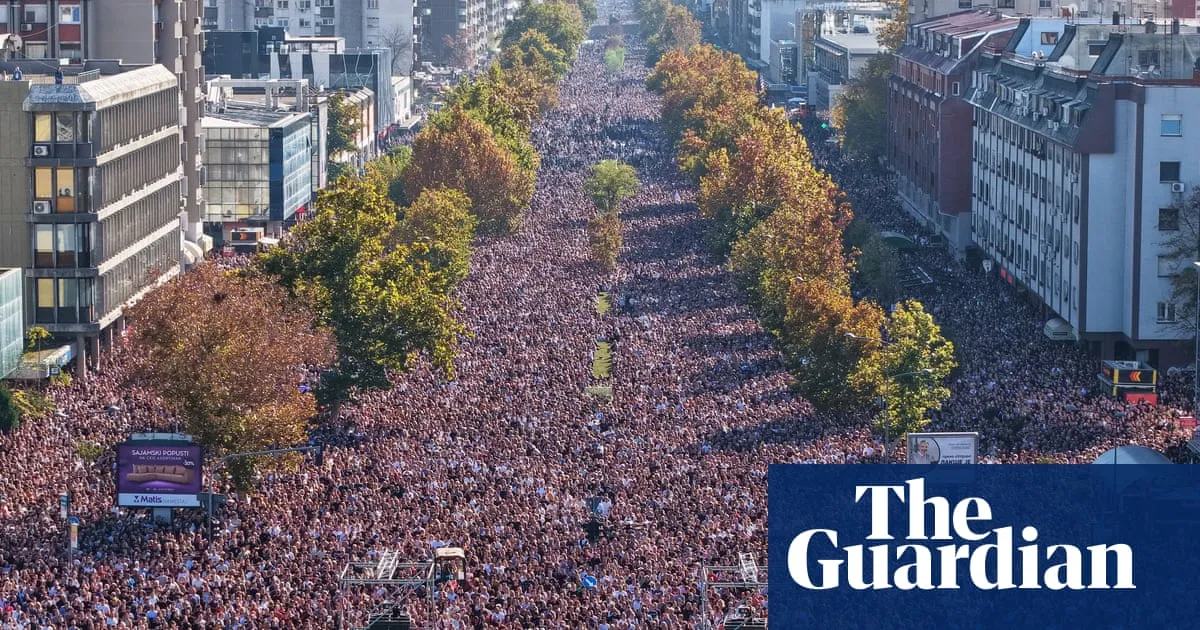
On the first anniversary of the Novi Sad tragedy people filled the streets. Photograph: Armin Durgut/AP View image in fullscreen On the first anniversary of the Novi Sad tragedy people filled the streets. Photograph: Armin Durgut/AP Friday briefing: How a leaderless student group is challenging power in Serbia In today’s newsletter: Born from the fury surrounding the deadly Novi Sad station collapse, Serbia’s Student List has taken its protests all the way to the elections in an unprecedented grassroots campaign Good morning. As waves of youth-led protests swell across Europe, prompted by the cost of living, unaffordable housing and education standards, in Serbia the younger generation is taking on the apparatus of the state itself. In tight-run parliamentary elections this Sunday, the country’s most consequential political movement in decades, Student List, is challenging former Slobodan Milošević henchman Aleksandar Vučić and his 12-year domination of Serbian politics. Two years on from a singular national tragedy that galvanised public anger at state cover-ups and corruption, gen Z have channelled their energy and fury into a bold experiment in direct democracy, creating a genuinely leaderless, grassroots movement that is firing up disaffected voters across the country. I spoke to Julian Borger, our senior international correspondent, who has just returned from Belgrade, about their hopes of emulating the defeat of Vučić’s ally, Viktor Orbán, in neighbouring Hungary and the potential for a democratic domino through central Europe. But first, the headlines. UK news | Every Briton is being urged to stock up to nine litres of bottled water and three days’ worth of food in new government guidance designed to ensure that households can survive a weather, cyber or other serious emergency. Ukraine | Russia has carried out a massive “demonstrative” attack on Ukraine, bombarding Kyiv with ballistic missiles just hours after Vladimir Putin said he had agreed to resume trilateral negotiations. UK politics | Nigel Farage’s newest billionaire donor was in business with a powerful Iranian religious foundation under the authority of the country’s supreme leader. Europe news | Emmanuel Macron has said “illegitimate” demonstrations will be banned over the coming days as France seeks to get a grip on civil unrest after some of its worst street violence in years. Energy | Great Britain is expected to pay some of the highest energy costs in Europe this winter as its reliance on imports to ensure a steady supply is forecast to deepen. In depth: ‘The essence of our movement is direct democracy’ View image in fullscreen A large group of Student List supporters arrive in Belgrade after marching from several cities across Serbia. Photograph: Pierre Crom/Getty Images It was, one Serbian student told me, “the drop that overflowed the glass”. On 1 November 2024, the collapse of a concrete canopy at the railway station in Novi Sad, Serbia’s second largest city, killed 16 people. The youngest was a six-year-old girl, Sara Firic, who was sitting on a bench with her grandfather and older sister. The Serbian Times reported they were still holding hands when their bodies were dug out of the rubble. In the aftermath of the disaster, student-led protests developed organically, with demonstrators blocking a nearby crossroads for the same number of minutes as lives lost. As details emerged of botched refurbishment work carried out in what critics described as a corrupt deal with a Chinese consortium, the anger mounted. Ongoing protests were brutally suppressed and Vučić himself branded demonstrators western-backed “terrorists”. Two years later, that single tragedy has sparked a mass movement for accountability and inclusive democracy to counter the creeping authoritarianism of Vučić’s Serbian Progressive party (SNS). “There was a deep well of public discontent, and the students were inspirational in keeping the protest movement going,” says Julian. Vučić expected the protesters to dissipate – instead, the mounting pressure forced the president to resign and call a snap parliamentary election, as he endeavours to consolidate his 12 years in power in a Putin-inspired switch to become prime minister. In response, the student movement is fielding a list of 250 candidates of its own, mainly locally respected academics but also actors, musicians and farmers, with each candidate approved by citizens’ assembly. Some polling suggests that Student List is edging ahead; others that the SNS is consolidating support. Julian tells me he left Belgrade with the sense that anything could happen on Sunday. How did a student network put together an election campaign? The Serbian student I spoke to is buzzing ahead of Sunday’s vote: “We’re really excited,” he tells me over the phone from the Serbian capital. “We hope we win.” He is studying for a masters in dramatic arts at the University of Belgrade, and asks not to be named in accordance with the leader-less structure of his movement. He talks me through the “big collective effort”, including collecting canvas data door to door, and the “A student in every village” programme targeting Vučić’s base of rural voters, all coordinated by democratic citizens’ assembly. The thinking is that a higher turnout of disaffected voters will favour Student List. Julian encapsulates the Student List movement as “a bold democratic experiment”, and that is how my student describes it: “The essence of our movement is direct democracy. This collective effort is about making people feel part of the decision-making, not just spectators.” When Julian joined Student List volunteers canvassing in the housing estates of Krnjača, a Belgrade suburb, they were met with overwhelmingly positive reactions – “the response was ‘bring it on’” – though he caveats that opinion in outlying suburbs varies from those of the urban intelligentsia and others in more rural settings. “People were saying to the volunteers, ‘Take my contact and tell me anything I can do on election day.’ There’s a feeling of now or never.” The demands of the student movement are focused on governance, Julian tells me, and their slogan, “Serbia or mafia?”, highlights repeated allegations of links between the SNS and organised crime, something the government denies. “Student List wants a rules-based order that conforms with the constitution on paper, not the system of classic crony capitalism that Vučić has established, where everything depends on your link to the SNS.” Julian says Vučić is plainly taking the Student List threat seriously. He made 129 live television appearances in August, more than four times the previous month’s total. But the elections are happening in a context of growing repression: Serbia has regressed in international rankings for press freedom and corruption in recent years. And only last week, the Guardian revealed that Vučić intervened to advance an allegedly illegal scheme to hand over a protected landmark in Belgrade for a Trump tower, another spur for recent protests. A September survey for Serbian pro-democracy group the Centre for Research, Transparency and Accountability (CRTA) found no negative coverage of the ruling majority on the country’s television channels, compared with 37% of the time for the opposition. Student List has accused the foreign ministry of rigging the diaspora vote by keeping overseas polling stations open where support for Vučić is strong, while closing them in parts of North America where the opposition could expect to perform well. The ministry did not respond to Julian’s request to comment. Meanwhile the digital rights group SHARE Foundation found that members of the student movement had been targeted by advanced spyware, while Reuters this week reported on intimidation and beating of protesters by police. What is the likely aftermath of Sunday’s elections? With preliminary results expected in the early hours of Monday morning, a fundamental problem for the country is that neither side sees the other as legitimate, says Julian. “So in the aftermath of the election, barring a really clear decision, it will be disputed one way or another.” Indeed, the European Council on Foreign Relations has warned of further street protests and possible violent repression, depending on the outcome and the margin of victory. Big questions remain around how Student List would configure themselves as a government. Reforming the state and economy after more than a decade of highly centralised SNS control will be immensely challenging. So far their policy platform has been decided by full general assembly, and divisive issues such as future relations with Kosovo or Russia, and stance on EU membership, have been played down. Although Serbia is an EU-candidate country, public opinion on accession is split, and the SNS has counter-balanced relationships with the US, Russia and China, particularly after the Trump administration opened dialogue on energy and technology with them earlier this year. A Student List win would throw this geopolitical balancing act, which protesters argue brings little benefit to the people of Serbia, up in the air and potentially bring the country closer to Europe. And a contested Vučić victory would challenge the EU on whether to freeze diplomacy and funding to the country. The student organiser I spoke with is clear that regime change is just the beginning: “Once we remove the regime, the big debate starts in Serbia about what we should do next. Should we join the EU? What about foreign policy? How are we going to democratise the country? There’s a lot that’s not working because of corruption. But right now we’re focused on these elections.” What else we’ve been enjoying View image in fullscreen Central High School’s desegregated prom, 1967. Photograph: © Life Picture Collection, Meredith Operations Corporation I loved Lindsey Winship’s latest piece, which tells the story of a changing US through gorgeous images of American dancefloors across the years. My favourite shot has to be the crowd of beaming boppers at a 1967 desegregated high school prom. Lucinda Everett, newsletters team In this week’s you be the judge, a reader asks: “Should my husband stop letting our cat drink on the kitchen counter?” Totally perplexing this question needed to be asked. I’d be filing for divorce. Michael I’ve spent way too much time playing our new budget game, where you step into John Healey’s shoes and try to balance the books, while keeping backbenchers and the markets happy. Humbling but a lot of fun. Lucinda I spent a week of my year seven summer holiday as an extra in the History Boys film (it was shot at my school). Nadia Khomami reports on its return to the stage, but fails to mention my scene-stealing cameo … Michael Sport View image in fullscreen Bournemouth’s Amine Adli adds gloss to the scoreline with his late free-kick. Photograph: Catherine Ivill/AMA/Getty Images Football | Ruben Amorim’s Milan side were beaten 3-0 by Bournemouth after Mike Maignan’s mad red card. Meanwhile Celtic suffered more pain as Spanish side Celta Vigo came from behind to win 2-1 at Parkhead. Cricket | Scott Boland batted for more than three hours but South Africa beat Australia by an innings and 31 runs in the second Test in Gqeberha. Cycling | The most ambitious Grand Départ in the long history of the Tour de France was unveiled in Paris as race organisers fleshed out the details of 2027’s men’s and women’s race starts in Edinburgh and Yorkshire. Our critics’ roundup of the best things to watch, read, play and listen to right now View image in fullscreen Mount Fuji is the truth … Under the Wave off Kanagawa, 1830-1833, AKA The Great Wave. Photograph: Courtesy the Iuchi Collection, on deposit at The National Museum of Western Art, Tokyo. Photo by Norihiro Ueno Art and design Hokusai: Thirty-Six Views of Mount Fuji (Dulwich Picture Gallery, London) | ★★★★★ With its helpless rowers, naked river-crossers and snowbound tea-drinkers, this magnificent series of images from the Japanese master is a warning to put your faith in the essential and enduring. Read Jonathan Jones’s full review. Film Scream (in cinemas now) | ★★★★☆ The 30th anniversary rerelease of Wes Craven’s horror is a self-aware romp through the genre that is redolent of the 90s – but its ghost-masked killer remains as alarming as ever. Read Peter Bradshaw’s full review. TV Ellie & Natasia (BBC Two) | ★★★★ ☆ The hilarious duo are back with deeply silly sketches about an evil trad-wife, Lime bike addicts and Dubai chocolate. There are only three episodes, but each one is gloriously unsettling – and packed with ridiculously good guest stars. Read Hannah J Davies’ full review. Music Weird Baile: Collected Rips 2004-2024 | ★★★★ ☆ In our global album of the month, two decades of work from producers JLZ, VHOOR, Mu540 and DJ RaMeMes strips the Brazilian genre to its essential parts until it chimes with grime and drill. Read Ammar Kalia’s full review. The front pages View image in fullscreen Photograph: The Guardian “Stock up on supplies to survive 72 hours in a crisis, Britons told”, is the Guardian’s splash today. The Telegraph says “Streeting: Stockpile food for cyber war”, the Times writes “Be prepared with 3 days of supplies, Britons told”, Metro has “Prepare for the worst”, while the Mail’s take is “DON’T PANIC”. Elsewhere, the FT leads on “Barclays to axe 5,000 jobs this year in AI adoption and cost-cutting overhaul”, the i Paper has “Career plans to 14-year-olds set to be created in schools to help avoid benefits”, and the Mirror, on the Covid report has “Indefensible”. PHP explained: the race to fix the code flaw causing website shutdowns Websites around the world have been taken offline as governments and businesses scramble to fix a flaw in the computer language PHP. There are fears that hackers could exploit the vulnerability to steal data, take control of web servers and disrupt services. Millions of attempts have already been made to attack websites since the issue with the programming language was revealed, cybersecurity companies have said. Michael Safi speaks to global technology reporter Aisha Down. Cartoon of the day | Ben Jennings View image in fullscreen Illustration: Ben Jennings/The Guardian The Upside A bit of good news to remind you that the world’s not all bad View image in fullscreen A prisoner holds a skunk at the detention centre’s on-site zoo. Photograph: Jamie Lee Taete Monroe County detention centre, Florida is an unlikely, but successful, place for a zoo. Beginning as a makeshift rescue centre for some local ducks in 1994, the prison now houses animals such as a partially blind ostrich and a capybara. Select prisoners look after the animals and their enclosure alongside the more mundane chores inside the prison. Research shows working with animals helps improve mental health and decreases the likelihood for prisoners to reoffend. Zoo supervisor Jeanne Selander, and former prisoners, have much to say on the positive effects the Zoo has brought to the prison and its wider community. And finally, the Guardian’s puzzles are here to keep you entertained throughout the day. Until tomorrow. Explore more on these topics Serbia First Edition newsletter Europe newsletters Share Reuse this content
SRCThe Guardian - World News
WORDS2,463
FRI · 2026-10-23 · 05:43 GMTBRIEF NSR-2026-1023-121237
NSR-2026-1023-121237·
Friday briefing: How a leaderless student group is challenging power in Serbia
In today’s newsletter: Born from the fury surrounding the deadly Novi Sad station collapse, Serbia’s Student List has taken its protests all the way to the elections in an unprecedented grassroots campaign Good morning. As waves of youth-led protests swell across Europe, prompted by the cost of liv
Libby BrooksThe Guardian - World NewsFiled 2026-10-23 · 05:43 GMTRead · 10 min
The Guardian - World NewsFIG 01
Reading time
10min
Word count
2,463words
Sources cited
—cited
Entities identified
0entities
Quality score
0%
§ 04