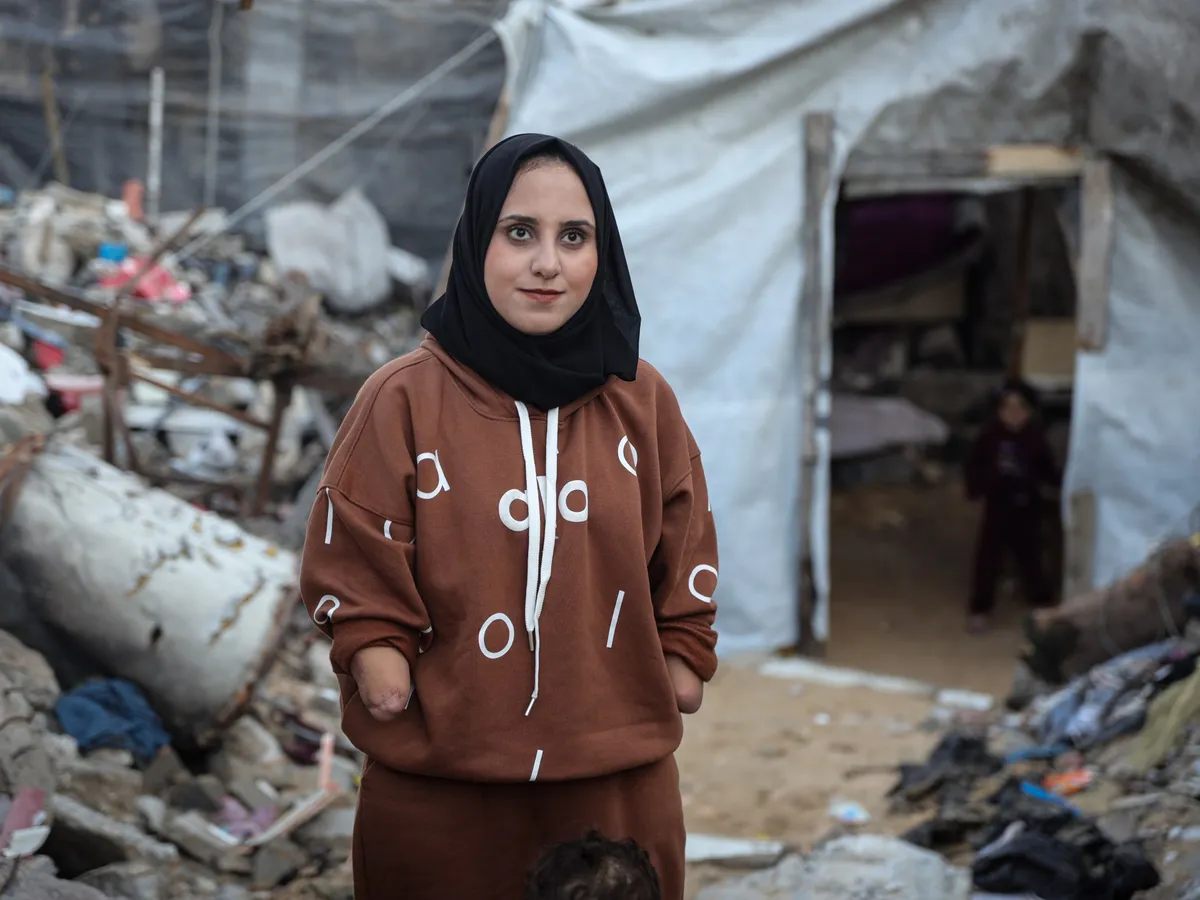
The Rafah crossing’s pilot opening begins amid confusion, as Gaza’s patients face unclear criteria, limited travel slots, and ongoing medical neglect.Nebal al-Hessi stands in front of her family tent in the an-Nazla section of the Jabalia refugee camp in Gaza on February 1, 2026 [Abdelhakim Abu Riash/Al Jazeera]Published On 1 Feb 2026Gaza City – With what remains of her wounded forearms, Nebal al-Hessi scrolls on her phone to follow news updates on the reopening of the Rafah land crossing from her family’s tent in an-Nazla, Jabalia in the northern Gaza Strip.Nebal’s hands were amputated in an Israeli artillery attack on the home where she had taken shelter with her husband and her daughter in the Bureij refugee camp in central Gaza, on October 7, 2024.Recommended Stories list of 3 itemslist 1 of 3Gaza’s collapsing economy drives youth to create unconventional solutionslist 2 of 3How Western officials, media coverage pushed to discredit Gaza death tolllist 3 of 3Israel says it will ban MSF from operating in Gazaend of listMore than a year later, the 25-year-old mother is one of thousands of wounded people placing their hopes on the reopening of the Rafah crossing between Gaza and Egypt as they seek access to adequate medical treatment outside the besieged Palestinian territory.“It’s been a year and five months since I got injured … Every day, I think about tomorrow, that I might travel, but I don’t know,” Nebal tells Al Jazeera in a quiet voice.Recalling the attack, Nebal says she was sitting on her bed holding her baby daughter Rita, trying to communicate with her family in northern Gaza, when the shell hit suddenly.“I was trying to catch an internet signal to call my family … my daughter was in my lap… suddenly the shell hit. Then there was dust; I don’t remember anything else,” Nebal says.“It was the shell fragments that amputated my hands,” she recounts.‘Life is completely paralysed’Nebal was taken to the hospital with severe injuries, including complete amputation of both upper limbs up to the elbows, internal bleeding, and a leg injury. She underwent two abdominal surgeries.She spent about 40 days in the hospital before beginning a new stage of suffering in displacement tents, without the most basic long-term care.Today, Nebal, an English translation graduate and mother to two-year-old Rita, relies almost entirely on her family for the simplest daily tasks.“I can’t eat or drink on my own … even getting dressed, my mother, sister, and sister-in-law mainly help me,” she says sorrowfully.“Even going to the bathroom requires help. I need things in front of me because I cannot bring them myself.”Nebal talks about the pain of motherhood left suspended, as her daughter grows up before her eyes without her being able to hold her or care for her.“My little daughter wants me to change her, feed her, give her milk, hold her in my arms like other mothers… she asks me, and I can’t,” Nebal says with sorrow.“My life is completely paralysed.”Doctors tell Nebal that she urgently needs to travel to continue treatment and have prosthetic limbs fitted, emphasising that she needs advanced prosthetics to regain a degree of independence, not just cosmetic appearance.“Doctors tell me that I need a state or an institution to adopt my case so I can gradually return to living my normal life,” she adds.Nebal with her two-year-old daughter, Rita [Abdelhakim Abu Riash/Al Jazeera]With Palestinian authorities announcing arrangements to open the Rafah crossing today for batches of wounded people and medical patients, Nebal, like many others, lives in a state of anticipation mixed with fear.According to Gaza’s Ministry of Health, thousands of wounded still require specialised treatment unavailable inside the Strip, while the scheduling of names depends on medical lists and complex approvals, amid the absence of a clear timetable or publicly announced priority criteria.Nebal says she received repeated calls over the past months from medical organisations informing her that she would be among the first on the travel lists.“They contacted me more than once, told me to prepare… they gave me hope,” she adds. “But this time, no one has contacted me yet.”Today, Nebal fears her case might be overlooked again, or that the crossing’s opening could be merely a formality, disregarding the urgent needs of patients like her.“I die a little every day because of my current situation … not figuratively. I’ve been like this for a year and four months, and my daughter is growing up in front of me while I am helpless,” she says.Nebal with her two-year-old daughter, Rita [Abdelhakim Abu Riash/Al Jazeera]Uncertain futureNada Arhouma, a 16-year-old girl whose life has been completely altered by a single injury, is also hoping the crossing opens as soon as possible.Nada, who was displaced with her family from Jabalia refugee camp in northern Gaza amid Israel’s two-year genocidal war on Gaza, was hit in the face by shrapnel while inside a displacement tent in Sheikh Radwan, Gaza City.The incident caused the complete loss of one eye, in addition to fractures in her facial bones, orbital damage, and severe tissue tearing.Her father, Abdul Rahman Arhouma, 49, says that her health deteriorated over time despite treatment attempts in Gaza.“She entered the ICU at al-Shifa Hospital, then was transferred to Nasser Hospital. She stayed there for about two and a half months. They tried multiple times to graft her eye, but each operation failed, and the disfigurement worsened,” he says.According to her father, Nada underwent three surgical attempts using tissue from her hand and other facial areas, but all failed, further complicating her medical and psychological condition.“My daughter bleeds from her eye every day, and she has pus and discharge,” he says. “I am standing helpless, unable to do anything.”Today, Nada needs constant assistance to walk and suffers from persistent dizziness and balance weakness. Her vision in the healthy eye is also affected.“Even going to the bathroom, my sisters help me. I can’t walk alone,” Nada tells Al Jazeera in a soft voice.A photo showing Nada’s condition before and after the injury [Courtesy of Abdul Rahman Arhouma]Nada has an official medical referral and urgently needs to travel for reconstructive surgery and the implantation of a prosthetic eye. But her ability to get the treatments remains uncertain pending the reopening of Rafah – as is the case for other patients and wounded individuals.“Since I’ve been in the hospital, I hear every week: next week the crossing will open. Honestly, I feel they are lying. I’m not optimistic,” Nada says.Her father told Al Jazeera that the continuing wait for the Rafah crossing to reopen was “disappointing”.“Unfortunately, we didn’t understand anything. All the reports came from Israeli sources, and it seemed Rafah looked like a gate for prisoners, not for travel,” he says.“Our situation is difficult, and it’s clear we face a long wait to secure my daughter’s right to treatment.”Pilot reopeningSunday was the first pilot reopening day at Rafah, amid ambiguity and a lack of clarity about the mechanism, particularly regarding the number of patients and wounded who would be allowed to travel.According to Gaza’s Ministry of Health, thousands of patients and wounded people require urgent medical transfers outside the Strip, amid the collapse of the healthcare system and lack of resources.The World Health Organization has repeatedly confirmed that Gaza’s health system is “on the brink of collapse”, and that delays in travelling for critical cases threaten their lives.Meanwhile, Israel has said it will only allow those whose names it has approved in advance to cross, without any clear announcement on daily numbers or approved criteria, leaving families of patients in constant anticipation and frustration.
SRCAl Jazeera
LANGEN
LEANCenter
WORDS1 258
ENT7
SUN · 2026-02-01 · 20:35 GMTBRIEF NSR-2026-0201-12514
NSR-2026-0201-12514News Report·EN·Human Rights
Gaza patients in limbo amid Israel’s ‘pilot reopening’ of Rafah crossing
The Rafah crossing between Gaza and Egypt has begun a pilot reopening, but confusion surrounds the process for Gazan patients seeking medical treatment abroad. Thousands of wounded individuals, like Nebal al-Hessi, who lost her hands in an Israeli attack in October 2024, are hoping to access adequate medical care outside of Gaza.
Maram HumaidAl JazeeraFiled 2026-02-01 · 20:35 GMTLean · CenterRead · 6 min
Al JazeeraFIG 01
Reading time
6min
Word count
1 258words
Sources cited
2cited
Entities identified
7entities
Quality score
100%
§ 01
Briefing Summary
AI-generatedNEWSAR · AI
The Rafah crossing between Gaza and Egypt has begun a pilot reopening, but confusion surrounds the process for Gazan patients seeking medical treatment abroad. Thousands of wounded individuals, like Nebal al-Hessi, who lost her hands in an Israeli attack in October 2024, are hoping to access adequate medical care outside of Gaza. However, unclear criteria, limited travel slots, and ongoing medical neglect within Gaza are hindering their ability to leave. Nebal, injured over a year ago, relies on her family for basic needs and faces uncertainty about her chances of receiving treatment. The reopening aims to alleviate the suffering of those needing specialized medical attention unavailable in the besieged territory, but its effectiveness remains questionable.
Confidence 0.90Sources 2Claims 5Entities 7
§ 02
Article analysis
Model · rule-basedFraming
Human Rights
Conflict
Tone
Mixed Tone
AI-assessed
CalmNeutralAlarmist
Factuality
0.70 / 1.00
Factual
LowHigh
Sources cited
2
Limited
FewMany
§ 03
Key claims
5 extracted01
It’s been a year and five months since I got injured … Every day, I think about tomorrow, that I might travel, but I don’t know.
quoteNebal al-Hessi
Confidence
1.00
02
Nebal al-Hessi's hands were amputated in an Israeli artillery attack on October 7, 2024.
factual
Confidence
1.00
03
Nebal spent about 40 days in the hospital before beginning a new stage of suffering in displacement tents.
factual
Confidence
0.90
04
Rafah crossing's pilot opening begins amid confusion.
factual
Confidence
0.90
05
More than a year later, wounded people are placing their hopes on the reopening of the Rafah crossing.
factual
Confidence
0.80
§ 04
Full report
6 min read · 1 258 words§ 05
Entities
7 identifiedKey playerOppositionContextPositiveNeutralNegative
Organizations1
§ 06
Keywords & salience
8 termsrafah crossing
1.00
gaza
0.90
medical treatment
0.80
wounded patients
0.70
medical neglect
0.60
amputation
0.50
israeli attack
0.50
displacement
0.40
§ 07
Topic connections
Interactive graph Network visualization showing 51 related topics
View Full Graph Person Organization Location Event|Click node to navigate|Edge numbers = shared articles