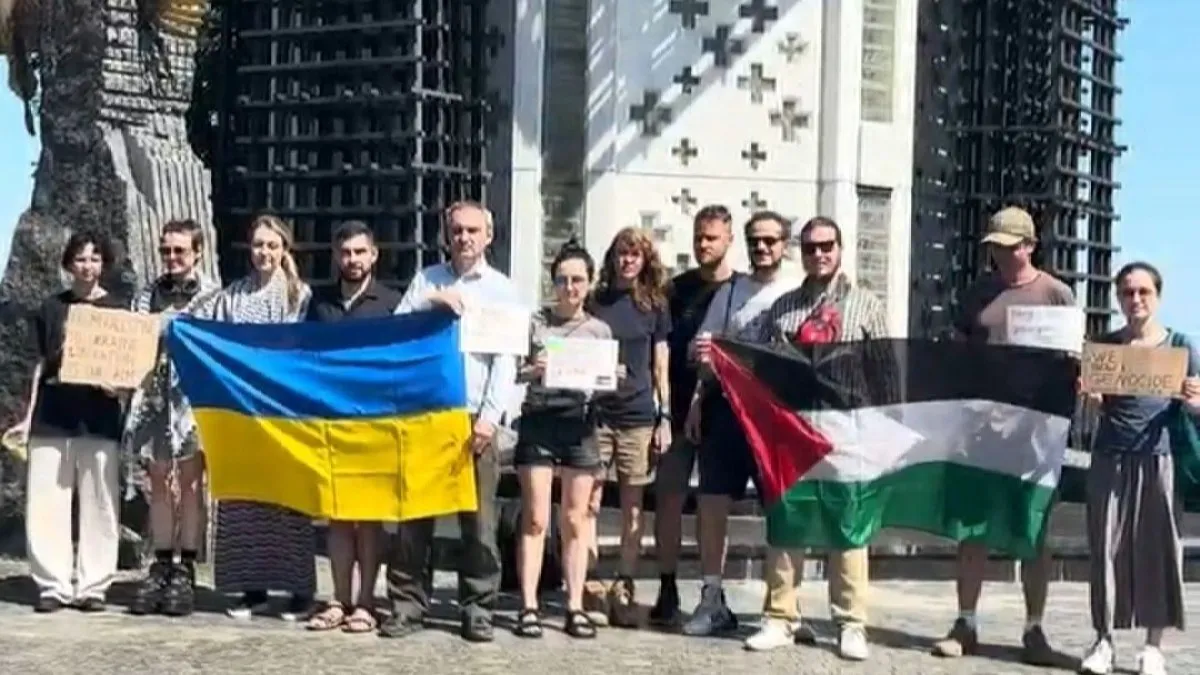
With Washington’s stance on Ukraine shifting, debates in Kyiv over Gaza continue to gain momentum.In August, protesters in Kyiv rallied in solidarity with Palestine, linking two war shattered communities [Facebook/Ukraine Solidarity Campaign]Published On 2 Feb 2026Kyiv, Ukraine – At the start of Israel’s genocidal war on Gaza in October 2023, Ukrainian President Volodymyr Zelenskyy voiced support for Israel, while First Lady Olena Zelenska said Ukrainians understand and “share the pain” of the Israeli people.Billboards across Kyiv lit up the capital with Israeli flags.Recommended Stories list of 4 itemslist 1 of 4Russia to pause bombing Kyiv during extreme winter conditions, says Trumplist 2 of 4Zelenskyy seeks 50,000 Russian ‘losses’ a month to win the Ukraine warlist 3 of 4Ukrainian President Zelenskyy invites Putin to Kyiv for talkslist 4 of 4UN nuclear watchdog discusses Ukraine nuclear safety risksend of listThe response reflected a position held by much of Ukrainian society and many Western leaders at the time.For some people straddling both identities, the early reactions were difficult to watch.‘Travelling as a Palestinian closes’ doorsHashem, a Gaza-born medical professional who obtained Ukrainian citizenship after nearly a decade living in the country, said the contrast in how Palestinians and Ukrainians are treated internationally has long been apparent.“Travelling as a Ukrainian opens doors; travelling as a Palestinian closes them,” he said, describing the stark difference in freedom of movement, visa access and public sympathy attached to each of his identities.“This is not a competition of suffering, but a question of principle. If human rights are truly universal, they cannot depend on nationality or passport,” said Hashem, who requested Al Jazeera withholds his surname.Citizens with foreign passports wait to travel through the Rafah crossing in November 2023, when a small number of foreign passport holders and seriously wounded were allowed to enter Egypt from Gaza [File: Ahmad Hasaballah/Getty Images]A shifting view of IsraelHowever, as Israel’s bombardment of Gaza continued and developed into a genocide against Palestinians, some Ukrainians said public opinion gradually shifted.Yuliia Kishchuk, a Ukrainian researcher who, along with 300 Ukrainian scholars, activists and artists, signed an open letter expressing solidarity with Palestinians, said the engineered starvation of Palestinians in Gaza triggered many to reconsider their view of the conflict.She said some Ukrainians drew parallels with the Soviet-era famine known as the Holodomor, which is regarded by Kyiv as a deliberate act of genocide by Stalin’s regime.Kishchuk added that attacks on other countries, such as Syria, challenged the Israeli narrative that it had been simply defending itself against Hamas in the Gaza Strip.Pro-Palestinian protests have sprung up in Kyiv while prominent mainstream media journalists and podcasters have begun covering the plight of the Palestinians, she explained.But Kishchuk said the bombardment of Ukraine’s infrastructure over recent weeks, which has left millions without heating, electricity and water as the country endures a freezing winter, has temporarily halted the burgeoning protest movement.Zelenskyy and his wife Olena pay their tributes at a monument to victims of the Holodomor that killed millions in the 1930s, in Kyiv, Ukraine [File: Ukrainian Presidential Press Office via AP]A shifting view of the USUnited States President Donald Trump’s approach to the Russia-Ukraine war has left many Ukrainians jaded.Washington is seen by many as less of a steadfast ally and more as a power willing to treat Ukraine as a resource base, while maintaining a conciliatory posture towards Russian President Vladimir Putin.Kishchuk said this has meant many now see the US “as an imperial power in Ukraine” compared with the beginning of the war, when they felt “supported and included”.The signing of a mineral deal which provides Washington with access to valuable rare minerals in Ukraine has also made Ukrainians reflect on how the country is seen as “a resource base … something that connects us to Palestine and to countries in the Global South that are usually perceived in that similar logic by the big empires”, she said.Kyiv has also shifted its stance towards Palestine, with Zelenskyy publicly saying at the Shangri-La Dialogue in Singapore in 2024 that “Ukraine recognises two states, both Israel and Palestine, and will do everything it can to convince Israel to stop, to end this conflict and prevent the suffering of civilians”.In July 2024, Kyiv sent 1,000 tonnes of wheat flour to the Palestinian territories as humanitarian assistance through its “Grain from Ukraine” initiative.Ukraine’s Ministry of Foreign Affairs also openly criticised Israel’s September 2025 attack on Qatar, describing it as a gross violation of international law.‘War has the same face everywhere’Aaisha Aroggi, a 25-year-old student from Gaza City, was displaced 10 times in the first months of Israel’s war. She later made it to Egypt via the Rafah crossing, then to Ukraine, where she was granted residency because her brother was living and working in Kyiv.Compared with the brutal conditions in Gaza, Kyiv felt like a safe haven at first, she said. But now, with constant Russian attacks on infrastructure, she feels she has gone from one place of destruction to another.“War has the same face everywhere,” she said.Palestinian children walk past the rubble of residential buildings in Gaza City, January 28, 2026 [Mahmoud Issa/Reuters]Aroggi said at the beginning of the genocidal war on Gaza, people in Ukraine and much of Europe did not understand the Palestinian experience. However, since then, Palestinian platforms and information have spread across the continent.In Kyiv, students at her university ask about Gaza and show support for the Palestinian cause.“They really understand what has happened,” she said.‘In Ukraine, when I speak about Palestine, reactions vary’Despite these gradual changes, Hashem said, he still sees double standards, “not out of anger toward Ukrainians, but because of the system that decides whose suffering matters more”.“In Ukraine, when I speak about Palestine, reactions vary. Some people listen and try to understand; others struggle to accept comparisons, often because they have been told for years that the situations are not comparable,” he said.However, he believes moments of political change have created opportunities for deeper understanding.“Experiencing reduced support does not erase the difference in treatment, but it may help some people see that solidarity based on principles – not politics – is the only solidarity that truly lasts,” he concluded.
SRCAl Jazeera
LANGEN
LEANCenter
WORDS1 020
ENT9
MON · 2026-02-02 · 07:22 GMTBRIEF NSR-2026-0202-12584
NSR-2026-0202-12584News Report·EN·Political Strategy
In war-torn Ukraine, showing sympathy for Palestine is no longer a taboo
In war-torn Ukraine, initial widespread support for Israel following the October 2023 Gaza war is evolving. While President Zelenskyy initially voiced support for Israel, public opinion has gradually shifted as Israel's actions in Gaza continued.
Nils AdlerAl JazeeraFiled 2026-02-02 · 07:22 GMTLean · CenterRead · 5 min
Al JazeeraFIG 01
Reading time
5min
Word count
1 020words
Sources cited
3cited
Entities identified
9entities
Quality score
100%
§ 01
Briefing Summary
AI-generatedNEWSAR · AI
In war-torn Ukraine, initial widespread support for Israel following the October 2023 Gaza war is evolving. While President Zelenskyy initially voiced support for Israel, public opinion has gradually shifted as Israel's actions in Gaza continued. Some Ukrainians, including scholars and activists, have begun expressing solidarity with Palestinians, triggered by events like the engineered starvation in Gaza. This shift marks a departure from the earlier unified stance, with debates over Gaza gaining momentum in Kyiv. The change reflects a growing awareness of the Palestinian perspective and a reevaluation of the conflict.
Confidence 0.90Sources 3Claims 5Entities 9
§ 02
Article analysis
Model · rule-basedFraming
Political Strategy
Human Rights
Tone
Mixed Tone
AI-assessed
CalmNeutralAlarmist
Factuality
0.70 / 1.00
Factual
LowHigh
Sources cited
3
Well sourced
FewMany
§ 03
Key claims
5 extracted01
Yuliia Kishchuk, along with 300 Ukrainian scholars, signed an open letter expressing solidarity with Palestinians.
factualAl Jazeera (reporting)
Confidence
1.00
02
Travelling as a Ukrainian opens doors; travelling as a Palestinian closes them.
quoteHashem, Gaza-born medical professional
Confidence
1.00
03
At the start of Israel’s war on Gaza in October 2023, Ukrainian President Volodymyr Zelenskyy voiced support for Israel.
factualAl Jazeera (reporting)
Confidence
1.00
04
Some Ukrainians drew parallels with the Soviet-era famine known as the Holodomor.
factualYuliia Kishchuk
Confidence
0.90
05
Some Ukrainians said public opinion gradually shifted as Israel’s bombardment of Gaza continued.
factualAl Jazeera (reporting)
Confidence
0.80
§ 04
Full report
5 min read · 1 020 words§ 05
Entities
9 identifiedKey playerOppositionContextPositiveNeutralNegative
§ 06
Keywords & salience
9 termspalestine
0.90
ukraine
0.90
gaza
0.80
solidarity
0.70
israel
0.70
genocide
0.60
public opinion
0.60
zelenskyy
0.50
human rights
0.50
§ 07
Topic connections
Interactive graph No topic relationship data available yet. This graph will appear once topic relationships have been computed.