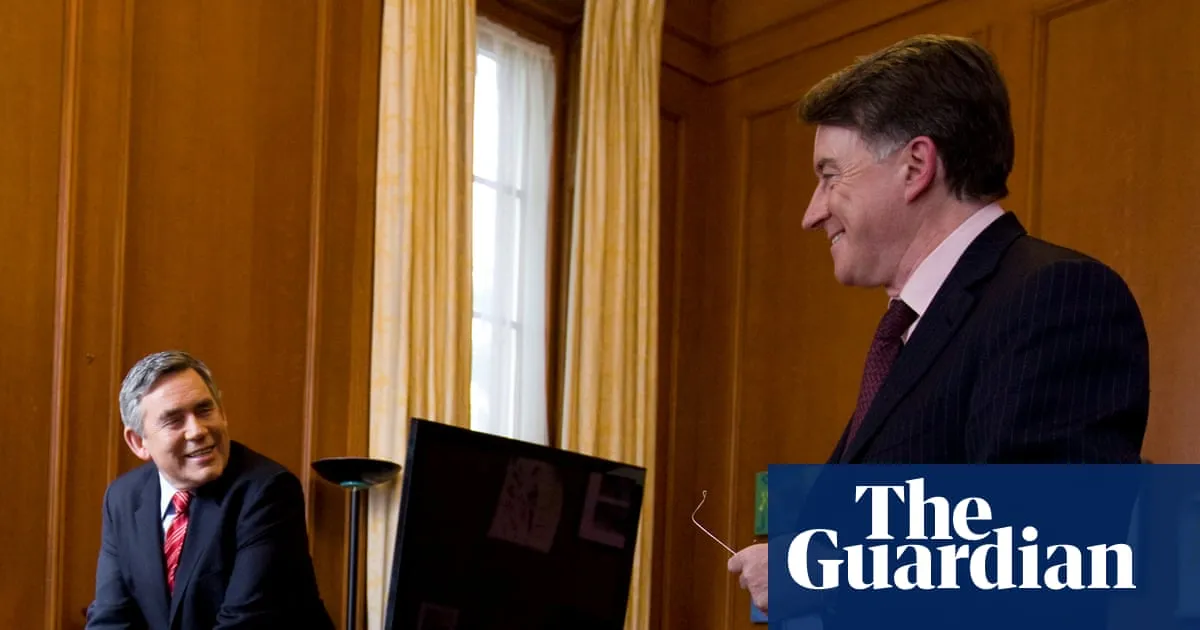
On a brisk Monday evening in May 2010, Gordon Brown stood on the steps of Downing Street and delivered one of the most dramatic announcements of the New Labour era: his resignation as UK prime minister.The decision came days after a nail-biting general election that left no single party with a clear run at No 10. Brown kept his decision, which followed days of political wrangling, to a tight inner circle. Nick Clegg, who would go on to serve as deputy prime minister of the Conservative-Liberal Democrat coalition, was formally told of Brown’s resignation only 10 minutes before the announcement.But across the pond, a man named Jeffrey Epstein, a well-connected financier and convicted child sex offender, had been briefed hours before. “Finally got him to go today …” an email believed to be sent by Peter Mandelson informed Epstein on Monday morning.The apparent tip-off, revealed in the latest tranche of the Epstein files, not only gave Epstein an inside track on the UK’s political future, but also on large moves that were to ripple through global markets.Those included further wild swings in the value of the British pound, which had already been volatile in the lead-up to the 6 May general election. It fell 2.2% on the day of the vote, its worst day in over a year, illustrating how concerned traders were about the risk of a hung parliament and political instability.On the day of Mandelson’s apparent tip-off to Epstein, the pound rose by more than two cents to $1.505, before losing all its gains as Brown’s resignation – and his plan for Labour to hold coalition talks with Clegg’s Liberal Democrats – sent shock waves through Westminster. Sterling would gain back a cent a day later, as the Lib Dems struck a deal with the Tories, handing the keys of No 10 to the Conservative leader David Cameron.While there is no evidence that anyone traded off the leaks, it is just one example of the kind of inside information that Mandelson is alleged to have shared with Epstein, according to the latest batch of documents released by the US Department of Justice this week. Those leaks have caused political outrage across the UK, with Keir Starmer asking police to investigate over concerns they contained market sensitive information.The market for sterling is one of the largest and most liquid in the world, traded through currency desks globally. Bank of International Settlements data shows it was the fourth most traded currency in 2010.Among the allegations that Starmer has asked police to investigate are that the former business secretary, who resigned from the House of Lords on Tuesday, may have also given Epstein advance notice of a €500bn eurozone rescue deal.On the same weekend that Brown was locked in talks over the Labour party’s political future, EU finance ministers were scrambling to strike a deal that would shore up the euro and stave off potential collapse of the eurozone.What started during the 2008 financial crisis, and had balloonedinto a sovereign debt crisis in Greece, was now threatening the solvency and stability of the eurozone. It had spread along the Mediterranean, triggering market bets against Portugal, Spain, Italy, as well as Ireland, and raising questions over whether European leaders had the political will to save the common currency.Jeffrey Epstein (left) with Peter Mandelson on a boat. Photograph: US Department of JusticeOverall, the crisis, and its resolution, created lucrative opportunities for traders and financiers to profit in European stock markets and moves on the euro.On the night of Sunday 9 May 2010, while eurozone ministers were still in negotiations, Epstein emailed Mandelson, saying sources were claiming that the €500bn bailout was “almost compelte” [sic].“Sd be announced tonight,” a reply which appears to have been sent by Mandelson, said. When Epstein asks if the UK business secretary is home, Mandelson wrote “Just leaving No10..will call”. The UK government, which never joined the common currency, did not contribute to the bailout, but the then-chancellor, Alistair Darling, had been in Brussels for the negotiations.At about 2.30am the next morning in Brussels, eurozone finance ministers announced a jaw-dropping €750bn rescue plan – topped up with €250bn from the International Monetary Fund – to shore up the currency bloc.It came shortly after markets in Tokyo had opened for trading, and prompted a sharp rally after European stock markets opened at 8am UK time that day. France’s CAC 40 index alone saw significant moves, surged by 8.8% that session. The euro also rallied in early trading before falling back. Currency traders could have been placing trades from as early as 10pm on Sunday, UK time.Chris Beauchamp, chief market analyst at IG, told the Guardian there would only have been “limited time” to trade on such information before the eurozone bailout was announced, as policymakers had tried to time bailouts with the markets’ open.In contrast, Mandelson’s tip-off over Brown’s resignation seems to have been sent during market trading hours, meaning it could have been easier for someone with inside information to trade on sterling, government bonds or stocks on the FTSE 100. However, “there’s the risk that the market might not interpret the move in the same way as you did”, Beauchamp noted.“If proven, the allegations as reported would amount to a serious abuse of entrusted power at the heart of government during a national crisis, said Daniel Bruce, chief executive of the anti-corruption body Transparency International UK. “It is right that the police are now involved.“Any investigation should examine whether offences have been committed under both the Bribery Act and the common law offence of misconduct in public office. “With public trust in politics at historic lows, government needs to act decisively to rebuild confidence. While we welcome progress on misconduct legislation and reform of peerage removal rules, ministers should accelerate these reforms to arrest the UK’s declining reputation as a beacon of good governance.”
SRCThe Guardian - World News
LANGEN
LEANCenter-Left
WORDS976
ENT10
TUE · 2026-02-03 · 18:11 GMTBRIEF NSR-2026-0203-13056
NSR-2026-0203-13056News Report·EN·Political Strategy
‘Finally got him to go’: how Epstein was given an inside track on UK’s political future
Newly released documents from the Jeffrey Epstein files reveal that Peter Mandelson allegedly informed Epstein of Gordon Brown's impending resignation as UK Prime Minister in May 2010, hours before the public announcement. This tip-off provided Epstein with insider knowledge of significant political events that impacted global markets, particularly the value of the British pound.
Kalyeena Makortoff and Graeme WeardenThe Guardian - World NewsFiled 2026-02-03 · 18:11 GMTLean · Center-LeftRead · 4 min
The Guardian - World NewsFIG 01
Reading time
4min
Word count
976words
Sources cited
3cited
Entities identified
10entities
Quality score
100%
§ 01
Briefing Summary
AI-generatedNEWSAR · AI
Newly released documents from the Jeffrey Epstein files reveal that Peter Mandelson allegedly informed Epstein of Gordon Brown's impending resignation as UK Prime Minister in May 2010, hours before the public announcement. This tip-off provided Epstein with insider knowledge of significant political events that impacted global markets, particularly the value of the British pound. The pound experienced volatility surrounding the election and Brown's resignation, potentially creating opportunities for financial gain. While there is no proof of illicit trading, the revelation has sparked outrage in the UK, with Keir Starmer requesting a police investigation into potential market-sensitive information leaks. The investigation aims to determine if Mandelson's actions violated any laws related to insider trading or misuse of privileged information.
Confidence 0.90Sources 3Claims 5Entities 10
§ 02
Article analysis
Model · rule-basedFraming
Political Strategy
Economic Impact
Tone
Mixed Tone
AI-assessed
CalmNeutralAlarmist
Factuality
0.80 / 1.00
Factual
LowHigh
Sources cited
3
Well sourced
FewMany
§ 03
Key claims
5 extracted01
Keir Starmer has asked police to investigate the leaks over concerns they contained market sensitive information.
factualArticle's own claim
Confidence
1.00
02
The British pound experienced volatility around the time of the 2010 general election and Brown's resignation.
factualArticle's own claim
Confidence
1.00
03
"Finally got him to go today …" an email believed to be sent by Peter Mandelson informed Epstein on Monday morning.
quoteEmail content
Confidence
0.90
04
Peter Mandelson allegedly informed Jeffrey Epstein of Gordon Brown's impending resignation hours before the public announcement.
factualArticle's own claim based on released documents
Confidence
0.80
05
Mandelson may have given Epstein advance notice of a €500bn eurozone rescue deal.
factualArticle's own claim
Confidence
0.70
§ 04
Full report
4 min read · 976 words§ 05
Entities
10 identifiedKey playerOppositionContextPositiveNeutralNegative
People6
Organizations1
§ 06
Keywords & salience
10 termsjeffrey epstein
1.00
peter mandelson
0.80
political future
0.80
uk politics
0.70
inside information
0.70
british pound
0.60
market sensitive information
0.60
gordon brown
0.50
financial markets
0.50
political instability
0.40
§ 07
Topic connections
Interactive graph Network visualization showing 51 related topics
View Full Graph Person Organization Location Event|Click node to navigate|Edge numbers = shared articles