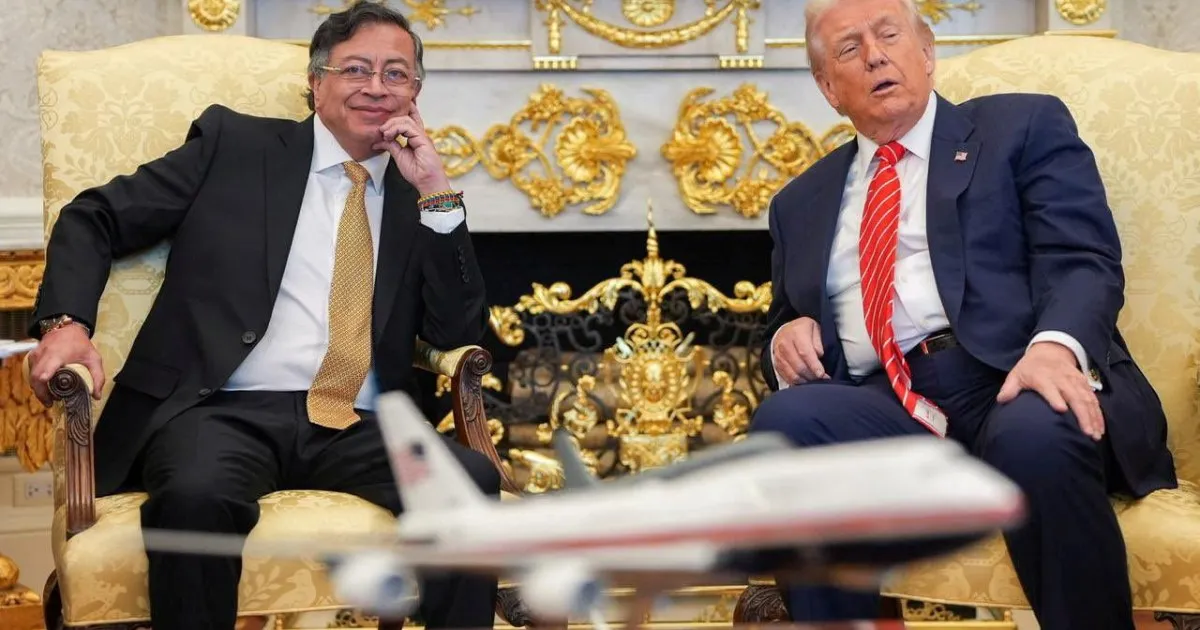
Despite months of clashing over US military intervention and drug trafficking, the two leaders say they shared a ‘terrific’ meeting.US President Donald Trump and his Colombian counterpart Gustavo Petro meet at the Oval Office at the White House on February 3 [Colombia Presidency/Handout via Reuters]Published On 4 Feb 2026For months, United States President Donald Trump has called him a “sick man” and an “illegal drug leader”.But on Tuesday, Trump welcomed his Colombian counterpart, Gustavo Petro, to the White House for their first face-to-face meeting in Washington, DC.Recommended Stories list of 3 itemslist 1 of 3Trump and Petro clash over how best to uproot Colombia’s cocaine cropslist 2 of 3Gustavo Petro: Colombia’s former rebel fighter turned presidentlist 3 of 3Trump-Petro meeting: Just how icy are US-Colombia relations?end of listBoth leaders hailed the meeting as productive, while acknowledging the lingering tensions that divide them.At a news conference after their meeting, Petro waved away questions about his rocky history with Trump, whom he has publicly accused of human rights violations.Instead, he called the interaction “ a meeting between two equals who have different ways of thinking”.“He didn’t change his way of his thinking. Neither did I. But how do you do an agreement, a pact? It’s not as between twin brothers. It’s between opponents,” Petro said.Separately, Trump told reporters from the Oval Office that he felt good about the meeting. “I thought it was terrific,” he said.On the agenda for the two leaders were issues including the fight against transnational drug trafficking and security in Latin America.Here are five takeaways from Tuesday’s meeting.A White House charm offensiveOver the past year, Trump has invited the media to participate in his meetings with foreign leaders, often holding news conferences with the visiting dignitaries in the Oval Office.Not this time, however. The meeting between Trump and Petro lasted nearly two hours, all of it behind closed doors.But the two leaders emerged with largely positive things to say about one another.In a post on social media, Petro revealed that Trump had gifted him several items, including a commemorative photograph of their meeting accompanied by a signed note.“Gustavo – a great honor. I love Colombia,” it read, followed by Trump’s signature.In another post, Petro showed off a signed copy of Trump’s book, The Art of the Deal. On its title page, Trump had scrawled another note to Petro: “You are great.”“Can someone tell me what Trump said in this dedication?” Petro wrote jokingly in Spanish on social media. “I don’t understand much English.”A turning point in a tense relationship?Petro’s joke appeared to be a cheeky nod to his notoriously rocky relationship with Trump.It was only six days into Trump’s second term, on January 26, 2025, that he and Petro began their feud, trading threats on social media over the fate of two US deportation flights.Petro objected to the reported human rights violations facing the deportees. Trump, meanwhile, took Petro’s initial refusal to accept the flights as a threat to US “national security”. Petro ultimately backed down after Trump threatened steep sanctions on imported Colombian goods.They continued to trade barbs in the months since. Petro, for instance, has condemned the deadly US attacks on boats in the Caribbean Sea and Pacific Ocean, comparing the strikes with murder.He has also criticised Trump for carrying out a US military offensive in Venezuela to abduct then-President Nicolas Maduro. That attack, Petro said, was tantamount to “kidnapping”.Trump, meanwhile, stripped Petro of his US visa following the Colombian leader’s appearance at the United Nations General Assembly, where he criticised the US and briefly joined a pro-Palestinian protest.The Trump administration also sanctioned Petro in October, blaming the left-wing leader for allowing “drug cartels to flourish”.After removing Maduro from power on January 3, Trump offered a warning to Petro: he had better “watch his a**”. The statement was widely interpreted to be a threat of military action against Colombia.But Trump and Petro appeared to have reached a turning point last month. On January 7, the two leaders held their first call together. Tuesday’s in-person meeting marked another first in their relationship.Agreeing to disagreeDespite the easing tensions, the two leaders used their public statements after the meeting to reaffirm their differences.Trump was the first to speak, holding a news conference in the Oval Office as he signed legislation to end a government shutdown.The US president, a member of the right-wing Republican Party, used the appearance to reflect on the political tensions the two leaders had in the lead-up to the meeting.“He and I weren’t exactly the best of friends, but I wasn’t insulted, because I’d never met him,” Trump told reporters.He added that Tuesday’s meeting was nevertheless pleasant. “I didn’t know him at all, and we got along very well.”Petro, meanwhile, held a longer news conference at the Colombian Embassy in Washington, DC, where he raised some points of divergence he had with Trump.Among the topics he mentioned was Israel’s genocidal war on Gaza, which the US has supported, and sustainable energy initiatives designed to be carbon neutral. Trump, in the past, has called the so-called green energy programmes a “scam”.Petro, Colombia’s first left-wing leader, also reflected on his region’s history with colonialism and foreign intervention. He told reporters it was important that Latin America make decisions for itself, free from any outside “coercion”.“ We don’t operate under blackmail,” he said at one point, in an apparent reference to Trump’s pressure campaigns.Differing approach to drug productionOne of the primary points of contention, however, was Petro’s approach to combatting drug trafficking.Colombia is the world’s largest producer of cocaine, responsible for producing 68 percent of the global supply.The Trump administration has used the fight against global drug trafficking as justification for carrying out lethal military strikes in international waters and in Venezuela, despite experts condemning the attacks as illegal under international law.It has also stripped Colombia of its certification as an ally in its global counter-narcotics operations.Trump’s White House has said it will consider reversing that decision if Petro takes “more aggressive action to eradicate coca and reduce cocaine production and trafficking”.But Petro has rejected any attempt to label him as soft on drug trafficking, instead touting the historic drug busts his government has overseen.He made that argument yet again after Tuesday’s meeting, claiming that no other Colombian administration had done as much as his to fight cocaine trafficking.Rather than take a militarised approach to destroying crops of coca — the raw ingredient for cocaine — Petro argued on Tuesday that he has had more success with voluntary eradication programmes.That push, he said, succeeded in “getting thousands of peasant farmers to uproot the plant themselves”.“These are two different methods, two different ways of understanding how to fight drug trafficking,” Petro said. “One that is brutal and self-interested, and what it ends up doing is promoting mafia powers and drug traffickers, and another approach, which is intelligent, which is effective.”Petro maintained it was more strategic to go after top drug-ring leaders than to punish impoverished rural farmers by forcibly ripping up their crops.“I told President Trump, if you want an ally in fighting drug trafficking, it’s going after the top kingpins,” he said.Colombia’s President Gustavo Petro speaks during a news conference at the Colombian embassy in Washington, DC, on February 3 [Jose Luis Magana/AP Photo]A Trumpian noteTuesday’s meeting ultimately marked yet another high-profile reversal for Trump, who has a history of shifting his relationships with other world leaders.
SRCAl Jazeera
LANGEN
LEANCenter
WORDS1 228
ENT9
WED · 2026-02-04 · 02:49 GMTBRIEF NSR-2026-0204-13149
NSR-2026-0204-13149News Report·EN·Diplomatic
‘A great honor’: Key takeaways from Trump’s meeting with Colombia’s Petro
In February 2026, US President Donald Trump and Colombian President Gustavo Petro met at the White House in Washington, D.C., despite previous clashes over drug trafficking and US intervention. Both leaders described the meeting as productive, focusing on issues like combating transnational drug trafficking and regional security in Latin America.
Al Jazeera StaffAl JazeeraFiled 2026-02-04 · 02:49 GMTLean · CenterRead · 5 min
Al JazeeraFIG 01
Reading time
5min
Word count
1 228words
Sources cited
3cited
Entities identified
9entities
Quality score
100%
§ 01
Briefing Summary
AI-generatedNEWSAR · AI
In February 2026, US President Donald Trump and Colombian President Gustavo Petro met at the White House in Washington, D.C., despite previous clashes over drug trafficking and US intervention. Both leaders described the meeting as productive, focusing on issues like combating transnational drug trafficking and regional security in Latin America. Petro emphasized the meeting was between equals with differing viewpoints, while Trump called it "terrific." The meeting, which lasted nearly two hours behind closed doors, concluded with Trump gifting Petro a signed photograph and a copy of "The Art of the Deal" with a personal note. The meeting aimed to address tensions and find common ground despite disagreements.
Confidence 0.90Sources 3Claims 5Entities 9
§ 02
Article analysis
Model · rule-basedFraming
Diplomatic
Political Strategy
Tone
Measured
AI-assessed
CalmNeutralAlarmist
Factuality
0.70 / 1.00
Factual
LowHigh
Sources cited
3
Well sourced
FewMany
§ 03
Key claims
5 extracted01
The meeting between Trump and Petro lasted nearly two hours.
factualArticle
Confidence
1.00
02
Trump gifted Petro a signed commemorative photograph and a signed copy of 'The Art of the Deal'.
factualArticle
Confidence
1.00
03
Petro accused Trump of human rights violations.
factualArticle
Confidence
1.00
04
Trump previously called Petro a “sick man” and an “illegal drug leader”.
quoteArticle
Confidence
1.00
05
Donald Trump and Gustavo Petro met at the White House on February 3.
factualArticle
Confidence
1.00
§ 04
Full report
5 min read · 1 228 words§ 05
Entities
9 identifiedKey playerOppositionContextPositiveNeutralNegative
Organizations1
§ 06
Keywords & salience
8 termsdonald trump
0.90
gustavo petro
0.90
us-colombia relations
0.80
meeting
0.70
drug trafficking
0.60
white house
0.50
oval office
0.40
security in latin america
0.40
§ 07
Topic connections
Interactive graph Network visualization showing 51 related topics
View Full Graph Person Organization Location Event|Click node to navigate|Edge numbers = shared articles