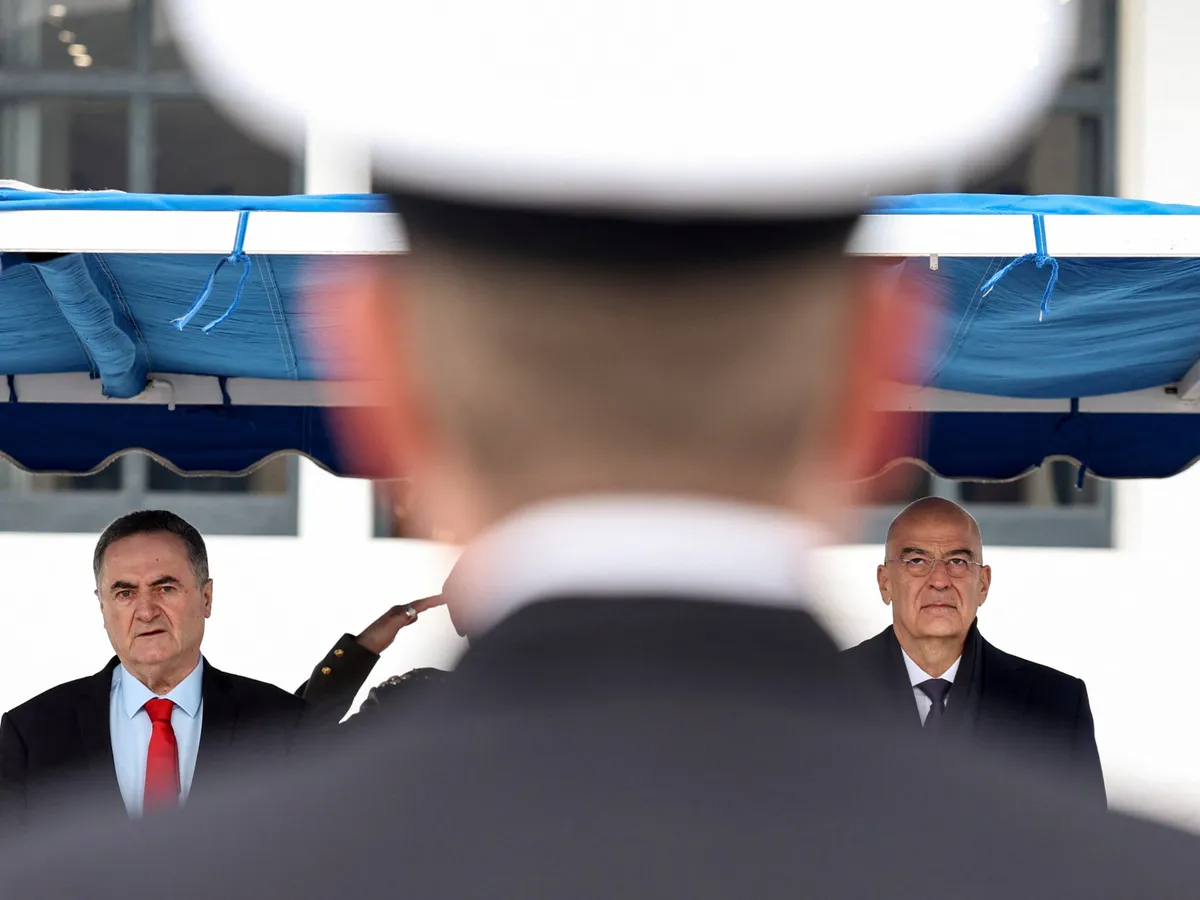
Critics say Athens appears to be embracing Israel’s ‘defence model’ after announcing the largest purchase of its weapons.Israel's Defence Minister Israel-katz" class="entity-link entity-person" data-entity-id="4249" data-entity-type="person">Israel Katz and his Greek counterpart Nikos Dendias inspect an honour guard, prior to a meeting in Athens, Greece, on January 20, 2026 [Louisa Gouliamaki/Reuters]Published On 4 Feb 2026Athens, Greece – Greece is interested in jointly developing weapons with Israel, Greek officials have told Al Jazeera.“We’re an excellent customer of Israeli systems,” Angelos Syrigos, chairman of the Greek parliament’s Defence Affairs Committee, told Al Jazeera. “The leap in our defence relationship will happen when there’s co-production of defence systems and common planning.”Recommended Stories list of 4 itemslist 1 of 4These are the Palestinians that Israel killed during Gaza’s ‘ceasefire’list 2 of 4Just five medical patients leave Gaza after Israel reopens Rafah crossinglist 3 of 4‘Red line’: Global NGOs working in Gaza defy Israel’s threats after MSF banlist 4 of 4In Gaza, my sister and nieces were my life. Israel killed themend of listThe relationship is strengthening as Israel stands accused of committing genocide against Palestinians in Gaza.On December 4, Greece’s Defence Affairs Committee approved the purchase of 36 PULS rocket artillery systems at a cost of $760m, the largest Greek acquisition of Israeli weapons to date.The medium-range air defence system is to form part of Greece’s Shield of Achilles, a 2.8-billion-euro ($3.3bn) layered air defence umbrella announced last year.Syrigos said that if co-production were on the table, the remainder of that budget could be devoted to Israeli systems.(Al Jazeera)Greece is nominally a member of the European Sky Shield Initiative (ESSI) formed by Germany in 2022 as a vehicle to sell mostly German air defence systems such as Iris-T and Skyranger. But Greece is not known to have entered into talks to buy those systems.In contrast, Greece’s Ministry of National Defence last month formed negotiating committees to buy three additional missile defence systems, Spyder, Barak and David’s Sling, produced by the Israel-owned Rafael and Israeli Aerospace Industries, worth a potential 3.1 billion euros ($3.5bn).The three systems, comprising short, medium and long-range air defence against airborne threats including ballistic missiles, would complete the Shield of Achilles.Greece and Israel are discussing a government-to-government deal that bypasses a competitive bid process.“Otherwise, everyone would come in and tender an offer, which Greece wants to avoid,” Kathimerini newspaper’s foreign and defence affairs reporter Vassilis Nedos told Al Jazeera.He explained why Greece prefers to award the contracts directly to Israel: “Israel has no problem giving you a qualitative edge. With other suppliers, you have to negotiate it.”The procurement advisory committees, made up of officers from all four branches of the armed forces, are also discussing a “360 approach” involving unmanned aerial, surface and underwater vehicles with their Israeli counterparts, said Nedos.“We’ve also discussed ballistic missiles with other countries,” Syrigos said, without specifying which ones.Greek Defence Minister Nikos Dendias confirmed on January 20 that Greece wants to move towards co-development.“Israel, until a few decades ago, bought all the weapons it needed for its defence, and today it is at the summit of defence technologies,” Dendias said during a visit from his Israeli counterpart. “Our goal is for Greece to transition from a customer and buyer of defence systems to a co-producer of low-cost, dual-use, innovative products.”Dealing with Israel amid genocide ‘a problem’But not everyone agrees that emboldening ties with Israel amid its ongoing deadly assaults on Gaza is a good thing.“Not dealing with an international human rights issue because you’re putting your strategic relationship first, is a problem,” said Lefteris Papagiannakis, head of the Greek Council for Refugees, a legal aid group for refugees, referring to the ethnic cleansing of Palestinians in Gaza.“If you don’t want to call it genocide, then don’t, but as a humanitarian country, you have to do more than the bare minimum … It’s as if Greece is copying Israel’s defence model, and becoming the second-most heavily armed state in the east Mediterranean.”But if Israel and the United States ever have a “rupture in their relationship for whatever reason”, Greece will find itself in a difficult position, he added.Pro-Palestinian demonstrators throw red paint on mock bodies during a protest as part of a two-day campaign called ‘Target Souda Base for Palestine’, calling for the closure of the naval base in Souda Bay and denouncing Greece’s involvement in the conflict, on the island of Crete, Greece, on October 18, 2025 [Stefanos Rapanis/Reuters]Last year, the left-wing opposition Syriza party suggested Greece’s national team boycott a friendly basketball match with Israel.“While famine in Gaza is killing thousands of people, [Israeli Prime Minister] Benjamin Netanyahu is openly declaring that his goal is ethnic cleansing,” said a party announcement, referring to Israel’s efforts to eject two million Palestinians from Gaza into Jordan and Egypt. “More and more countries are denouncing these genocidal policies.”Greece and Israel drew closer after 2010, when Israeli-Turkish relations frayed over Turkish aid to the Palestinians following clashes in the Gaza Strip between Palestinian armed groups and the Israeli army.As Greece and Israel drew closer, they formed a trilateral relationship with Cyprus, initially to discuss common energy projects, but now extending to security and defence.The three countries share similar threat perceptions from Turkiye, and Ankara has referred to their relationship as an “anti-Turkish” alliance.Panathinaikos fans raise a banner on the day of their EuroLeague game against Maccabi Tel Aviv at the OAKA Indoor Stadium, in Athens, Greece, on November 12, 2024 [Alkis Konstantinidis/Reuters]In April 2019, they discussed a radar system based in all three countries to cover the Eastern Mediterranean. In December 2025, they signed a military cooperation work plan.“Those who dream of dragging the region backward … will encounter a resolute alliance of free, strong nations capable of defending themselves,” Israeli Defence Minister Israel-katz" class="entity-link entity-person" data-entity-id="4249" data-entity-type="person">Israel Katz said during his visit to Athens on January 20, in what was widely interpreted as a thinly veiled reference to Turkiye.The Israeli-Turkish relationship has further deteriorated since December 2024, when forces backed by Ankara seized control of Syria.Greece and Israel have since begun joint military exercises.The extent to which Greece now sees its security as bound up with Israel’s was revealed in a recent interview by Greek Deputy Foreign Minister Alexandra Papadopoulou with To Vima newspaper.“Imagine how Greece could survive on the edge of Europe amidst a completely Muslim region, if Israel should cease to exist,” she said.Is cooperation possible?On February 2, the Hellenic Aerospace Industry announced it had taken a step in this direction, by combining its own Centaur anti-drone electronic warfare system with Israel Aerospace Industries’ Barak anti-drone hard-kill rocket system, providing a soft-kill, hard-kill combined weapon.“We are in conversation with a number of companies, including Israeli companies, to jointly develop systems,” said Hellenic Aerospace Industry CEO Alexandros Diakopoulos. The goal, he told Al Jazeera, was “to have joint development and co-production, with a transfer of knowledge.”Both HAI and IAI are state-owned, but Greece and Israel have very different corporate and government cultures.“Israeli state companies are no different to private sector companies. But Hellenic Aerospace Industry unfortunately has so many problems that [I doubt] its administration can go out and borrow $5m, or hire people. The law doesn’t allow it to operate like a private company and hire the people it needs to hire,” Tassos Rozolis, the president of the Greek Association of Defence Industries, told Al Jazeera.
SRCAl Jazeera
LANGEN
LEANCenter
WORDS1 210
ENT9
WED · 2026-02-04 · 07:33 GMTBRIEF NSR-2026-0204-13210
NSR-2026-0204-13210News Report·EN·National Security
‘Heavily armed’: Greece, Israel boost military ties amid Gaza genocide
Amidst accusations of genocide against Palestinians in Gaza, Greece and Israel are strengthening their military ties. Greece recently approved its largest purchase of Israeli weapons to date, acquiring 36 PULS rocket artillery systems for $760 million, as part of its "Shield of Achilles" air defense system.
John T PsaropoulosAl JazeeraFiled 2026-02-04 · 07:33 GMTLean · CenterRead · 5 min
Al JazeeraFIG 01
Reading time
5min
Word count
1 210words
Sources cited
3cited
Entities identified
9entities
Quality score
100%
§ 01
Briefing Summary
AI-generatedNEWSAR · AI
Amidst accusations of genocide against Palestinians in Gaza, Greece and Israel are strengthening their military ties. Greece recently approved its largest purchase of Israeli weapons to date, acquiring 36 PULS rocket artillery systems for $760 million, as part of its "Shield of Achilles" air defense system. Greek officials have expressed interest in jointly developing weapons with Israel, potentially allocating more of the 2.8-billion-euro defense budget to Israeli systems. While nominally a member of the European Sky Shield Initiative, Greece is actively negotiating to buy three additional Israeli missile defense systems worth a potential 3.1 billion euros to complete its air defense umbrella. The strengthening relationship occurs as Israel faces international scrutiny for its actions in Gaza.
Confidence 0.90Sources 3Claims 5Entities 9
§ 02
Article analysis
Model · rule-basedFraming
National Security
Conflict
Tone
Measured
AI-assessed
CalmNeutralAlarmist
Factuality
0.70 / 1.00
Factual
LowHigh
Sources cited
3
Well sourced
FewMany
§ 03
Key claims
5 extracted01
Greece's Ministry of National Defence formed negotiating committees to buy three additional missile defense systems.
factualAl Jazeera
Confidence
1.00
02
The medium-range air defence system is to form part of Greece’s Shield of Achilles.
factualAl Jazeera
Confidence
1.00
03
Greece’s Defence Affairs Committee approved the purchase of 36 PULS rocket artillery systems at a cost of $760m.
factualAl Jazeera
Confidence
1.00
04
Greece is interested in jointly developing weapons with Israel.
factualGreek officials
Confidence
0.90
05
Israel has no problem giving you a qualitative edge. With other suppliers, you have to negotiate it.
quoteVassilis Nedos, Kathimerini newspaper
Confidence
0.80
§ 04
Full report
5 min read · 1 210 words§ 05
Entities
9 identifiedKey playerOppositionContextPositiveNeutralNegative
Organizations2
§ 06
Keywords & salience
9 termsgreece
0.90
israel
0.90
military ties
0.80
weapons purchase
0.70
defence systems
0.70
gaza
0.60
air defence
0.60
co-production
0.50
genocide
0.40
§ 07
Topic connections
Interactive graph Network visualization showing 51 related topics
View Full Graph Person Organization Location Event|Click node to navigate|Edge numbers = shared articles