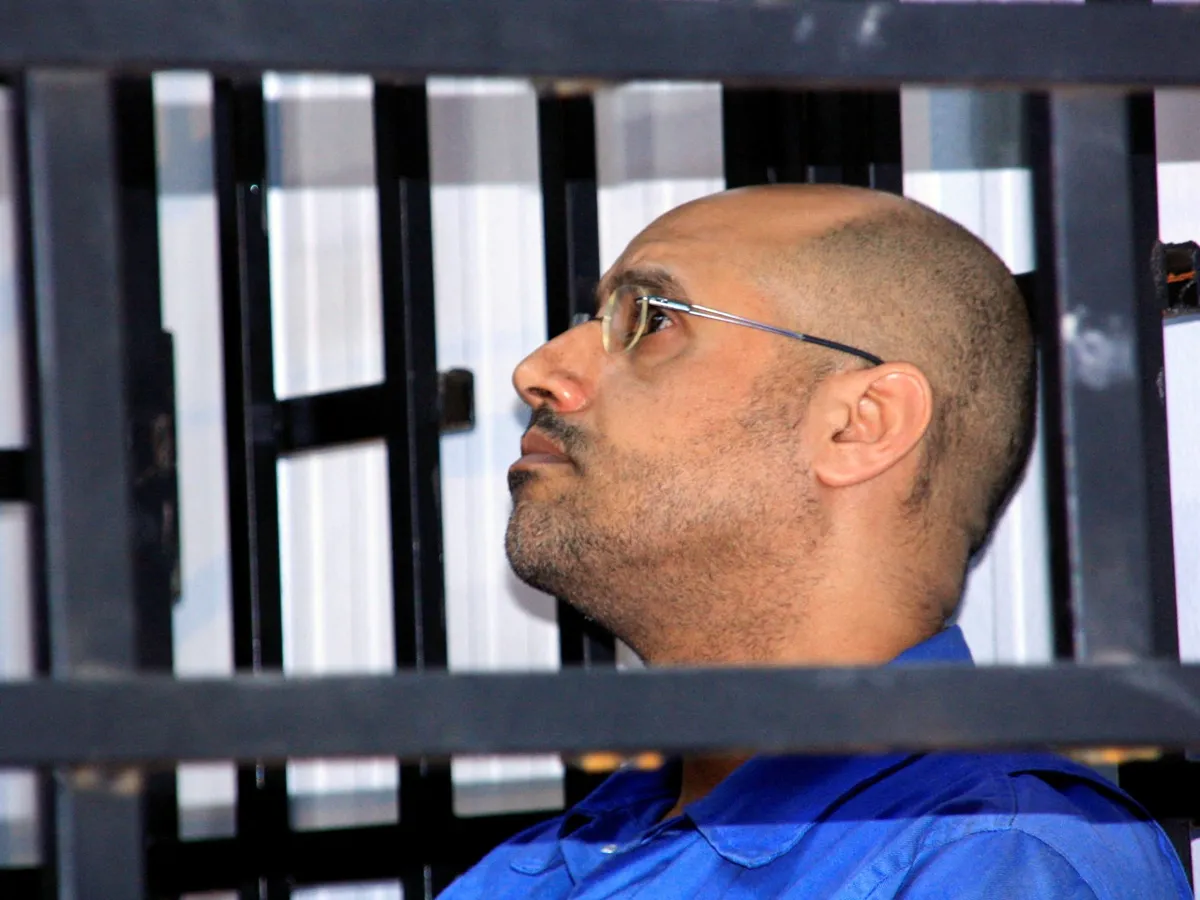
Death of former dictator’s son removes symbolic alternative to Libya’s entrenched political deadlock, analysts say.Saif al-Islam Gaddafi, son of late Libyan leader Muammar Gaddafi, attends a hearing behind bars in a courtroom in Zintan, Libya on May 25, 2014 [File: Reuters]Published On 4 Feb 2026The killing of Saif al-Islam Gaddafi, the most prominent surviving son of former Libyan dictator Muammar Gaddafi, removes a figure who commanded symbolic influence among some Libyans, even as he was reviled by others as the representative of a hated regime.The 53-year-old, killed on Tuesday in the western Libyan town of Zintan, was an alternative to the country’s current power duopoly, split between the United Nations-recognised government in the capital, Tripoli, and the so-called Libyan National Army in the east of the country.Recommended Stories list of 3 itemslist 1 of 3Libya’s top prosecutor launches probe into Saif al-Islam Gaddafi’s killinglist 2 of 3Saif al-Islam Gaddafi, son of former leader, killed in Libyalist 3 of 3What would be the impact of a US attack on Iran?end of listThe killing occurred less than a week after a reported January 28 meeting at Paris’s Elysee Palace brought together Saddam Haftar, son of eastern strongman Khalifa Haftar, and advisers to Tripoli-based Prime Minister Abdul Hamid Dbeibah.Then, on Sunday, a meeting brokered by the United States in Paris brought together senior officials from the two rival Libyan administrations to discuss efforts towards national unity.However, the manner of Gaddafi’s death – his political team said that four masked men had stormed his house and shot him – has once again highlighted the insecurity Libya still faces, and the murky nature of the country’s political divides.Saif al-Islam as heir to GaddafiSaif al-Islam Gaddafi had some influence in Libya despite having no notable military force under his command, and no control over territory, unlike his rivals.He was once seen as his father’s Western-friendly, reform-minded heir before he dropped that image dramatically during the 2011 revolution to help lead a brutal crackdown on protesters. In a televised speech at the time, he denounced the protesters and endorsed his father’s crackdown, threatening “rivers of blood”.“That speech during the protests marked the end of Saif the reformer and the birth of Saif the son of [Muammar] Gaddafi,” Anas El Gomati, director of the Sadeq Institute, a Libyan think tank, told Al Jazeera.After rebels captured Saif al-Islam Gaddafi in 2011, he spent six years held in Zintan by a local militia. Emadeddin Badi, a senior fellow at the Global Initiative against Transnational Organized Crime and Libya expert, said that his captors eventually became more sympathetic to him “and were acting as his bodyguards”.“He was not a captive in the traditional sense whatsoever and even had a social life there, married with kids,” Badi said.After his release in 2017, Gaddafi kept such a low profile that many speculated he might be dead. He resurfaced publicly with a New York Times interview in 2021, where he hinted at a political comeback, and later moved to pursue presidential ambitions.When he registered to run for president in 2021, it became a major controversy that contributed to the collapse of the entire electoral process.Saif al-Islam was disqualified because of an earlier war crimes conviction, but the disputes around his candidacy contributed to derailing the vote.Still, he retained support among some groups who, amid Libya’s descent into civil war and rival fiefdoms, were nostalgic for the perceived stability of the Gaddafi era.His father, Muammar Gaddafi, came to power in 1969, amid a wave of coups in the Arab world along a crescent from South Yemen, through Somalia and Sudan that year.Gaddafi presided over a regime, which, although dictatorial, saw a period of economic growth in the country, fuelled by Libya’s oil reserves.The regime was also known for mass human-rights abuses, including the execution of political opponents.“Saif al-Islam is popular among Gaddafi-era reformists and among those who saw him as that reformist candidate promising change,” Claudia Gazzini, senior Libya analyst at the International Crisis Group, told Al Jazeera.His real power wasn’t military but symbolic, El Gomati said. That ideological disposition is referred to locally as the Greens, after the elder Gaddafi’s “Green Book” outlining his political theories.“Saif didn’t really control forces, or territory, but controlled an important narrative and represented something for people who were nostalgic for the days of Gaddafi’s rule,” El Gomati said.What impact does this have in Libya?Saif al‑Islam’s death is likely to matter most in eastern Libya, because of the overlap between the supporters of the man who controls that region, military commander Khalifa Haftar, and Gaddafi’s base.Despite that overlap, Saif al-Islam Gaddafi and Khalifa Haftar deeply distrusted each other, mainly because Haftar had defected from the Gaddafi regime decades ago, and attempted a rebellion against Muammar Gaddafi after having initially helped him come to power.Tensions between Khalifa Haftar and Saif al-Islam Gaddafi flared in 2021 when Haftar-aligned militias blocked a court hearing on the latter’s election appeal after he was blocked, withdrawing only after demonstrations by his supporters.“They [the Gaddafi family] considered him [Khalifa Haftar] a traitor for rebelling against the Gaddafi regime, and it was thought Haftar was trying to replicate the system their father had built,” Gazzini said. “Haftar had always feared the popularity Saif had.”But that meant that Khalifa Haftar was attempting to fill a space left by Muammar Gaddafi, but one that Saif al-Islam was still trying to occupy himself. In effect, that made Saif al-Islam a threat to Haftar, as they were competing over the same constituency.“The immediate beneficiary [of the killing] is Haftar,” said El Gomati. “Saif represents an alternative to the authoritarian model which Haftar built.”Despite his symbolic importance, analysts still expect the immediate fallout from Saif al-Islam’s assassination to be limited.The people who once supported the Gaddafi regime have split apart dramatically since 2011, with many former loyalists now working within the competing eastern and western power structures.“This stirs waters, but won’t hit Libya with a storm,” Gazzini told Al Jazeera, noting that while Saif al-Islam Gaddafi’s death is significant, Libya’s basic political deadlock isn’t likely to change a great deal after the killing.“His death eliminates Libya’s last viable spoiler to the current power duopoly,” El Gomati said. “His assassination closes Libya’s last exit from this divided power system.”
SRCAl Jazeera
LANGEN
LEANCenter
WORDS1 037
ENT10
WED · 2026-02-04 · 18:15 GMTBRIEF NSR-2026-0204-13373
NSR-2026-0204-13373News Report·EN·Political Strategy
Killing of Saif Gaddafi removes alternative to Libya’s rival governments
Saif al-Islam Gaddafi, son of the former Libyan leader Muammar Gaddafi, was killed on Tuesday in Zintan, Libya. His death removes a symbolic figure who, despite lacking military or territorial control, represented an alternative to the country's divided government.
Faisal AliAl JazeeraFiled 2026-02-04 · 18:15 GMTLean · CenterRead · 5 min
Al JazeeraFIG 01
Reading time
5min
Word count
1 037words
Sources cited
3cited
Entities identified
10entities
Quality score
100%
§ 01
Briefing Summary
AI-generatedNEWSAR · AI
Saif al-Islam Gaddafi, son of the former Libyan leader Muammar Gaddafi, was killed on Tuesday in Zintan, Libya. His death removes a symbolic figure who, despite lacking military or territorial control, represented an alternative to the country's divided government. Libya is currently split between a UN-recognized government in Tripoli and the Libyan National Army in the east. The killing occurred shortly after meetings in Paris brokered by France and the US, aimed at fostering unity between the rival administrations. The circumstances of Gaddafi's death, reportedly by masked gunmen, highlight the ongoing insecurity and political complexities in Libya. He was once viewed as a reformer but became associated with his father's brutal crackdown during the 2011 revolution.
Confidence 0.90Sources 3Claims 5Entities 10
§ 02
Article analysis
Model · rule-basedFraming
Political Strategy
Conflict
Tone
Measured
AI-assessed
CalmNeutralAlarmist
Factuality
0.70 / 1.00
Factual
LowHigh
Sources cited
3
Well sourced
FewMany
§ 03
Key claims
5 extracted01
Saif al-Islam Gaddafi spent six years held in Zintan by a local militia after rebels captured him in 2011.
factual
Confidence
1.00
02
Saif al-Islam Gaddafi was killed on Tuesday in the western Libyan town of Zintan.
factual
Confidence
1.00
03
That speech during the protests marked the end of Saif the reformer and the birth of Saif the son of [Muammar] Gaddafi.
quoteAnas El Gomati, director of the Sadeq Institute
Confidence
0.90
04
Killing of Saif al-Islam Gaddafi removes symbolic alternative to Libya’s entrenched political deadlock.
quoteanalysts
Confidence
0.80
05
Four masked men had stormed his house and shot him.
quoteSaif al-Islam Gaddafi's political team
Confidence
0.60
§ 04
Full report
5 min read · 1 037 words§ 05
Entities
10 identifiedKey playerOppositionContextPositiveNeutralNegative
People4
Organizations1
§ 06
Keywords & salience
9 termssaif al-islam gaddafi
1.00
libya
0.90
political deadlock
0.80
rival governments
0.70
muammar gaddafi
0.70
killing
0.60
national unity
0.50
libyan national army
0.50
political divides
0.40
§ 07
Topic connections
Interactive graph No topic relationship data available yet. This graph will appear once topic relationships have been computed.