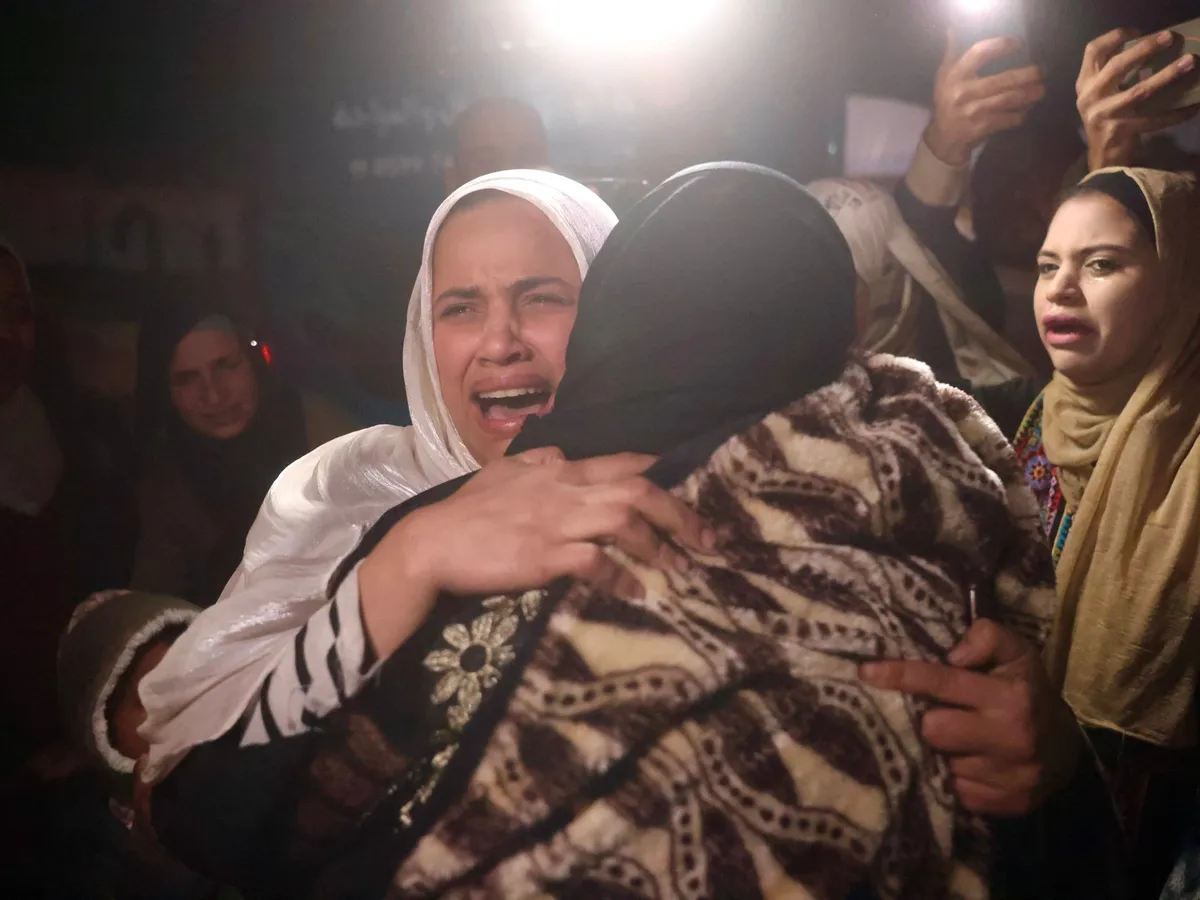
Emotional homecomings seen as some Palestinians reunite with loved ones amid mixed sentiments at the Rafah border.Palestinian women, coming from the Rafah crossing with Egypt, hug as they arrive at Nasser Hospital in Khan Younis in the southern Gaza Strip. [Bashar Taleb / AFP]Published On 4 Feb 2026Palestinians wept with joy as the Rafah crossing with Egypt partially reopened, allowing a small number of people to return to war-torn Gaza.Emotional crowds gathered around a bus bringing returnees to Nasser Hospital in Khan Younis late at night, filming on their phones and lifting children to the windows to greet arrivals.“We were exhausted from this humiliating journey,” said Rotana al-Riqib, a Palestinian woman in her thirties returning from Egypt. “The Israelis took us to the crossing – me, my mother and another woman from Khan Younis – and interrogated us. They don’t let us bring in anything. They confiscated everything we had, even my children’s belongings. They only left us some clothes.”The crossing, Gaza’s only exit point that does not lead to Israel, had remained largely closed since Israeli forces took control of it in May 2024 during Israel’s genocidal war against the Palestinian people in Gaza. Only about two dozen people crossed in both directions on the first day – far fewer than the expected 200, according to sources on both sides.“They don’t want a large number of people to return to Gaza,” al-Riqib added. “Rather, they want a large number to leave.”Egypt has consistently warned against the displacement of Palestinians from Gaza and has reportedly demanded equal numbers entering and exiting the territory each day.Ali Shaath, head of a Palestinian committee overseeing Gaza’s governance, called Rafah’s reopening a “window of hope” for the war-devastated territory.Although 150 people were scheduled to leave and 50 to enter on Monday, only 12 Palestinians – nine women and three children – were permitted to return from Egypt, according to Gaza’s Interior Ministry and border officials.Gaza’s Interior Ministry reported that eight people departed Gaza, while an Egyptian border source counted 12 people – five injured individuals and seven companions – entering Egypt.“Things were very difficult, and inspections were taking place everywhere,” said Samira Said after returning through Rafah.The reopening, long demanded by the United Nations and humanitarian organisations, forms a crucial element of US President Donald Trump’s Gaza truce proposal, where humanitarian conditions remain critical.For Gaza’s sick and injured, the crossing represents potential access to Egyptian medical care. Mohammed Abu Salmiya, director of Gaza City’s al-Shifa Hospital, reported 20,000 patients urgently requiring treatment, including 4,500 children.Gaza City resident Umm Mohammed Abu Shaqfa, 37, whose 11-year-old daughter needs treatment unavailable in the occupied Palestinian territory, said, “We are still waiting to travel through the Rafah crossing for treatment in Egypt. Opening the crossing is a glimmer of hope. Every day, I go to the Ministry of Health office and the World Health Organization to check if my daughter’s name is on the list.”While Rafah serves as a crucial entry point for both people and supplies, COGAT, the Israeli Defence Ministry body coordinating Palestinian civilian affairs, has not mentioned allowing a substantial increase in aid into Gaza.
SRCAl Jazeera
LANGEN
LEANCenter
WORDS520
ENT9
WED · 2026-02-04 · 18:02 GMTBRIEF NSR-2026-0204-13374
NSR-2026-0204-13374News Report·EN·Human Interest
Mixed emotions among Palestinians as Rafah crossing partially reopens
The Rafah crossing between Gaza and Egypt partially reopened, allowing a limited number of Palestinians to return to Gaza after being largely closed since May 2024. The reopening brought emotional reunions, but also frustration due to strict Israeli inspections and confiscations at the crossing.
By Al Jazeera and AgenciesAl JazeeraFiled 2026-02-04 · 18:02 GMTLean · CenterRead · 3 min
Al JazeeraFIG 01
Reading time
3min
Word count
520words
Sources cited
7cited
Entities identified
9entities
Quality score
100%
§ 01
Briefing Summary
AI-generatedNEWSAR · AI
The Rafah crossing between Gaza and Egypt partially reopened, allowing a limited number of Palestinians to return to Gaza after being largely closed since May 2024. The reopening brought emotional reunions, but also frustration due to strict Israeli inspections and confiscations at the crossing. While the reopening is seen as a "window of hope," the number of people allowed to cross was significantly lower than expected, with concerns raised that the aim is to encourage Palestinians to leave Gaza rather than return. Egypt has insisted on equal numbers entering and exiting Gaza, warning against displacement. The reopening is part of a Gaza truce proposal.
Confidence 0.90Sources 7Claims 5Entities 9
§ 02
Article analysis
Model · rule-basedFraming
Human Interest
Conflict
Tone
Mixed Tone
AI-assessed
CalmNeutralAlarmist
Factuality
0.70 / 1.00
Factual
LowHigh
Sources cited
7
Well sourced
FewMany
§ 03
Key claims
5 extracted01
20,000 patients urgently requiring treatment, including 4,500 children.
statisticMohammed Abu Salmiya
Confidence
1.00
02
The Israelis took us to the crossing and interrogated us. They confiscated everything we had.
quoteRotana al-Riqib
Confidence
1.00
03
Only 12 Palestinians were permitted to return from Egypt on Monday.
factualGaza’s Interior Ministry and border officials
Confidence
1.00
04
The crossing had remained largely closed since Israeli forces took control of it in May 2024.
factual
Confidence
1.00
05
Rafah crossing partially reopened, allowing a small number of people to return to Gaza.
factual
Confidence
1.00
§ 04
Full report
3 min read · 520 words§ 05
Entities
9 identifiedKey playerOppositionContextPositiveNeutralNegative
Organizations2
§ 06
Keywords & salience
9 termsrafah crossing
1.00
gaza
0.90
palestinians
0.90
egypt
0.70
border crossing
0.60
reopening
0.60
humanitarian aid
0.50
war-torn
0.40
displacement
0.40
§ 07
Topic connections
Interactive graph No topic relationship data available yet. This graph will appear once topic relationships have been computed.