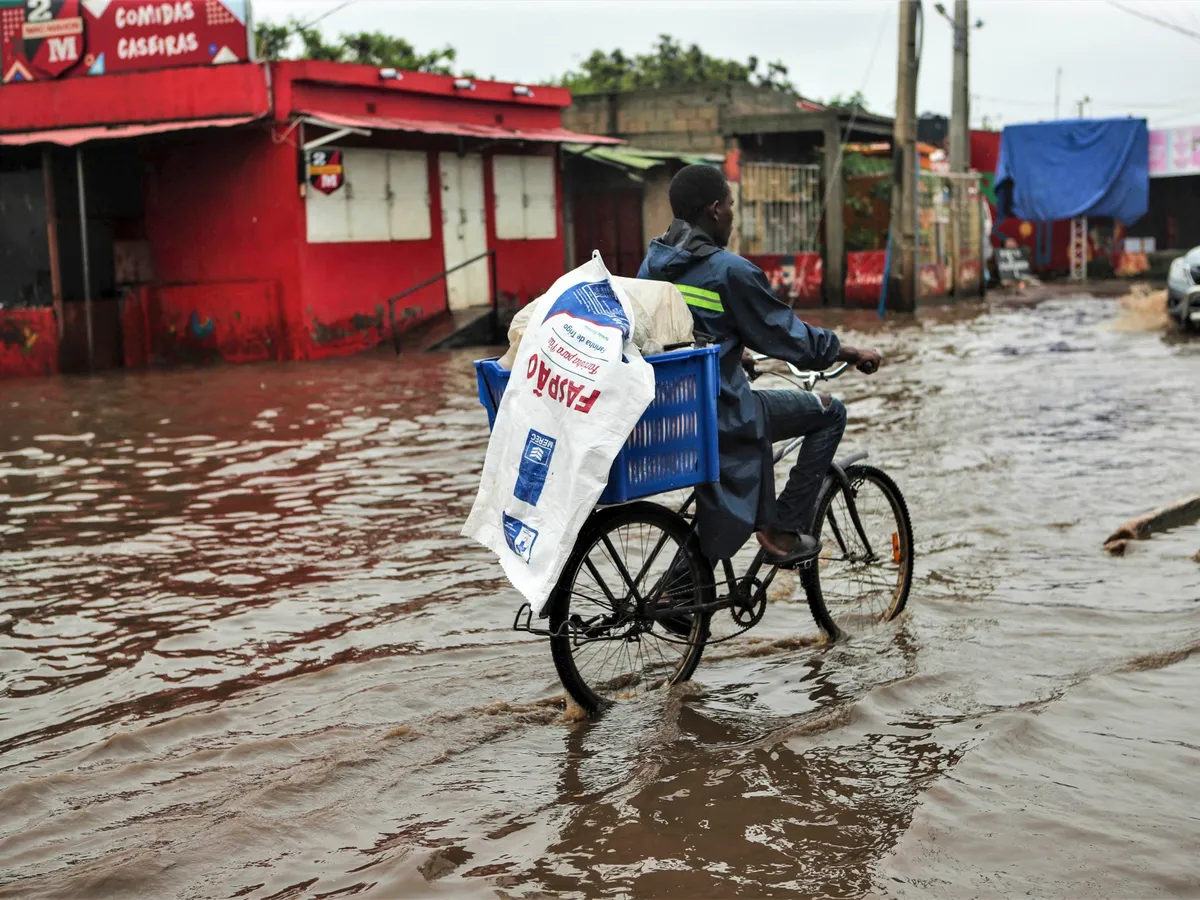
More than 150 people have been killed and some 800,000 affected by floods in the southern and central provinces of Mozambique.People walk through floodwaters in Maputo, Mozambique, January 16, 2026, after several days of continuous heavy rain [Luisa Nhantumbo/EPA]Published On 5 Feb 2026Maputo, Mozambique – When Emilia Machel, 30, and her three children rushed to the Chiaquelane site for displaced people on the afternoon of January 17, much of her hometown of Chokwe in Mozambique’s Gaza Province was already flooded.The Limpopo River, which begins in neighbouring South Africa and flows into Mozambique, had reached dangerously high levels after heavy rain fell on the Southern Africa region from late December to mid-January.Recommended Stories list of 3 itemslist 1 of 3Drought in the east, floods in the south: Africa battered by climate changelist 2 of 3Mozambique flood survivors displaced and ‘exhausted’list 3 of 3TotalEnergies restarts $20bn LNG project in Mozambique after 5-year freezeend of list“We knew there would be floods,” said Machel. “We watched on television that there would be flooding.”Machel, who supports her family by selling tomatoes and onions, first came to Chiaquelane, a long-term settlement for displaced people, at age four in 2000 during one of the deadliest floods in Mozambique’s history. “The reason why we came this time is because we had been here in 2000 and again in 2013. It is a safer area,” she said.This season, heavy rains and overflowing rivers have resulted in floods, which authorities say are some of the worst in decades, killing more than 150 people and affecting an estimated 800,000 people in the southern and central provinces of Mozambique.Although the rain has subsided and water levels in river basins have fallen, large swaths of land remain flooded, according to humanitarian workers.“In some places it feels like you’re flying over the ocean because the water stretches are very long distances and you see many isolated homes,” said Guy Taylor, chief of communications with the United Nations children’s agency UNICEF.Mozambique’s weather agency, Instituto Nacional de Meteorologia (INAM), has warned that moderate rain is set to continue in the northern provinces.The government says hundreds of millions of dollars have been lost in destroyed infrastructure, and in some parts of the country, the population is still stranded and needs rescuing.Paula Fonseca, a businesswoman in the capital city of Gaza province, Xai-Xai, which is among the areas most affected by flooding, said it is still difficult to assess the real impact. Her restaurant building remains underwater.The province is an agricultural heartland in Mozambique, but in recent weeks, hundreds of hectares of farming land and food storage barns have been washed out.The Matola municipality in Maputo Province, which is the most populated city in Mozambique, had “the most severe” urban flooding in years, according to its mayor, Julio Parruque.A high population density and unplanned construction that blocked water ways has resulted in a deluge that has forced thousands of households to move to accommodation centres installed in the city.In the capital city, Maputo, there are still impassable areas and homes beneath water.An aerial view shows the flooded neighbourhood between the Maputo and Gaza regions, Maputo, Mozambique, January 20, 2026 [Luisa Nhantumbo/EPA]‘A lot of water’After realising that water was entering her home at an increasingly faster speed, Machel, the Chokwe resident, took all the clothes and household items she could carry and fled with her children to a neighbour with a brick home whose roof they could use for storage.“All families in my neighbourhood were affected, and I think the current floods were far more dangerous than the ones in 2013,” Machel said.“There was a lot of water.”In 2013, the Limpopo River overflowed, causing inundation in Chokwe and bringing back memories of the floods of 2000, when she also had to flee.“It is tormenting to have to go to Chiaquelane every time it rains like this,” Machel lamented.It is yet to be established whether the current floods are the worst in Mozambique, but existing data suggests, at least by some measures, that the disaster is worse than in 1977 and 2000, which are considered benchmarks for such events.For months before the floods, INAM warned of heavy rainfall in the 2025-2026 rainy season.In the aftermath of the devastation of Cyclone Idai in 2019, which killed at least 1,500 people, Mozambique improved its early warning systems with a combination of technological upgrades, including radars and satellite imagery, the issuing of alerts by local radio across the country and community groups, and closer coordination with the disaster management agency INGD.However, critics say not enough has been done to adequately respond to extreme events.Retired hydrologist Carmo Vaz, who has written about floods for decades, told local media outlets that it is not enough to issue alerts. He said the government has to help people leave and find places for them to stay before events unfold.Rescue teams assist residents of a neighbourhood affected by heavy rains in the Maputo and Gaza regions, Mozambique, January 20, 2026 [Luisa Nhantumbo/EPA]‘Nothing you can do’Machel said she left her home only when it was clear that it was going to be submerged.“I couldn’t take all my goods,” she lamented.In Xai-Xai, despite the warnings, residents waited until the last minute to leave areas prone to flooding, fearing looting or because they did not know where to go, said Fonseca, the businesswoman.“We had to wait until that moment you realise there is nothing you can do besides leaving.”The government has had difficulty assisting everyone in need, the mayor of Matola admitted. “We are providing the assistance we can, and working with partners and friends to mobilise resources and respond,” he said.UN agencies have said for months they don’t have the resources to respond to a crisis of this scale, as the country continues to battle an ISIL (ISIS)-backed rebellion in northern Mozambique, which has displaced hundreds of thousands of people.But in many places, people are stepping up after the floods.“What we have seen is that people are helping each other, even those with little are helping others,” said Fonseca of the support systems for people in need.Countries in the region and elsewhere have also sent rescue teams and emergency food and shelter kits.As Mozambique is among the most vulnerable countries in the world to extreme events and the impacts of the climate crisis, the government has, in recent years, appealed for richer countries to finance adaptation efforts. In the last climate conference, COP30 in Brazil, the government said it needs more than $30bn for climate adaptation initiatives until 2030.Children wade through floodwaters in a neighbourhood in Maputo, Mozambique, on Friday, January 16, 2026 [Carlos Uqueio/AP]‘Rebuild and go back’Machel says life at Chiaquelane accommodation centre is hard and suffering is rife.“The assistance at the centre is not adequate. We sleep in mats and rely entirely on them to have food.”The centre, run by INGD, provides porridge in the morning and rice and beans late in the afternoon. Rarely do they have a third meal, and when it comes, it is too late for children who are already asleep.Taylor from UNICEF said feeding children, who the agency estimates are half of those displaced by flooding, is a major concern.“We are particularly worried about the dangers of waterborne diseases to children, particularly children that are suffering from malnutrition,” he said.“Even before the flooding crisis, around four in 10 children in Mozambique were suffering from chronic malnutrition; a child with malnutrition, even a case of diarrhoea, can prove deadly.”Sanitation services, which humanitarian agencies are prioritising, are also a concern in often overcrowded centres.After almost three weeks at the accommodation centre, Machel spends the day waiting.Her husband, an assistant to a truck driver, is stranded in a flooded area elsewhere in the Gaza Province, and she doesn’t know when they will be reunited.She still plans to go back to her business and her home, which has been swept away.“It is very sad what is happening,” she said, “but we have to rebuild to go back to our home.”
SRCAl Jazeera
LANGEN
LEANCenter
WORDS1 323
ENT7
THU · 2026-02-05 · 05:57 GMTBRIEF NSR-2026-0205-13515
NSR-2026-0205-13515News Report·EN·Human Interest
‘We have to rebuild’: Mozambique flood victims persevere in face of loss
Heavy rains and overflowing rivers in Mozambique's southern and central provinces have caused devastating floods, impacting an estimated 800,000 people and resulting in over 150 deaths. The floods, considered some of the worst in decades, began in late December 2025 and continued into January 2026, primarily affecting areas along the Limpopo River.
Tavares CebolaAl JazeeraFiled 2026-02-05 · 05:57 GMTLean · CenterRead · 6 min
Al JazeeraFIG 01
Reading time
6min
Word count
1 323words
Sources cited
4cited
Entities identified
7entities
Quality score
100%
§ 01
Briefing Summary
AI-generatedNEWSAR · AI
Heavy rains and overflowing rivers in Mozambique's southern and central provinces have caused devastating floods, impacting an estimated 800,000 people and resulting in over 150 deaths. The floods, considered some of the worst in decades, began in late December 2025 and continued into January 2026, primarily affecting areas along the Limpopo River. Many residents, like Emilia Machel, sought refuge in displacement sites like Chiaquelane, a settlement previously used during the 2000 and 2013 floods. While the rain has lessened, large areas remain flooded, isolating communities and causing significant infrastructure damage, with the government estimating losses in the hundreds of millions of dollars. The Mozambique weather agency warns that moderate rain is set to continue in the northern provinces.
Confidence 0.90Sources 4Claims 5Entities 7
§ 02
Article analysis
Model · rule-basedFraming
Human Interest
Environmental
Tone
Measured
AI-assessed
CalmNeutralAlarmist
Factuality
0.80 / 1.00
Factual
LowHigh
Sources cited
4
Well sourced
FewMany
§ 03
Key claims
5 extracted01
The Matola municipality had “the most severe” urban flooding in years.
quoteJulio Parruque, mayor
Confidence
1.00
02
The Limpopo River reached dangerously high levels after heavy rain.
factual
Confidence
1.00
03
More than 150 people have been killed and some 800,000 affected by floods in Mozambique.
statistic
Confidence
1.00
04
Hundreds of millions of dollars have been lost in destroyed infrastructure.
statisticThe government
Confidence
0.90
05
Moderate rain is set to continue in the northern provinces.
predictionInstituto Nacional de Meteorologia (INAM)
Confidence
0.80
§ 04
Full report
6 min read · 1 323 words§ 05
Entities
7 identifiedKey playerOppositionContextPositiveNeutralNegative
People1
Organizations1
§ 06
Keywords & salience
8 termsmozambique floods
1.00
displaced people
0.70
heavy rain
0.70
limpopo river
0.60
infrastructure damage
0.50
humanitarian aid
0.50
climate change
0.40
southern africa
0.40
§ 07
Topic connections
Interactive graph Network visualization showing 7 related topics
View Full Graph Person Organization Location Event|Click node to navigate|Edge numbers = shared articles