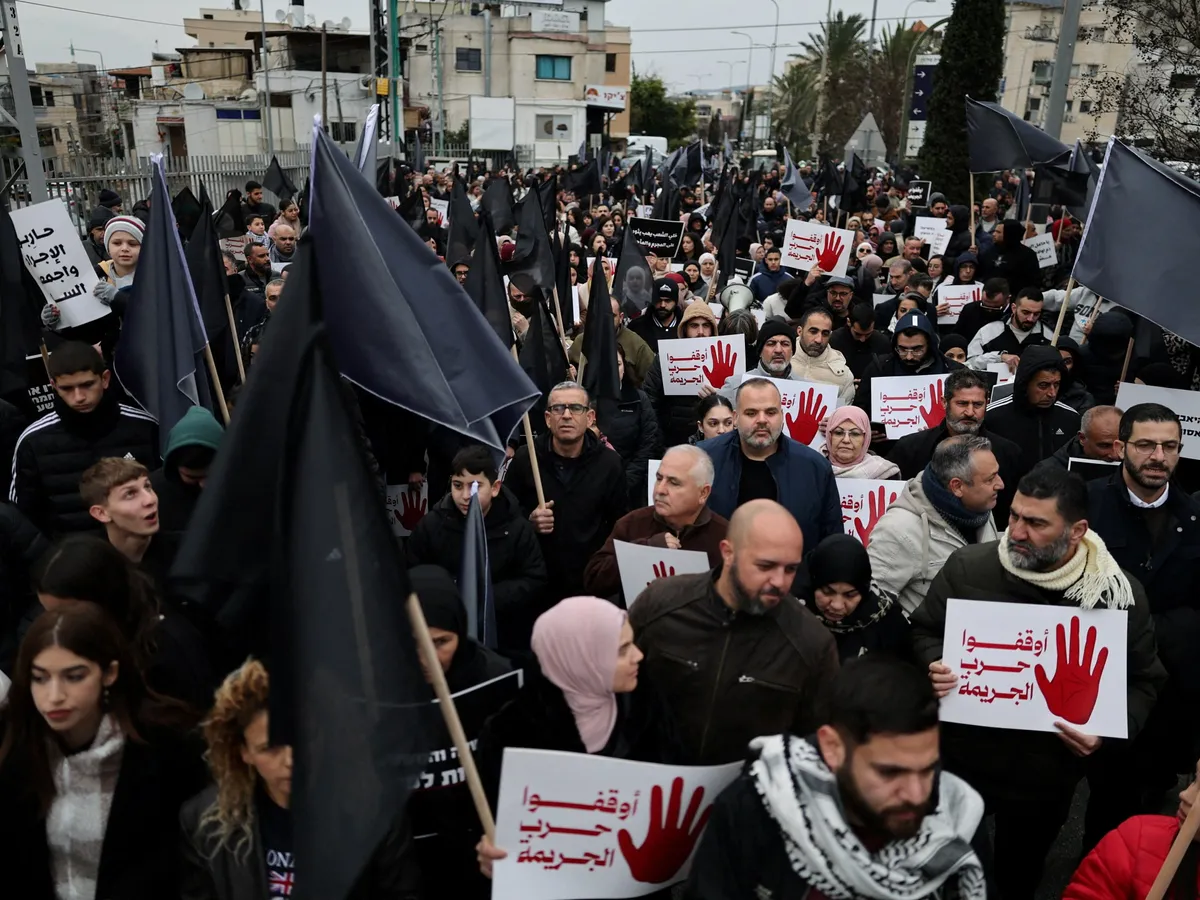
Israel is tolerating violence against its Palestinian citizens to push them out, while weaponising anti-Semitism to pull Jews in.Palestinian citizens of Israel protest, calling on the Israeli government to tackle a wave of crime and killings within their communities through effective law and order, in Sakhnin, northern Israel, January 22, 2026. [Ammar Awad/Reuters]Neve Gordon is Professor of International Law at London" class="entity-link entity-organization" data-entity-id="18663" data-entity-type="organization">Queen Mary University of London.Published On 5 Feb 2026While the international media has rightly focused on the genocide and enormous displacement in Gaza alongside the ethnic cleansing in the West Bank and occupied East Jerusalem, the 300 murders inside Israel in 2025, 252 of whom were Palestinian victims, garnered little to no media coverage outside Israel. Yet last year marked the deadliest year on record for murders among Palestinian citizens of Israel, who make up 21 percent of Israel’s population but sustain 80 percent of the murders. That is one murder every 36 hours.The international media have also covered the rise in anti-Semitism across the world, even as there has been little to no media coverage of how Israel has been exaggerating and instrumentalising a Zionist notion of anti-Semitism to create moral panic among Jews everywhere. Indeed, when I speak to Jewish friends in Israel, they often ask how I, who live in London, cope with anti-Semitism. As consumers of Israeli news, they can be forgiven for thinking that Jews across the world are in imminent danger.These two phenomena – the crime epidemic within Palestinian communities inside Israel and the weaponisation of anti-Semitism to amplify Jewish fear – might seem totally unconnected. Yet there is a clear thread linking them, and it is called demographic engineering.The foundational actsDemographic engineering has been at the heart of the Zionist project. During the 1948 war, about 750,000 Palestinians were displaced in what Fayez Sayegh called “racial elimination”. As part of this process, Palestinian cities were depopulated, and about 500 Palestinian villages were destroyed. By 1951, the Palestinians who had become refugees had been “replaced” by a similar number of Jewish immigrants, both Holocaust survivors from Europe and Mizrahi Jews from Arab countries, thus transforming the state’s racial composition without altering its overall population size.In the wake of the war, Israel not only disregarded United Nations Resolution 194 affirming the right of Palestinians who had been made refugees in 1948 to return to their homes, but in 1950 it passed the Law of Return, bestowing “on Jews worldwide the right to enter Israel and obtain Israeli citizenship regardless of their countries of origin and whether or not they can show links to Israel-Palestine, while withholding any comparable right from Palestinians, including those with documented ancestral homes in the country”.Over the past two years, a number of Israeli politicians and influencers have characterised what Israel has been doing in the territories it occupied in 1967 as completing the job left undone in 1948: “A second, real Nakba, to finish [former Israeli Prime Minister David] Ben-Gurion’s work,” one journalist quipped. Simultaneously, within Israel, a different kind of demographic strategy is unfolding, even as the overall objective remains the same.Crime as an impetus to leaveItamar Ben-Gvir is surely not the first minister of national security to have allowed criminal gangs to terrorise Palestinian communities. But on Ben Gvir’s watch, the murders have reached record levels. And 2026 seems to be following the trend, with 31 more Palestinians murdered during the first month.On the one hand, Israel has used the soaring crime to portray Palestinian citizens as uncivilised and barbaric, extending the dehumanisation from stateless Palestinians in Gaza and the West Bank to its own citizens. On the other hand, it has enabled criminals to terrorise Palestinian towns.Indeed, the police have solved only 15 percent of the murders within the Palestinian community while doing little, if anything, to stop criminals from collecting “protection fees” from businesses – fees that extract an estimated two billion shekels ($650m) a year from the community.On January 22, Palestinians launched the largest demonstration since 2019, waving black flags while chanting slogans accusing the police of total abandonment. The following day, the organisers called a general strike, with one of the organisers, Mohammed Shlaata, making it clear that responsibility for the violence lies with the authorities: “We are in a state of emergency,” he said. “We have a clear finger of accusation – we blame the police.”Talking to Palestinian friends, some tell me they fear for their children’s lives and want them to leave the country, while others have packed their bags and left. Admittedly, the number of those leaving is low, but Palestinian citizens are reaching a boiling point.Anti-Semitism and negative migrationAt the same time that the government does nothing to quell criminal activity and lawlessness within Palestinian communities in Israel, it exaggerates and instrumentalises a Zionist notion of anti-Semitism to continuously reassert Jewish victimhood.While much has been written on the use of a false notion of anti-Semitism – that conflates criticism of Israel and Zionism with anathema towards Jews – to silence Palestinian and pro-Palestinian voices, much less has been said about the mobilisation of anti-Semitism to address Israel’s problem of negative migration.Since 2023, more Jews have been leaving the country than entering. In 2024, the number of citizens leaving Israel was 26,000 higher than the number of immigrants entering it; in 2025, the gap was about 37,000 Israelis. In other words, negative migration has jumped by more than 42 percent, and Israeli officials are worried that this trend is taking root and even accelerating.Accordingly, both the Israeli public and the Jewish diaspora are told again and again that anti-Semitism across the globe has gone rampant. Jews are told that the horrific Bondi massacre in Australia is an indication of a new global trend, that in the United Kingdom anti-Semitism has been normalised, and that in Europe Jews are afraid to wear kippahs.Anti-Semitism has undoubtedly soared over the past two years, and there is obviously a kernel of truth in these articles. But in contrast to the very real panic among Palestinian citizens, which the state has ignored, in the case of anti-Semitism, the state dramatically exaggerates and instrumentalises the evidence to produce a moral panic. The message is clear: Jews across the world should fear for their lives, and therefore those who live in Israel should be wary of leaving, while the only way diasporic Jews can be safe is by migrating to Israel.Supremacy as glueThe glue holding all of the demographic strategies Israel deploys together is the belief in Jewish exceptionalism and supremacy. The genocide in Gaza and ethnic cleansing in the West Bank are justified through the dehumanisation of Palestinians; the neglect of the murders and crime in Palestinian communities within Israel is informed by racial discrimination that has been ongoing since 1948; and Israel is weaponising racism against Jews to curb negative migration. The ultimate objective is to guarantee the racial-religious character of Israel as exclusively Jewish, while the dream is a pure Jewish state.The views expressed in this article are the author’s own and do not necessarily reflect Al Jazeera’s editorial policy.
SRCAl Jazeera
LANGEN
LEANCenter
WORDS1 175
ENT11
THU · 2026-02-05 · 08:08 GMTBRIEF NSR-2026-0205-13556
NSR-2026-0205-13556Opinion·EN·Political Strategy
Here’s why Israel is allowing record murder rates in its Palestinian towns
In 2025, Israel experienced a record number of murders, with 252 Palestinian citizens among the 300 victims. The article argues that the Israeli government is tolerating this violence within Palestinian communities, who comprise 21% of Israel's population but account for 80% of the murders, to encourage their displacement.
Neve GordonAl JazeeraFiled 2026-02-05 · 08:08 GMTLean · CenterRead · 5 min
Al JazeeraFIG 01
Reading time
5min
Word count
1 175words
Sources cited
2cited
Entities identified
11entities
Quality score
100%
§ 01
Briefing Summary
AI-generatedNEWSAR · AI
In 2025, Israel experienced a record number of murders, with 252 Palestinian citizens among the 300 victims. The article argues that the Israeli government is tolerating this violence within Palestinian communities, who comprise 21% of Israel's population but account for 80% of the murders, to encourage their displacement. Simultaneously, Israel is accused of exaggerating anti-Semitism to incite fear among Jewish people worldwide and encourage immigration. The author contends that these actions are connected and part of a broader strategy of demographic engineering, similar to displacement tactics used in the 1948 war, to alter the state's racial composition. The goal is to increase the Jewish population while decreasing the Palestinian population within Israel.
Confidence 0.90Sources 2Claims 5Entities 11
§ 02
Article analysis
Model · rule-basedFraming
Political Strategy
Human Rights
Tone
Sensational
AI-assessed
CalmNeutralAlarmist
Factuality
0.30 / 1.00
Opinion-Heavy
LowHigh
Sources cited
2
Limited
FewMany
§ 03
Key claims
5 extracted01
300 murders inside Israel in 2025, 252 of whom were Palestinian victims.
statisticNeve Gordon
Confidence
0.90
02
Last year marked the deadliest year on record for murders among Palestinian citizens of Israel.
factualNeve Gordon
Confidence
0.90
03
During the 1948 war, about 750,000 Palestinians were displaced.
statisticNeve Gordon
Confidence
0.80
04
Israel is weaponising anti-Semitism to pull Jews in.
factualNeve Gordon
Confidence
0.70
05
Israel is tolerating violence against its Palestinian citizens to push them out.
factualNeve Gordon
Confidence
0.70
§ 04
Full report
5 min read · 1 175 words§ 05
Entities
11 identifiedKey playerOppositionContextPositiveNeutralNegative
People1
Organizations4
§ 06
Keywords & salience
9 termspalestinian citizens of israel
0.90
demographic engineering
0.80
anti-semitism
0.70
violence
0.70
murder rates
0.70
zionist project
0.60
ethnic cleansing
0.50
displacement
0.50
israeli government
0.40
§ 07
Topic connections
Interactive graph Network visualization showing 51 related topics
View Full Graph Person Organization Location Event|Click node to navigate|Edge numbers = shared articles