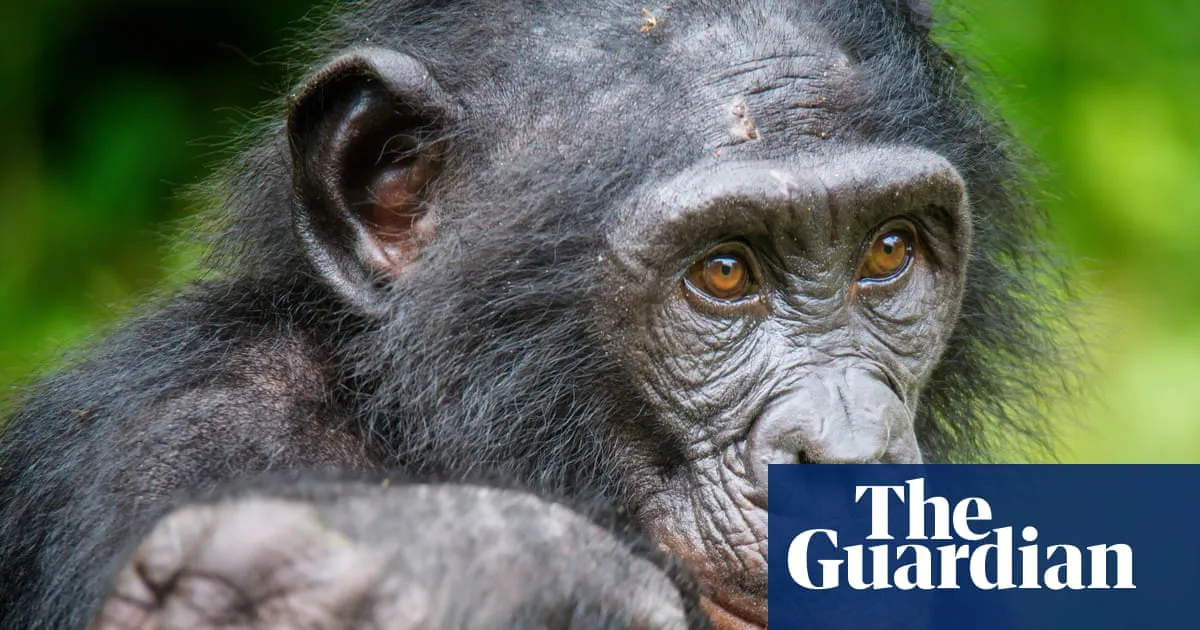
Whether it’s playing at being doctors or hosting a toy’s tea party, children are adept at engaging in make-believe – now researchers say bonobos can do it too.While there have been anecdotal reports of apes using imaginary objects, including apparently dragging pretend blocks across the floor, experts say it is possible such instances have other explanations.For example, apes might be carrying out actions that have previously brought benefits without actually imagining a pretend object.Now scientists working with a bonobo named Kanzi, who has since died at the age of 44, say the ape was able to identify the location of imaginary objects in pretend scenarios.“[It] shows that animals are capable of understanding pretence in a controlled experimental setting, which hadn’t been done before,” said Dr Amalia Bastos, first author of the research from the University of St Andrews.The ability to make believe could reach deep into our evolutionary past, the researchers added.“Because we share this [ability] with bonobos, we could reasonably expect that this sort of dates back to our common ancestor. So that would have been somewhere between 6- and 9m years ago,” said Bastos.Writing in the journal Science Bastos and co-author Dr Christopher Krupenye from Johns Hopkins University report how they first trained Kanzi to point to containers filled with juice by rewarding him for doing so.They then presented Kanzi with two empty transparent cups and pretended to fill them with an empty jug. The imaginary contents of one cup was then tipped back into the jug, and Kanzi was asked to indicate which of the cups contained juice.Kanzi selected the correct, “full” cup in 34 of 50 trials – better than would be expected from chance – suggesting he was able to understand the concept of pretend liquids.Crucially, Kanzi was not rewarded for the correct answer, meaning he was not simply learning a desired response based on the human’s physical motions.To test whether Kanzi believed a real liquid was being poured into the cups, the team presented him with two cups – one containing juice with the other left empty. They pretended to fill the empty cup using an empty jug, and asked Kanzi to choose a cup.In 14 out of 18 trials Kanzi chose the cup containing real liquid, suggesting he was able to distinguish between tangible and imaginary juice.In a third experiment, the team found Kanzi was able to correctly identify the location of an imaginary grape placed in one of two transparent containers.While the team say it is not clear if their findings would apply to apes that have not been trained to communicate with humans, they note their results provide experimental evidence that a non-human animal can follow imaginary objects in pretend scenarios.“As such, our findings suggest that the capacity for representing pretend objects is not uniquely human,” they write.Prof Zanna Clay of Durham University, who was not involved in the work, said that while further work was needed in apes without Kanzi’s unique rearing and learning environment, the study provided a first rigorous experimental test that apes have a form of imaginative thinking.“In this respect, what’s then striking is why people should be amazed that our closest living relatives can do something we can do too, given that they also show advanced cognitive abilities and have to navigate complex social and ecological environments,” Clay said.“It would be more surprising if we found this ability in more distantly related species with more divergent social and cognitive abilities.”
SRCThe Guardian - World News
LANGEN
LEANCenter-Left
WORDS574
ENT6
THU · 2026-02-05 · 19:00 GMTBRIEF NSR-2026-0205-13724
NSR-2026-0205-13724News Report·EN·Human Interest
Bonobos can play make-believe much like children, study suggests
A new study suggests bonobos, like children, possess the ability to engage in make-believe. Researchers at the University of St Andrews and Johns Hopkins University conducted experiments with Kanzi, a bonobo, to test his understanding of pretend scenarios.
Nicola Davis Science correspondentThe Guardian - World NewsFiled 2026-02-05 · 19:00 GMTLean · Center-LeftRead · 3 min
The Guardian - World NewsFIG 01
Reading time
3min
Word count
574words
Sources cited
3cited
Entities identified
6entities
Quality score
75%
§ 01
Briefing Summary
AI-generatedNEWSAR · AI
A new study suggests bonobos, like children, possess the ability to engage in make-believe. Researchers at the University of St Andrews and Johns Hopkins University conducted experiments with Kanzi, a bonobo, to test his understanding of pretend scenarios. Kanzi was able to identify the location of imaginary liquids and objects, indicating an understanding of pretense. The study, published in the journal Science, involved pretending to fill cups with an empty jug and asking Kanzi to identify the "full" cup. Kanzi's success rate was significantly higher than chance, suggesting he understood the concept of imaginary liquids. Researchers believe this ability may extend back to the common ancestor of humans and bonobos, dating back 6 to 9 million years.
Confidence 0.90Sources 3Claims 5Entities 6
§ 02
Article analysis
Model · rule-basedFraming
Human Interest
Technology
Tone
Measured
AI-assessed
CalmNeutralAlarmist
Factuality
0.80 / 1.00
Factual
LowHigh
Sources cited
3
Well sourced
FewMany
§ 03
Key claims
5 extracted01
Kanzi selected the correct, “full” cup in 34 of 50 trials.
statisticArticle
Confidence
1.00
02
Kanzi was able to identify the location of imaginary objects in pretend scenarios.
factualScientists working with Kanzi
Confidence
0.90
03
Our findings suggest that the capacity for representing pretend objects is not uniquely human.
quoteResearchers
Confidence
0.80
04
Bonobos can play make-believe much like children.
factualResearchers
Confidence
0.80
05
The ability to make believe could reach deep into our evolutionary past.
factualResearchers
Confidence
0.70
§ 04
Full report
3 min read · 574 words§ 05
Entities
6 identifiedKey playerOppositionContextPositiveNeutralNegative