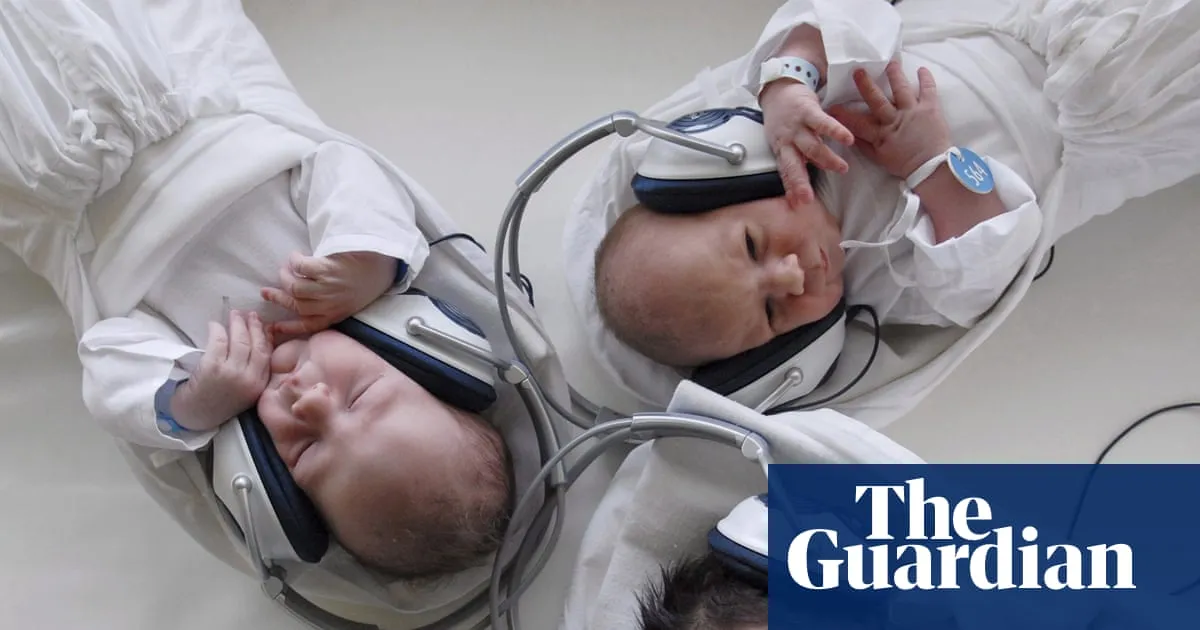
Newborn babies can anticipate rhythm in pieces of music, researchers have discovered, offering insights into a fundamental human trait.Babies in the womb begin to respond to music by about eight or nine months, as shown by changes in their heart rate and body movements, said Dr Roberta Bianco, the first author of the research who is based at the Italian Institute of Technology in Rome.“Previous research has also shown that aspects of musical memory can carry over from the womb to birth,” she added.However, it was unclear how deeply different aspects of music were processed by such young brains. The study sheds light on this, suggesting newborns can detect and predict patterns relating to rhythm, but not melody.Bianco said previous studies suggested macaque monkeys also showed a greater sensitivity to rhythmic patterns than melodic ones.“Rhythm seems to be built on very ancient auditory abilities that we share with other primates, while melody appears to depend on human brain specialisations that are shaped by learning after birth,” Bianco said.“In other words, rhythm may be part of our biological toolkit, while melody is something we grow into. This [may] help to explain why melodies vary so much across cultures, whereas rhythm tends to follow more universal patterns.”Writing in the journal Plos Biology, Bianco and her colleagues describe how they used electroencephalography (EEG) to collect brain activity data from sleeping newborns fitted with earphones.The babies were played, in random order, original pieces of music composed by Bach, as well as versions where pitches and note timings were shuffled.Bianco said the team used computer models to estimate how surprising each note in a piece was based on the preceding rhythmic or melodic structure of the music.They then analysed the EEG signals from 49 newborns to see if the surprises were reflected in their brain activity.The team found this was indeed the case for surprises in rhythm in the original pieces, suggesting babies can track and predict rhythmic patterns in real music. However, surprises in melody were not reflected in the brain activity.In addition, newborns’ brain activity did not reflect surprises in rhythm or melody in shuffled music.Bianco said: “Since the order of pitches and time intervals were randomised within a piece, the brain can’t extract regularities to build expectations upon.”Bianco said the findings suggested the human brain was biologically tuned to make predictions when listening to music, especially about rhythm.“Importantly, these predictions go beyond simply anticipating a regular interval: they involve detecting patterns in the music and learning how those patterns unfold over time,” she added.Bianco said such abilities in newborns probably had their roots in very basic biological and sensory experiences. “Before birth, the foetal environment is dominated by regular rhythms, such as the mother’s heartbeat and the repeated motion associated with her walking,” she said, noting such rhythms may provide the brain with an early sense of timing and predictability.Dr Giovanni Di Liberto of Trinity College Dublin, who was not involved in the work, praised the study but said it did not fully take into account whether mothers played music to their babies before they were born, although he said the study opened up the possibility of studying this.Bianco noted babies could hear music in the womb during the final trimester, adding that while melodies were distorted, rhythmic structure remained relatively intact.Prof Usha Goswami of the University of Cambridge said the study’s conclusions aligned with her own work with infants that suggested language acquisition began with speech rhythm.“Individual differences in children’s speech processing seem to depend on speech rhythm perception and not pitch structure perception, and this paper also proposes an evolutional perspective on this,” she said.
SRCThe Guardian - World News
LANGEN
LEANCenter-Left
WORDS605
ENT2
THU · 2026-02-05 · 19:00 GMTBRIEF NSR-2026-0205-13725
NSR-2026-0205-13725News Report·EN·Technology
‘Part of our biological toolkit’: newborn babies can anticipate rhythm in music, researchers find
Researchers at the Italian Institute of Technology have discovered that newborn babies can anticipate rhythm in music. The study, published in Plos Biology, used EEG to track brain activity in sleeping newborns as they listened to original Bach compositions and shuffled versions.
Nicola Davis Science correspondentThe Guardian - World NewsFiled 2026-02-05 · 19:00 GMTLean · Center-LeftRead · 3 min
The Guardian - World NewsFIG 01
Reading time
3min
Word count
605words
Sources cited
1cited
Entities identified
2entities
Quality score
100%
§ 01
Briefing Summary
AI-generatedNEWSAR · AI
Researchers at the Italian Institute of Technology have discovered that newborn babies can anticipate rhythm in music. The study, published in Plos Biology, used EEG to track brain activity in sleeping newborns as they listened to original Bach compositions and shuffled versions. The findings revealed that babies' brains responded to rhythmic surprises in the original music, indicating an ability to track and predict rhythmic patterns. However, their brains did not react to melodic surprises or rhythmic/melodic surprises in the shuffled music. The research suggests that rhythm processing may be a fundamental, innate human ability, while melody processing develops later in life. This could explain why rhythmic patterns tend to be more universal across cultures than melodies.
Confidence 0.90Sources 1Claims 5Entities 2
§ 02
Article analysis
Model · rule-basedFraming
Technology
Human Interest
Tone
Measured
AI-assessed
CalmNeutralAlarmist
Factuality
0.80 / 1.00
Factual
LowHigh
Sources cited
1
Limited
FewMany
§ 03
Key claims
5 extracted01
The team used electroencephalography (EEG) to collect brain activity data from sleeping newborns.
factualBianco and her colleagues
Confidence
1.00
02
Newborns can detect and predict patterns relating to rhythm, but not melody.
factualstudy
Confidence
0.90
03
Newborn babies can anticipate rhythm in pieces of music.
factualresearchers
Confidence
0.90
04
Babies in the womb begin to respond to music by about eight or nine months.
factualDr Roberta Bianco
Confidence
0.80
05
Rhythm may be part of our biological toolkit, while melody is something we grow into.
quoteBianco
Confidence
0.70
§ 04
Full report
3 min read · 605 words§ 05
Entities
2 identifiedKey playerOppositionContextPositiveNeutralNegative
People1
Locations1
§ 06
Keywords & salience
9 termsrhythm
1.00
newborn babies
1.00
music perception
0.90
brain activity
0.80
melody
0.70
biological toolkit
0.60
eeg
0.60
auditory abilities
0.50
musical memory
0.40
§ 07
Topic connections
Interactive graph Network visualization showing 26 related topics
View Full Graph Person Organization Location Event|Click node to navigate|Edge numbers = shared articles