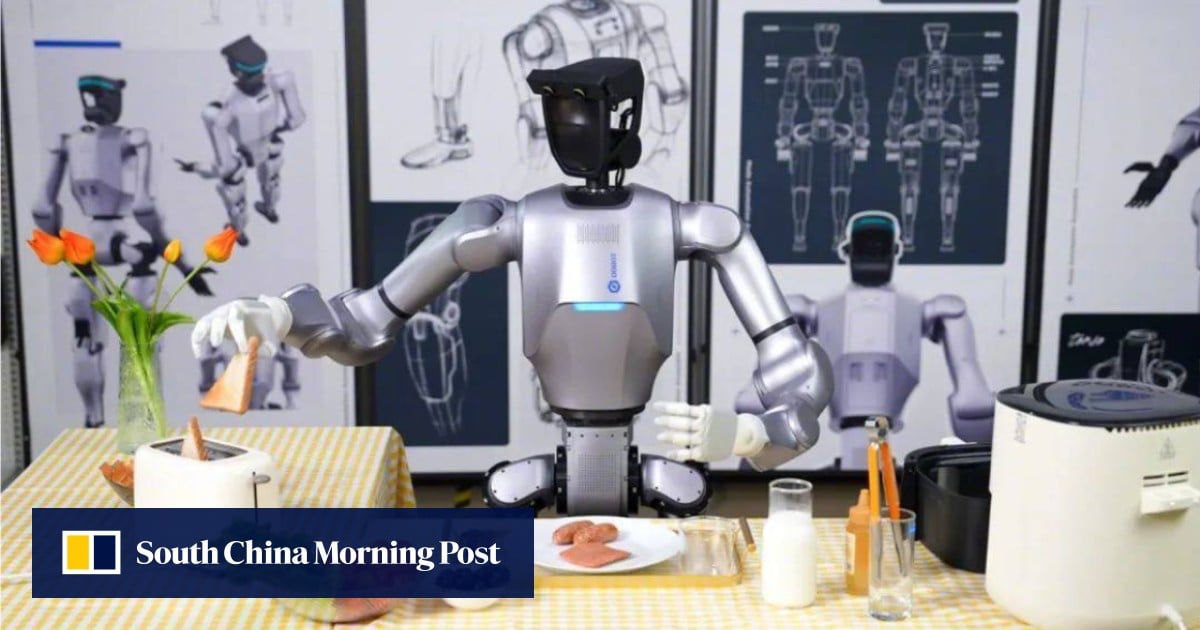
Chinese humanoid robotics companies are doubling down on developing intelligent models, as investors eye advances in robot “brains” as the next step towards real-world commercial use.Shenzhen-based Dobot said on Wednesday that it delivered its third batch of mass produced, full-size humanoid Atom robots, marking a shift from laboratory concept to an industrialised product.Dobot, listed in Hong Kong, said its self-developed Dobot-VLA, a vision-language-action model, enabled Atom to react to uncertainties in the real world rather than just perform preprogrammed tasks.With the model, Atom was expected to “see through” clusters of tasks, “understand” ambiguous instructions and make autonomous decisions to “get the job done”, according to the company. The company previously deployed Atom to serve popcorn in a Shenzhen cinema.“This ability to adapt autonomously based on the understanding of the environment is the starting point for humanoid robots to create value in industrial applications,” Dobot said.The announcement came days after its cross-town rival UBTech open-sourced Thinker, the company’s large-scale multimodal model designed for humanoid robots, on GitHub and Hugging Face.The model, based on a 10 billion parameter model, addressed the “lag” and “spatial inaccuracy” often seen in humanoid robots, the company said on the weekend.
SRCSouth China Morning Post
LANGEN
LEANCenter-Right
WORDS194
ENT6
FRI · 2026-02-06 · 01:15 GMTBRIEF NSR-2026-0206-13773
NSR-2026-0206-13773News Report·EN·Technology
China’s humanoid robot makers pivot from ‘body’ to ‘brain’ as commercial race heats up
Chinese humanoid robotics companies like Dobot and UBTech are increasingly focusing on developing intelligent models, or "brains," for their robots as the commercial race intensifies. Dobot announced the delivery of its third batch of mass-produced Atom robots, highlighting its self-developed Dobot-VLA model that enables the robot to autonomously adapt to real-world uncertainties.
Iris DengSouth China Morning PostFiled 2026-02-06 · 01:15 GMTLean · Center-RightRead · 1 min
South China Morning PostFIG 01
Reading time
1min
Word count
194words
Sources cited
2cited
Entities identified
6entities
Quality score
100%
§ 01
Briefing Summary
AI-generatedNEWSAR · AI
Chinese humanoid robotics companies like Dobot and UBTech are increasingly focusing on developing intelligent models, or "brains," for their robots as the commercial race intensifies. Dobot announced the delivery of its third batch of mass-produced Atom robots, highlighting its self-developed Dobot-VLA model that enables the robot to autonomously adapt to real-world uncertainties. This model allows Atom to understand instructions and make decisions to complete tasks. Similarly, UBTech recently open-sourced Thinker, its large-scale multimodal model designed to address issues like lag and spatial inaccuracy in humanoid robots. These advancements signal a shift towards creating robots capable of more than just pre-programmed actions, aiming for practical applications in industrial settings. Investors are closely watching these developments in robot intelligence as the next step toward widespread commercial use.
Confidence 0.90Sources 2Claims 5Entities 6
§ 02
Article analysis
Model · rule-basedFraming
Technology
Economic Impact
Tone
Measured
AI-assessed
CalmNeutralAlarmist
Factuality
0.70 / 1.00
Factual
LowHigh
Sources cited
2
Limited
FewMany
§ 03
Key claims
5 extracted01
Thinker is based on a 10 billion parameter model.
factualUBTech
Confidence
1.00
02
UBTech open-sourced Thinker, the company’s large-scale multimodal model designed for humanoid robots.
factual
Confidence
1.00
03
Dobot delivered its third batch of mass produced, full-size humanoid Atom robots.
factualDobot
Confidence
1.00
04
Dobot's Dobot-VLA enables Atom to react to uncertainties in the real world.
factualDobot
Confidence
0.90
05
Atom was expected to “see through” clusters of tasks, “understand” ambiguous instructions and make autonomous decisions.
quoteDobot
Confidence
0.80
§ 04
Full report
1 min read · 194 words§ 05
Entities
6 identifiedKey playerOppositionContextPositiveNeutralNegative
Organizations3
§ 06
Keywords & salience
10 termshumanoid robots
1.00
robot brains
0.80
intelligent models
0.70
vision-language-action model
0.60
commercial use
0.60
large-scale multimodal model
0.50
industrial applications
0.50
autonomous decisions
0.50
ubtech
0.40
dobot
0.40
§ 07
Topic connections
Interactive graph No topic relationship data available yet. This graph will appear once topic relationships have been computed.